
Short and long streaks of light appear across the night sky, as if someone is writing with a flashlight. NASA's November 20, 2026 Astronomy Picture of the Day reads the Morse code as V-G-R: Voyager 1's call sign, and a way for people on Earth to greet a probe far beyond the planets.
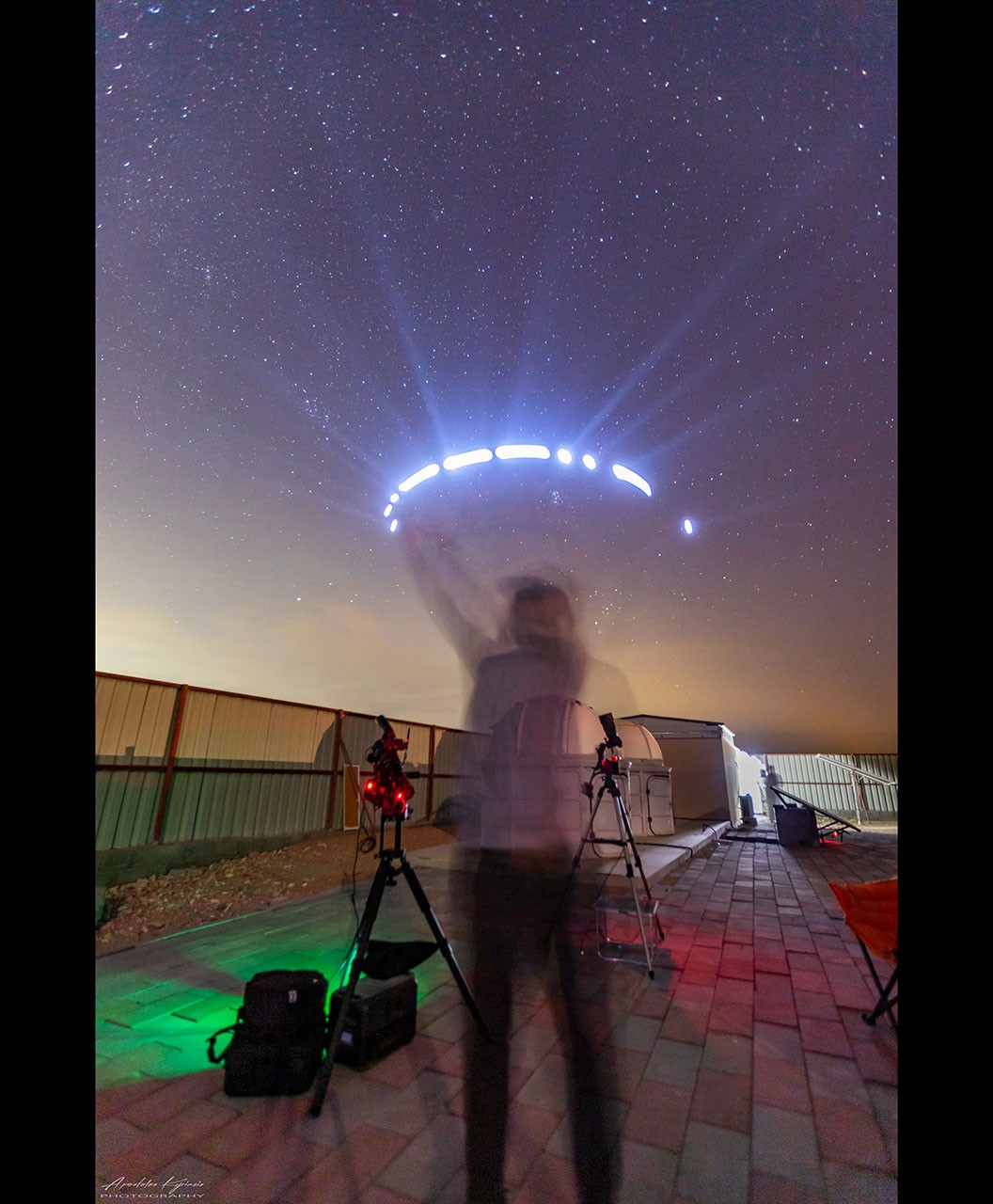
Image: Apostolos Kyriazis. Original page
This is not a radio signal from Voyager 1. On November 17, observers on the ground switched a flashlight on and off during a long exposure. The rhythm of short and long flashes can be read as three letters.
A day of light
NASA says Voyager 1 reached a distance of one light-day from Earth at 10:16:07 UTC on November 18: about 25.9 billion kilometers. A command sent from Earth now needs roughly 24 hours to arrive, and a reply needs another 24 hours to return.
The distance is measured between Earth and the spacecraft; it does not mean the probe is exactly one light-day from the Sun. NASA's trajectory calculations and carrier-signal confirmation established the milestone, while the team was still dealing with a temporary loss of science and engineering data in mid-November. At this distance, a conversation resembles a letter sent through an extremely slow post: every round trip takes two days.
NASA gives another scale for the journey. If Voyager 1 keeps moving at its current pace, reaching one light-year would take roughly 18,000 years. Light is fast; a human-built spacecraft running on limited power is the thing that takes time.
You can learn the code by comparing V, G, and R on the Original page, then practising the rhythm with a flashlight on an indoor wall. Never point a light at aircraft, drivers, or the open sky. The useful lesson is to turn “far away” into signal travel time.
More background: NASA/JPL's light-day explanation and mission update.