

Minimalist living is not about having much less, but about having less of what truly matters.
💬 Deep Dive
For the past five years, I have embraced the philosophy that "less is more" and pursued a simple lifestyle. As a result, I have a limited wardrobe. A few days ago, I took inventory and found that I own 28 pieces of outerwear for all four seasons and five pairs of shoes.
Although the quantity is small, I have never felt that I lacked options. In this newsletter, I will share my five principles for purchasing clothing and how to buy less while still dressing well.
1. Follow the Lindy Effect
The "Lindy Effect" suggests that the longer something has existed, the greater the likelihood it will continue to exist into the future.
When it comes to buying clothes, this principle means purchasing only classic or basic styles. Classic designs never go out of fashion; the more timeless they are, the better they can transcend trends.
But what exactly is a classic style? Typically, it is simple, unadorned, and free of flashy designs—think plain T-shirts, hoodies, and straight-leg jeans.
If you follow fleeting trends, clothing that looked great a couple of years ago may now feel out of place. So, ensure that the pieces in your wardrobe can stand the test of time.
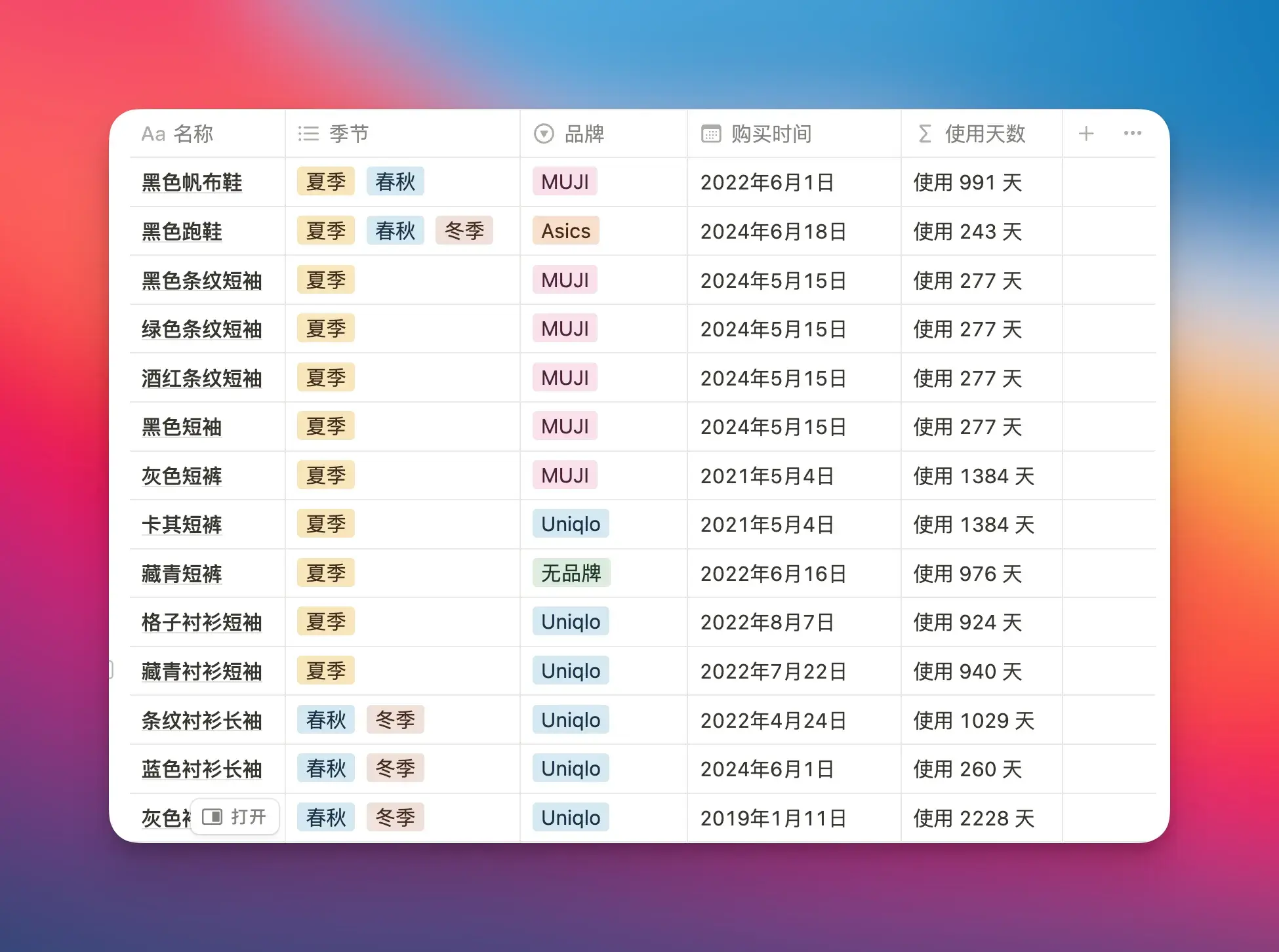
The image below shows the purchase dates for some of my clothes and shoes, many of which are the same style in different colors. I calculated that the average usage time for all my clothes and shoes is 902 days, with a median of 983 days—roughly two and a half years.
2. Embrace Versatile Pairings
The beauty of tools like Notion is that their block content is as flexible as LEGO, allowing you to mix and match at will.
Clothes can work the same way—transform your wardrobe into a box of LEGO blocks, where any two pieces can be paired together. This allows you to frequently wear the same items without worrying about styling.
For example, my autumn wardrobe consists of 3 shirts, 4 sweatshirts, and 4 pairs of all-season trousers, and almost all my shoes are sneakers. I can simply choose one shirt, one sweatshirt, one pair of trousers, and one pair of sneakers without any awkwardness.
In the winter, I merely layer my down vest or down jacket over a sweatshirt. Similarly, wearing a sweater with a down jacket offers the same versatile combination.
3. Only Buy Comfortable, Low-Maintenance Pieces
Before I adopted minimalism, I sometimes sacrificed comfort for style or a good sale, purchasing items that were not very comfortable.
For instance, I once bought a particularly heavy coat that made my neck ache after just a few hours of wear. Although it looked "good" initially, it ended up being a burden in my closet.
So, if you don't want your money to turn into clutter, make sure to buy clothes that fit comfortably and easily. Don’t let discomfort become a burden.
Additionally, the ease of maintenance is crucial. For example, sweaters tend to pill and are hard to care for, whereas sweatshirts require less upkeep.
4. Buy Only from Brands That Fit Your Needs
Once you’ve established the first three principles—only buying classic, versatile, and comfortable items—the next question is: where should you shop?
For me, I almost exclusively shop at Uniqlo and MUJI. The designs, sizes, and prices of these brands suit me, and most of their products are basic styles, so I rarely feel the need to shop from other brands.
It’s important to note that every person has unique body measurements and financial situations, so Uniqlo and MUJI might not be perfect for everyone. The key is to find one or two brands that match your needs, and then consistently choose from those.
This approach helps you avoid impulse purchases during sales, saving you time on selection, comparison, and hesitation.
5. Try In-Store, Then Buy Online
I appreciate Uniqlo and MUJI partly because both have physical stores, allowing me to try items on first. After finding a piece that fits well, in terms of style, color, and material, I then purchase it online.
This strategy helps avoid scenarios where online purchases may not fit properly or meet your material preferences. Whether it’s the design, fabric, or quality, if you’re not 100% satisfied, resist the urge to buy it.
After all, even a tiny dissatisfaction can grow over time, leading you to avoid wearing the item or negatively affecting your mood every time you do. Just as I mentioned earlier, my heavy coat, though initially appealing, became burdensome over time.
In fact, this principle applies to all shopping decisions: if you’re not completely satisfied upon receiving an item, return it.
Fin
If you too are seeking a simplified life, consider these principles and see how they can transform your wardrobe. The true essence of minimalist living lies not in having much less, but in having less of what you don’t need.
Just as MUJI's philosophy states: "This is Enough"
MUJI’s goal is not "to be good enough" but "to be enough," ensuring that customers maintain a rational level of satisfaction.
"To be good enough" carries elements of selfishness and discord, whereas "to be enough" involves rational restraint and compromise. However, it may contain a hint of resignation or slight dissatisfaction.
MUJI aims to dispel even a hint of dissatisfaction, creating a clear and confident space of "this is enough."
💎 Curated Gems
1
I’d like to share two articles related to password management. One is Douban Users' Password Setting Tips, which is quite intriguing. The other is by blogger Jack on Password Protection Techniques, which covers more common practices.
I previously tried using Elpass to manage my passwords, but after Apple introduced its password management app in iOS 18—which makes it much easier—I switched to the native app.
2
AI can offer data to inform our decisions and improve decision quality, but it cannot make decisions for us. I fully agree with Szhans:
At the task level, AI can provide improvements of 3-10 times in:
- Business competitive analysis
- New product ideas
- User profiling
- Data mining
- Team communication
- Software development
However, AI cannot make decisions or place bets for you.
Intuitive insight, aesthetic taste, and the determination to create are competitive advantages that will never be replaced.
Intuitive insight, aesthetic taste, and the determination to create will always remain your irreplaceable competitive edge.
3
There are two key metrics that most influence social media content: the click-through rate and the completion rate (or dwell time).
- The quality of the cover image and title affects the click-through rate.
- The quality of the content itself impacts the completion rate.
Clickbait, while potentially increasing clicks, ultimately reduces the completion rate and erodes long-term user trust.
I recently shared a video by He Tongxue that tests what kinds of covers and titles are most attractive. The conclusions are as follows:
- Covers should be impactful and story-driven (ideally set in a scene). Adding text can clarify the message but may reduce visual impact.
- Titles should be simple and direct. While a bit of suspense is ideal, you must avoid over-hyping to maintain trust.
🧵 One More Thing
I have purchased several content subscriptions, but my favorite remains Light’s "SmallTalk." It is concise yet profound. Although both seasons of SmallTalk have ended, there’s still plenty to digest.
I recommend starting with his WeChat public account "Loudly Thinking." If you want to read more after that, you can purchase "SmallTalk" through my links, which will also earn me a small reward.
SmallTalk Season One Recommendation Link
SmallTalk Season Two Recommendation Link
By the way, this is just a unidirectional recommendation and part of my promotional efforts. Please purchase responsibly. 😄