
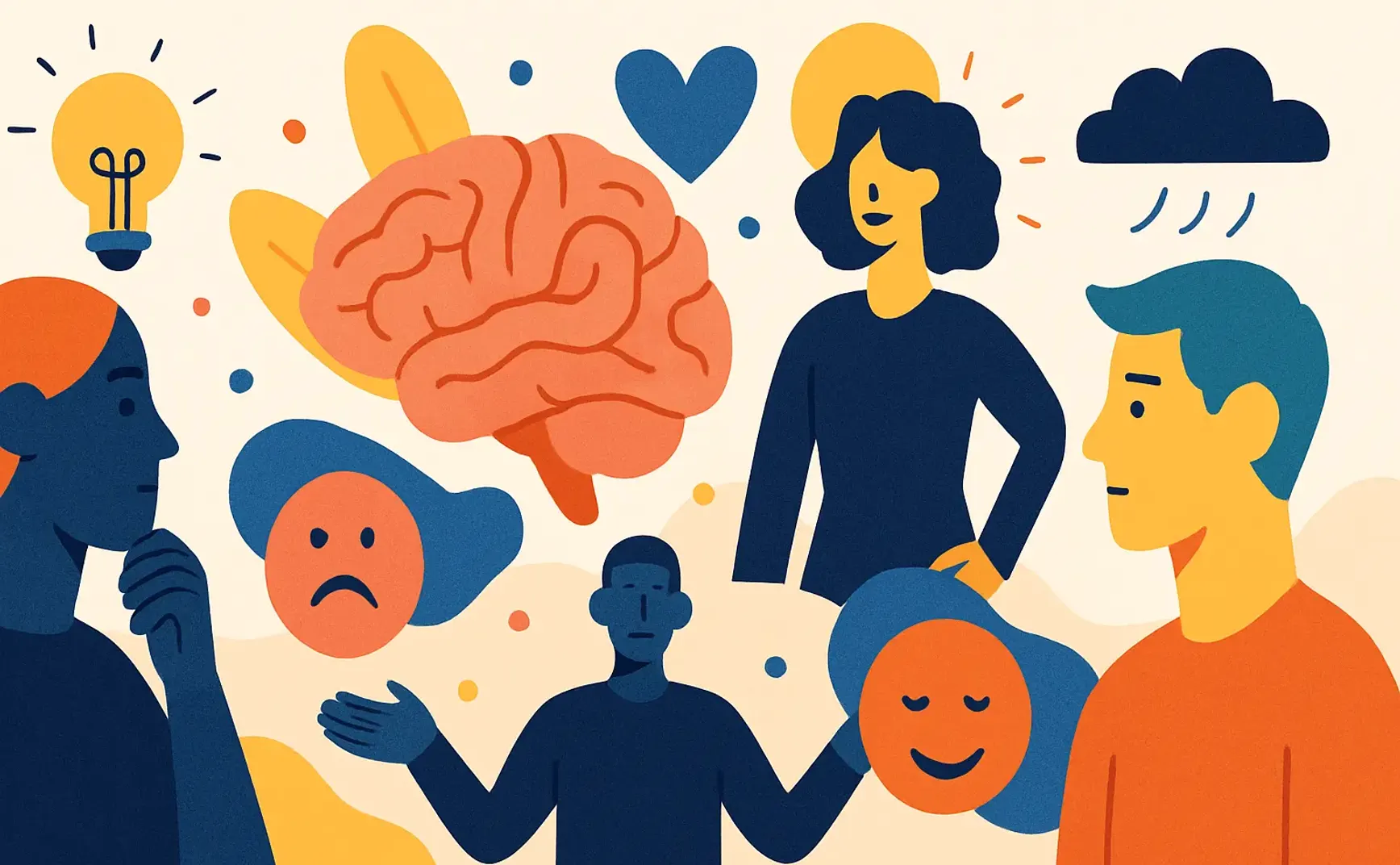
Being overly fixated on finding one single answer might mean you'll never find it; letting go of the pursuit of a non-existent perfect answer may reveal that every situation holds its own solution.
💬 Deep Dive
Last month, I finished reading one of my favorite books—We Are Not the Same: 40 Lectures on Personality Psychology. What I loved most about it was its simple and clear structure. It uses three ultimate life questions—"Who am I?", "Where do I come from?", and "Where am I going?"—to explain the personality that makes "me" unique.
In this issue of Better Living, I’m sharing my notes on this book.
1. Personality Traits: Who am I?
Personality, also referred to as character or temperament, is the unique and stable pattern of cognition, emotion, and behavior that makes “me” who I am and distinguishes me from others. It is the core to answering the question, "Who am I?"
In everyday life, people often use astrological signs or MBTI to understand themselves and others.
Astrological signs are a non-scientific construct, which needs little further explanation.
Though MBTI is developed from Jung’s theory of psychological types, like astrology it attempts to categorize personality into fixed types, thereby masking individual differences behind broad characteristics. Consequently, it is not considered a rigorous scientific tool by mainstream psychology.
Currently, the most widely accepted personality model in psychology is the Big Five, which includes Extraversion, Conscientiousness, Agreeableness, Neuroticism, and Openness. They are like the three primary colors, which can be combined in various ways to create a vast array of personalities.
Each trait exists on a spectrum, and the five traits represent five spectra. The majority of people fall somewhere between the extremes of each spectrum.
Individual differences are not only reflected in where one lies on each spectrum—for example, both A and B may be extraverted, but A might lean slightly more to the left while B leans to the right—but also in the ways these five different traits interact and combine.
A particular combination of traits at specific degrees will produce unique psychological and behavioral styles. This is how a limited set of personality traits can account for millions of distinct individuals.
Even if we share the same traits, differences in the degree of each trait or the way they are combined make each person unique. This diversity is what makes human psychology complex, rich, and fascinating.
The goal of psychology is to describe, explain, predict, control, or influence behavior. Personality psychology is no different. We study personality traits because they consistently drive us to exhibit relatively stable behavioral patterns across different situations—this relative stability is the foundation for predicting behavior. For example, Zhang San always plays it safe to avoid risks, while Li Si tends to settle for “it’s okay” in the face of conflict.
However, "relative stability" does not mean "fixed." Personality is malleable and developmental; it is always a work in progress. Just as existentialism emphasizes that existence precedes essence, the self is dynamically constructed rather than static. Personality has no fixed essence, only shifting tendencies, and is continually in the process of becoming.
2. The Origins of Personality: Where Do I Come From?
Next, we must clarify the factors that shape personality. In other words, where do I come from? Is personality more influenced by innate nature or by nurture?
The answer is that personality results from a complex interplay between biological nature and social nurture, making it impossible to simply distinguish which has a greater influence. Behavioral geneticists no longer obsess over how much genetics (biology) or environment (social influences) affects specific traits but focus instead on the synergy between the two. Genetics and environment are inextricably linked, with the environment capable of activating or suppressing genetic expression.
A “bad” genotype is not a verdict in itself; it requires a “bad” environment. Similarly, a “bad” environment is not a verdict—it needs to interact with a “bad” genotype to produce outcomes. (Ridley, 2003)
So, if we separate the biological genetic factors from the social environmental ones, what are they?
From the biological or innate side:
- The human psyche is essentially a function of the brain, which has evolved over millions of years for survival and reproduction. Some evolved features were not meant to grant you a pleasant life but to help your ancestors survive. Given the slow pace of evolution, certain brain functions that were adaptive in ancestral environments might not be as suited to modern life. No trait or function perfectly adapts to external conditions, so individual differences persist within populations. The diversity and richness of personality are gifts from a long evolutionary history.
- The brain’s physiological structure and neurotransmitters affect personality traits. For example, a more easily activated amygdala is linked with higher neuroticism; a more developed prefrontal cortex tends toward higher conscientiousness; a shorter dopamine reward circuit is associated with higher extraversion.
- Genetic factors also have clear effects on personality. For instance, in a Dutch family known for violent behavior, all the males had an X chromosome containing a low-activity form of the monoamine oxidase A gene, which influences the breakdown of neurotransmitters such as dopamine, norepinephrine, and serotonin. Low activity in this gene leads to higher levels of these neurotransmitters, making a person more irritable and prone to aggression.
From the social or acquired side:
- Adult intimate relationships are often replays of childhood attachments. If parents respond positively to a child's needs and help establish secure attachment early on, the child is more likely to exhibit adaptive stress regulation in midlife and maintain a sense of security and joy in close relationships even in old age.
- Long-term immersion in a specific culture affects the brain and mind. For example, East Asians, living in complex social networks, tend to emphasize collectivism, whereas Westerners, with less dense social relations, emphasize individuality. The group’s tendencies become part of each individual’s personality.
- The broader social and ecological environment also shapes personality traits. For example, individuals raised in regions with moderate temperatures (averaging around 22°C) tend to score higher in extraversion, agreeableness, conscientiousness, and openness, and lower in neuroticism. Similarly, societies with a significantly higher number of men than women face challenges in social stability, with a corresponding rise in crime rates.
- Even epidemics have an influence. Areas historically ravaged by frequent plagues tend to develop more conservative social norms and stronger collectivism.
No single gene or environmental factor plays a decisive role. These conclusions are based on group studies, and individual differences are considerable, so no one can be perfectly categorized.
Genetics lays the foundation, but through the growth environment (such as education and career opportunities) and personal choices (like challenging conventional roles), personality traits can change significantly.
3. Personality Dynamics: Where Am I Going?
Finally, where are we headed? This question about personality dynamics concerns needs, goals, and motivation—in essence, what drives us to act continuously?
Different schools of thought offer various explanations. Freud emphasized the influence of the unconscious, Jung focused on the collective unconscious, Adler stressed the pursuit of superiority, behaviorists highlighted external rewards and punishments, humanists underscored free will and self-actualization, and cognitive psychologists focused on how we process and interpret information.
I asked ChatGPT to compare the theories and viewpoints mentioned in this book by various figures and schools, and it produced a chart to help you quickly grasp the differences.
One theory I want to highlight is Kelly’s Personal Construct Theory. This theory posits that a person’s behavior is guided by the way they predict events—differences in information processing lead to differences in personality, or in other words, differences in personality are differences in thought.
First, let’s explain the term “construct.” It refers to the categories a person uses to explain, predict, and understand the world. Constructs are not reflections of objective reality but are subjective experiences.
Each construct has two poles, such as "open vs. conservative," "independent vs. dependent," "hardworking vs. lazy," and "generous vs. stingy." The more constructs one has and the more complex they are, the richer one’s perspective will be; conversely, fewer and simpler constructs result in a more limited understanding of the world.
The number, common use, organizational complexity, and malleability of these constructs vary from person to person, and these differences create variations in personality.
For instance, if A typically uses the constructs "open vs. conservative" and "independent vs. dependent," while B relies on "hardworking vs. lazy" and "generous vs. stingy," then their descriptions of the same person in the same situation might differ considerably. A might see someone as "conservative and not independent," while B may view that same person as "generous and hardworking." This leads to significant differences in A’s and B’s attitudes and behaviors toward the same individual.
Kelly stated that "everyone is a scientist." We construct our own reality much like scientists build theories—constantly hypothesizing, testing, revising, and testing again.
Conversely, scientists are also human. Every theory is inherently subjective and even flawed; each has its contributions and limitations. There is no absolute right or wrong. What matters is whether a theory can effectively explain part of reality and illuminate aspects of human nature.
Therefore, rather than getting caught up in the question of whether a given theory is right or wrong, remember: being fixated on finding one final answer might prevent you from ever finding it; by letting go of the pursuit of a non-existent standard answer, you might find answers everywhere.
Final
Returning to the original questions—Who am I? Where do I come from? Where am I going?—there is no standard answer.
The significance of studying personality lies in understanding that we are products of both biology and society, as well as the result of our own choices. We are both relatively stable and relatively fluid.
We are uniquely ourselves.
We come from the vast and wondrous physical world, the social world that connects us, and our inner spiritual world—humanity is the product of all these forces.
To seek meaning deeply, to become what we might be, and to pursue a richly fulfilling life.
References
We Are Not the Same: 40 Lectures on Personality Psychology
💎 Curated Gems
1. Learning About Singapore
I have always had a great affinity for Singapore—a city that is clean and orderly, with high per capita income (and consequently high prices), a competitive education system, and public housing that supports young residents. Here are a few links to learn more about Singapore.
References
An Overview of Singapore’s Economy
Singapore: The Truth Behind the “Fear of Losing” Education Culture
2. Changing Your Environment
One should avoid immersing oneself in the same environment or experiences for too long. It’s akin to spending an entire day indoors, repeating the same stimuli—like lying around on your phone—which will likely lead to a state in which excessive relaxation prevents you from summoning basic energy and sleep regulation, or entering a mood that craves new comforts yet fails to find satisfaction in other activities.
One perk of having a job is being able to switch environments 🤣. Coming home after work and feeling relieved, "It’s good to be home," is much like the joy of traveling.
Without new environmental stimuli, life can feel dull and lacking in energy.
References
3. Figma Update Overview
Figma isn’t just expanding laterally as a “design tool”; it’s redefining the workflow of “product creation.” From idea to prototype, design, content, launch, and even operations, it’s attempting to integrate the entire process into one suite.
It’s somewhat like how Notion aspires to be the gateway to workspaces, while Figma aims to be the entry point for “product creation.”
Figma’s update from a couple of weeks ago was impressive—check out this summary by Qingzhou, a developer at FocusFour (and apparently one of the few engineers among the minority).
I usually use Canva for most of my design work. The advantage of Canva is that, once you’re a VIP member, you have access to many assets; however, its limitations with effects like shadows and canvas size switching mean I often supplement with Figma.
This time, Figma has conveniently added “noise” and “texture” as default effects. Additionally, the use of Buzz for managing brand assets and Sites for building websites is very appealing.
References
Just saw Figma’s update—I feel like many tools are in danger
🧵 One More Thing
You may have noticed that this Newsletter has been published every four weeks for the past two issues. This might be the update frequency going forward.
This year, besides working on the Newsletter in my spare time, I’ve been creating videos and plugins—multiple projects that require me to switch rhythms as needed. For example, two weeks ago I suddenly realized that my Cursor membership was about to expire, so I hastily optimized and submitted a plugin update, which delayed this Newsletter.
I’m not sure if this is good or bad. From a growth perspective, after spending over a year writing the Newsletter, I have 155 subscribers, while on Bilibili I posted 3 videos (one hidden) and already have over 400 subscribers.
Based on the numbers, it might make sense to focus more on videos rather than articles. But I know that the Newsletter sharpens my thinking and character, so I shouldn’t give up this form of self-refinement.
Writing is the hardest. Although creating videos or podcasts involves a lot of editing and physical effort, it all starts with writing.

From February to May, I managed to produce only three videos, but each one received good feedback. There’s an interesting dynamic too—what does well on Bilibili might not perform as strongly on Xiaohongshu, and vice versa.
If you're interested in my videos, you can search for "jiayifun" on Bilibili, Xiaohongshu, or YouTube and subscribe. By the way, I also started a podcast called "Better Living Podcast." I plan to record an episode before 618 to talk about some great finds from the first half of 2025.