
A steaming pool, the Milky Way across the zenith, and one question that connects them.
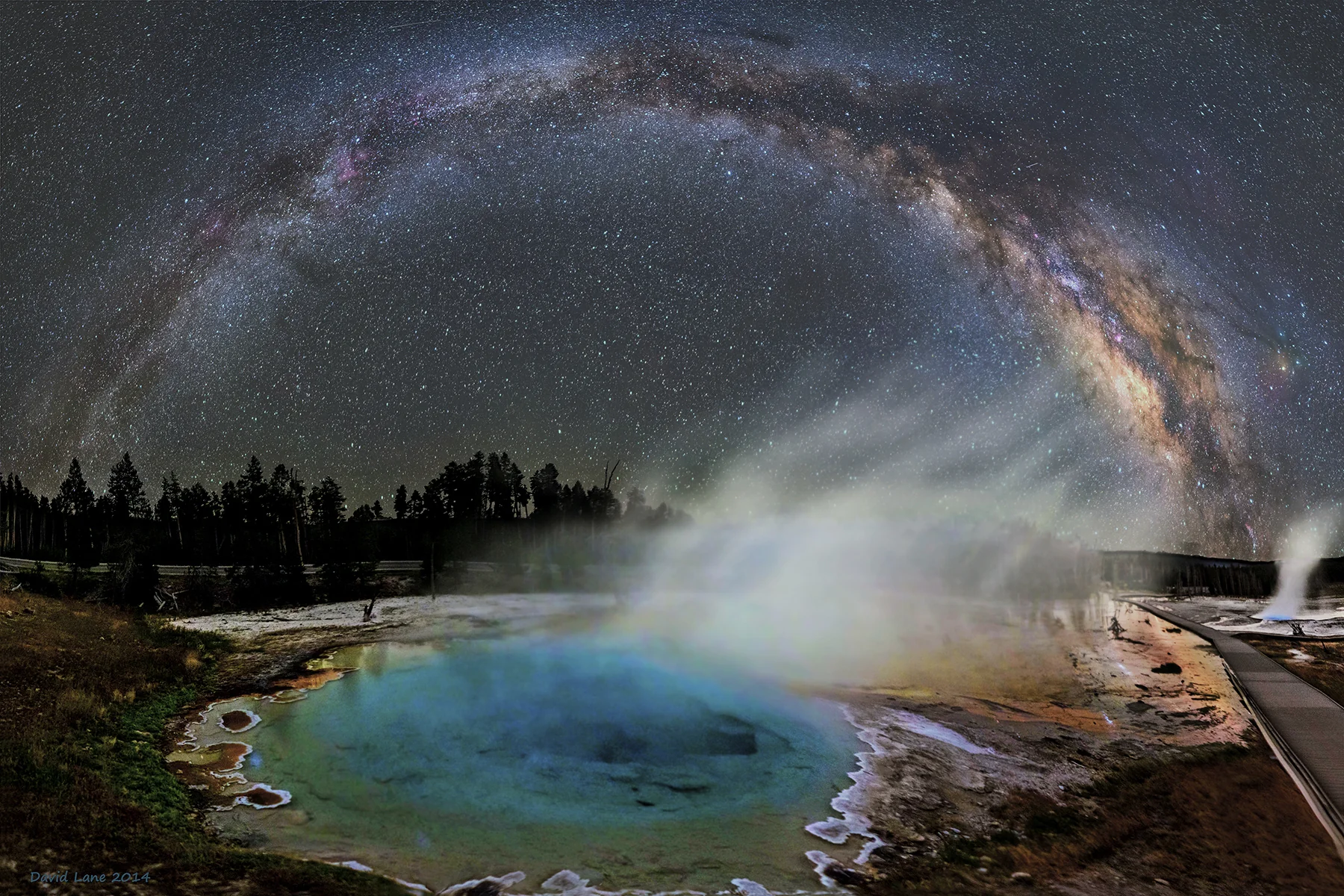
Image: NASA Astronomy Picture of the Day (APOD) · Image Credit & Copyright: Dave Lane · Today's page
Today's NASA Astronomy Picture of the Day begins with a clarification:
"The Milky Way was not created by a lake evaporating."
Why would an astronomer need to say that? One look at the photograph explains it. At the center, a pool of hot water glows blue in the dark. White steam rises straight from the surface, fades as it climbs and seems to dissolve into the Milky Way arching overhead. The whole image makes the pool look as if it were breathing stars into the sky.
Of course it is not. But the illusion is the picture's finest feature. It places something three meters from the viewer's feet and something 30,000 light-years away inside the same frame.
There Are Really Only Two Things in the Picture
The pool in the foreground is about 10 meters across. It is Silex Spring in the Lower Geyser Basin of Yellowstone National Park, Wyoming. Silex is Latin for silica. The spring water dissolves large quantities of silica underground, then deposits it layer by layer along the pool walls and runoff channels.
According to measurements by the National Park Service, Silex Spring has an average temperature of 79.3 degrees C and an average pH of 8.4. Its last eruption was in 2006. The heat driving the steam comes from the magma beneath the Yellowstone hotspot.
The band of light behind it points toward the center of our galaxy and is assembled from billions of stars.
One qualification matters: the vivid colors in the photograph were produced with artificial illumination, as APOD's description explicitly notes. Standing there at night, a visitor would not see the pool glowing so intensely. Dave Lane made the image in 2014 as a 16-frame panorama. It is already 12 years old.
Blue Is Physics; Orange Is Life
Look at the pool's colors: clear blue in the middle, ringed by orange, yellow and brown.
The two color families have completely different origins.
The blue center is physics. Water itself absorbs light, taking in far more red than blue. In a pool deep and clean enough, the light returned to the eye therefore looks blue. It is the same reason the sea is blue.
The orange, yellow and brown around the edge are life. They are living microbial mats. The National Park Service puts it plainly: the green, brown and orange mats are cyanobacteria that can survive in water as hot as 73 degrees C (167 degrees F). At that temperature they are usually yellow-green. As the water cools, they turn orange, rust-red and brown; in cooler zones, other heat-loving microorganisms join them and make the palette more varied.
Put those facts together and the pattern becomes clear.
At 79.3 degrees C, the center of Silex Spring is 6.3 degrees C above the cyanobacteria's tolerance limit. The middle is empty not because nothing has arrived, but because it is too hot for these organisms to grow. Only after the water spills from the pool, spreads through the channels and cools past 73 degrees can life catch up - and color catches up with it.
This is not a pool of dyed water. It is a temperature map. Blue marks the hottest water; farther out, the water grows cooler. Every color boundary is the line between where a particular organism can and cannot live.
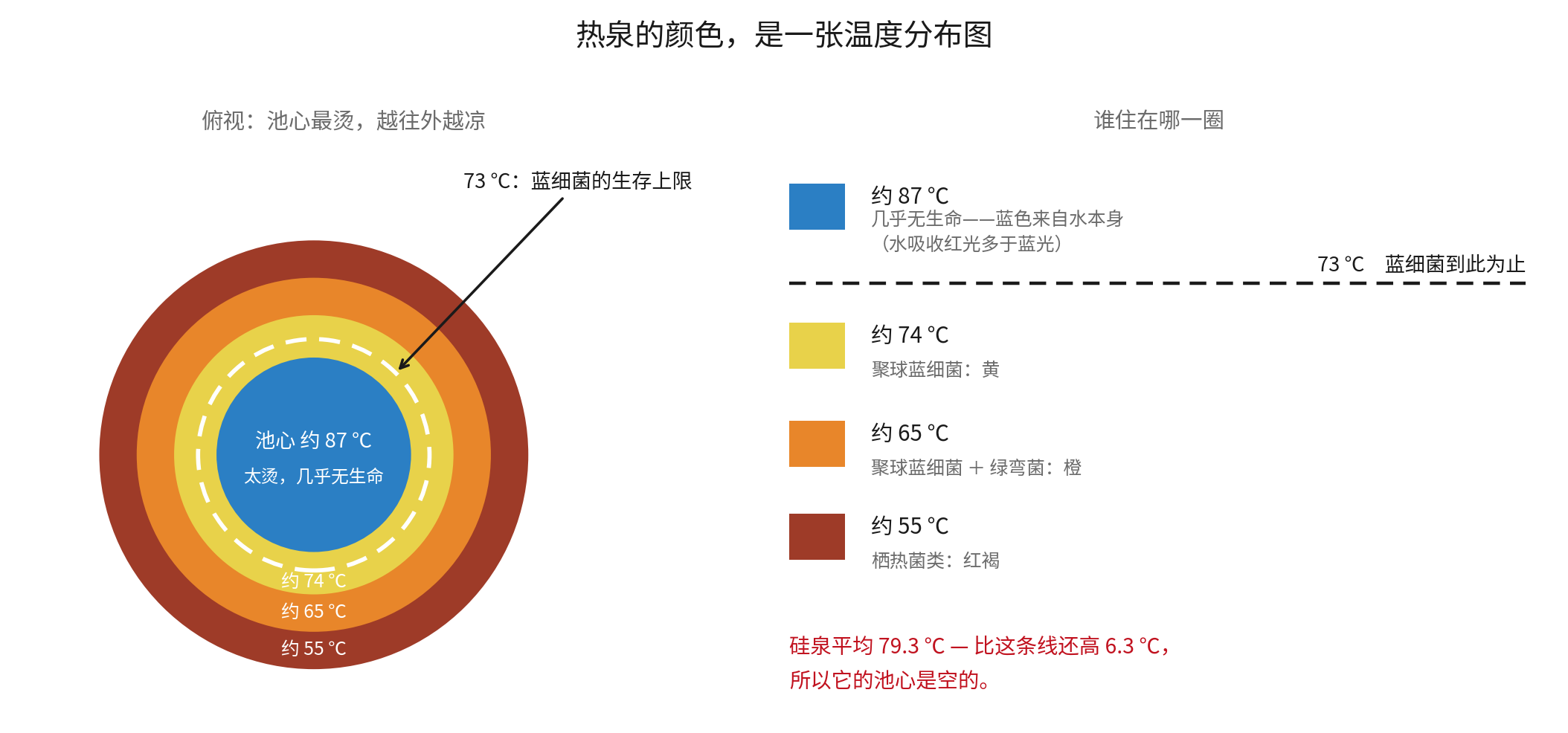
Yellowstone's best-known hot spring, Grand Prismatic Spring, has a fuller set of color bands and has been measured in greater detail. Its center is a clear blue at about 87 degrees C; farther out, yellow appears around 74 degrees, orange around 65 degrees and reddish brown around 55 degrees.
There is a small reversal hidden in those yellows and oranges: they are sunscreen. The cyanobacteria photosynthesize with chlorophyll and would otherwise appear green. Under intense summer sunlight, however, they produce large quantities of carotenoids - the family of pigments that makes carrots orange - to block excess light. The same pool is therefore more orange in summer and greener when sunlight is weaker. That blaze of color is a colony of bacteria protecting itself from the Sun.
A Bacterium From Near-Boiling Water Changed Every PCR Test
What gave this water a place in scientific history was not its beauty.
On June 20, 1964, microbiologist Thomas Brock and his team did something that seemed almost dull at the time. They suspended microscope slides in Yellowstone's scalding springs, left them for several days, then pulled them out and looked.
Every slide held microorganisms.
Until then, the prevailing view was that life could not survive at such temperatures. In 1969, Brock's team published a description of one of the bacteria and named it Thermus aquaticus. It tolerated higher temperatures than any microorganism then known. That was 57 years ago.
The second half of the story unfolded in the 1980s. Biochemist Kary Mullis was developing a method to copy DNA millions of times: polymerase chain reaction, or PCR. Its principle is straightforward. Heat DNA above 90 degrees C so the double helix separates into two strands; cool it so an enzyme can copy each strand; then heat and cool it again, repeating the cycle dozens of times as one copy becomes two and two become four.
The obstacle was the enzyme. Ordinary DNA polymerase is machinery from organisms that live at moderate temperatures. Every heating cycle destroyed it, so a person had to add more enzyme by hand after every round. Across dozens of cycles, the process could neither be automated nor widely adopted.
The answer was waiting in a Yellowstone pool. Taq polymerase, extracted from Thermus aquaticus, had evolved to work in near-boiling water and remained intact through repeated heating. The need to replenish the enzyme disappeared, and a machine could run unattended all night. Mullis shared the 1993 Nobel Prize in Chemistry for PCR, 33 years ago.
Every nucleic-acid test used in recent years follows that technical lineage. It began when someone lowered a glass slide into hot water where life was not supposed to exist.
Sky and Ground Ask the Same Question
Now return to the photograph.
NASA Astrobiology's own account says Thermus aquaticus expanded the boundary of what counts as habitable. It brought environments previously dismissed as incapable of supporting life back into consideration. Researchers study how organisms survive at Earth's extremes in order to understand how life might survive on other worlds.
That is the less obvious connection in the image. The 79-degree, alkaline water in the foreground, seemingly hopeless as a habitat, is one of the measures humanity uses to imagine the ocean beneath Europa's ice, the plumes of Enceladus and hydrothermal systems under the Martian surface. Ground and sky are not two subjects that happen to share a frame. Only after finding life in boiling water on Earth could humans seriously search for it on other worlds.
The scale of the heat source is worth remembering, too. The Yellowstone hotspot produced a supereruption about 640,000 years ago. Another would affect a vast area of North America. Today, Yellowstone contains more than 10,000 hot springs, geysers, mud pots and fumaroles, clustered in roughly 120 thermal areas, including at least 700 geysers. The US Geological Survey also points out an easily missed proportion: all the thermal areas together cover about 70 square kilometers, less than 1% of the park. A steaming pool is actually a rarity in a broad, quiet forest.
China Has Pools Like This Too
The same mechanism can be seen without crossing the Pacific.
Rehai in Tengchong, Yunnan, is one of China's finest high-temperature hot-spring systems. According to the Tengchong municipal government, the area contains more than 20 unusual springs. Fourteen spring groups have water above 90 degrees C, with a combined daily flow of 3,383.51 cubic meters. A high-throughput sequencing study published in Microbiology China in 2019 measured the temperature and pH of three Rehai springs: Guming Spring, 96 degrees C and pH 9.5, strongly alkaline; Hamazui, 86 degrees C and pH 7.5, neutral; and Huangguaqing, 65 degrees C and pH 2.5, strongly acidic.
Across the three sites, researchers identified microorganisms from 19 phyla and 66 genera, including the lineage containing Thermus, the Deinococcus-Thermus phylum. The study also found that archaeal diversity was markedly greater in the 86-to-96-degree springs than at the 65-degree site.
Over a walk of just a few dozen meters, the water temperature changes by 30 degrees and the entire community living in it changes too. It is the same rule as Yellowstone, in a pool in China.
At hot springs from Tengchong to Changbai Mountain and Yangbajain in Tibet, the arrangement of clear, green and orange zones acts as an unmarked thermometer, with microorganisms writing the scale by choosing where they can live.
The rules at such sites reflect the danger and fragility of those communities: entering or touching the pools, or throwing objects into them, is prohibited. The water may be far beyond scalding, and a microbial mat damaged by one footstep can take years to grow back.
Sources: NASA Astronomy Picture of the Day for August 16, 2026; US National Park Service pages on Silex Spring and the microorganisms of Fountain Paint Pot; Live Science on the causes of Yellowstone's hot-spring colors; NASA Astrobiology's feature on Thomas Brock; the US Geological Survey Yellowstone Volcano Observatory's numerical overview of Yellowstone's thermal areas; the Tengchong municipal government's introduction to the Rehai scenic area; and a 2019 Microbiology China study of microbial diversity in the hot springs of Tengchong Rehai.