
Seven years, two minutes, sixty seconds.
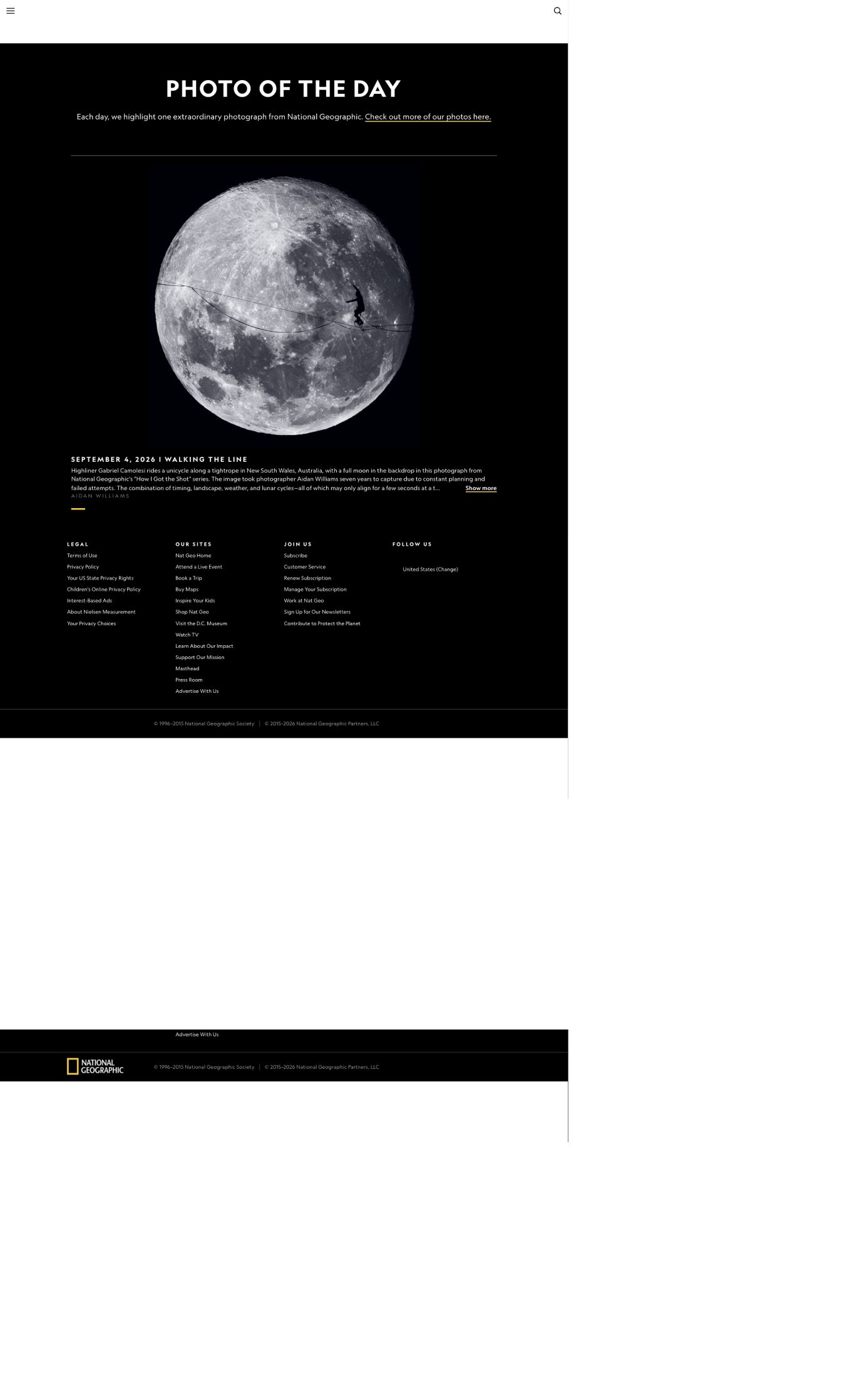
Screenshot: National Geographic Photo of the Day · Original page
Today's National Geographic Photo of the Day can be described in one sentence, though you may still find it hard to believe:
A man is riding a unicycle on a suspended highline, with a huge full moon behind him.
National Geographic's caption identifies the rider as Gabriel Camolesi, the photographer as Aidan Williams and the location as New South Wales, Australia. The image is part of National Geographic's "How I Got the Shot" series. The caption says that, after continual planning and repeated failures, the photograph took Williams seven years to make. Timing, terrain, weather and the lunar phase might align for only seconds at a time.
Seven years for a few seconds.
That sounds like literary exaggeration. It is not. The number can be estimated.
First, a Correction
The caption uses tightrope, yet calls its subject a highliner in the same sentence. Those are not the same thing, and the distinction is worth making.
A tightrope is pulled extremely taut. It is rigid and does not bounce; walking on one is more like walking along a beam, as Philippe Petit did between the Twin Towers.
A slackline is a flat length of webbing under much less tension. It sways and springs underfoot, like trying to balance on a trampoline. Suspended high above the ground, it becomes a highline, widely regarded as the discipline's highest form. Highlines use redundant anchors and usually a leash connecting the person to the line.
The precise description, then, is that Camolesi is riding a unicycle on a highline.
Two records show just how difficult that is. The world record for walking a slackline is 3,646 meters, set when Estonia's Jaan Roose crossed the Strait of Messina in July 2024. The Guinness World Record for riding a unicycle on one is 50 meters, set by Canada's Guillaume Fontaine on October 30, 2018.
On the same kind of line, the walking record is 73 times the riding record.
Camolesi is no random passerby. In November 2022, he, Nathaniel Glavurdic and others completed a 1,290-meter highline in the Blue Mountains of New South Wales, the longest in Australian history and the country's first longer than a kilometer. They crossed it five times in three days, twice without falling. The photographer who documented that record was Aidan Williams, who had prepared for it for about a year.
Williams lives in the Blue Mountains, specializes in highline photography and has traveled through 49 countries. He describes his style as "a very small human in a very large, empty landscape." Today's photograph is an extreme version of exactly that.
Now for the Moon
Here is the most counterintuitive part of the story.
The moon is small. Its angular diameter in the sky is about 0.52 degrees, ranging from 0.568 degrees at perigee to 0.489 degrees at apogee. Hold out your arm: the width of your little finger is about one degree, so the moon spans only one-third to one-half of your little finger's width.
(A fact that is especially good for children: why does a small child's hand still measure one degree? Because hand size generally scales with arm length. A child's small fist on a short arm measures about 10 degrees; an adult's large fist on a long arm still measures about 10.)
So how does the moon in the photograph look large enough to swallow the rider?
Most people answer: a telephoto lens.
That answer is wrong.
Focal Length Cancels Out
The arithmetic is easy to check.
How tall is the moon's image on a camera sensor? moon height = focal length x 0.00904, where 0.00904 is 0.52 degrees in radians. With a 600 mm lens, the moon is 5.4 millimeters high on the sensor, or 22.6 percent of the short side of a full-frame sensor.
What about the rider? A 1.7-meter person at a distance of D meters has an image height of focal length x 1.7 / D.
Divide one by the other to find how many times taller the moon appears than the person:
ratio = (focal length x 0.00904) / (focal length x 1.7 / D) = 0.00532 x D
Focal length cancels out completely.
That gives us an easy threshold to remember: 188 meters.
Stand closer than 188 meters and the moon will always appear shorter than the person. Even a 1,000 mm lens cannot change that; it only enlarges the fixed proportions of the entire scene. From 500 meters away, the moon appears 2.7 times the person's height. From 1,000 meters, it appears 5.3 times taller.
Another way to picture it: from 500 meters, the moon looks like a 4.5-meter object standing beside the person. From 1,000 meters, it looks nine meters tall, about the height of a three-story building.
The moon in this image appears several times larger than the rider, so Williams was probably 500 to 800 meters away. That is an inference from the formula, not a distance he supplied. For seven years he was not waiting for a longer lens. He was waiting for the camera position, the highline and the moonrise bearing to align.
Focal length determines clarity. Distance determines relative size. If you remember one thing from this article, make it that.
The Arithmetic of Seven Years
Now we can estimate the wait.
First constraint: the moon rises in a different place each month.
A full moon is opposite the sun, so its declination is roughly the inverse of the sun's for that month. Over a year it sweeps between a little more than plus and minus 23 degrees; with the tilt of the moon's orbit, the extremes can reach plus or minus 28.7 degrees in some years. At the latitude of the Blue Mountains, the full moon's rising point sweeps across about 57 degrees of the eastern horizon each year, and as much as 71 degrees in an extreme year. On average, it moves 10 to 13 degrees each month.
The highline is fixed, and so is the camera bearing Williams needs. That means only about two full moons a year have a real chance of rising in the right place, once as the moon's path crosses the desired bearing in each direction.
Second constraint: the tolerance is frighteningly small.
Suppose the rider is 500 meters away. A 1.7-meter person has an angular height of 0.195 degrees, while the moon's diameter is 0.52 degrees. To fit the entire rider inside the lunar disc, the moon's center can be no more than plus or minus 0.162 degrees from the rider. At the camera position, that becomes a tolerance of about 1.4 meters vertically and two meters horizontally.
It is a box roughly three meters high and four meters wide, seen from 500 meters away. The moonrise bearing that night determines exactly where the box will be.
Third constraint: the moon moves faster than you think.
Relative to the horizon, the moon appears to travel about 14.5 degrees per hour, or 0.24 degrees per minute. Its own diameter is 0.52 degrees.
Every 2.1 minutes, it moves by one full moon-width.
After allowing for the framing tolerance, the window in which the rider sits inside the lunar disc lasts only about 60 to 80 seconds. During that minute, the unicyclist must also arrive at exactly the right point on the line.
Fourth constraint: everything else. The sky must be clear. The Blue Mountains are rainy and foggy; indeed, their name comes from the haze created by eucalyptus oil. The highline must already be rigged, a full-day job for a team. The athlete must be present. And a unicycle crossing is difficult enough that there may be only a few attempts in an evening.
Multiply plausible values to see the scale: two alignment opportunities a year x 0.4 for weather x 0.5 for the team being ready x 0.4 for reaching the mark during that minute = 0.16 successful opportunities per year.
Take the reciprocal: an expected wait of 6.3 years.
The caption says seven.
(Those probabilities are reasonable assumptions, not measurements. Substitute your own: improve the weather probability to 0.6 and the answer falls to 4.2 years; demand tighter framing and it can rise to 12. The order of magnitude remains the same. "Seven years" is not merely lyrical. It is an estimable number.)
Photographers now use specialist software for these calculations, including PhotoPills, The Photographer's Ephemeris and PlanIt Pro. Each answers the same question: for a given location and time, what are the sun's or moon's azimuth and altitude? Or, in reverse: if you need the moon at an azimuth of 78 degrees and an altitude of two degrees, where should you stand, and on what date and time? PlanIt also includes terrain profiles. The Blue Mountains are full of cliffs, and paper calculations alone cannot tell you which rock face the moon will rise behind.
That Feeling of an Enormous Moon Is an Illusion
One more point matters because this is among the world's most common visual illusions.
When the moon first rises over the horizon, it looks enormous. By the time it is overhead, it seems to have shrunk to an ordinary little patch of sky.
Physically, the opposite is true.
When the moon is overhead, you are one Earth radius closer to it than Earth's center is. At the horizon, you and Earth's center are nearly the same distance from it. The result is that the horizon moon is actually 1.5 to 1.7 percent smaller than the moon overhead.
Yet people perceive it as about 50 percent larger.
Less than two percent smaller in physics, half again as large in the mind. That contrast is the whole story.
What causes the illusion? The candid answer is: nobody knows.
NASA says that although people have observed the illusion for thousands of years, we still have no solid scientific explanation. Wikipedia is blunter: no single theory has prevailed. A 2013 collection devoted 19 chapters to research on the moon illusion and reached differing conclusions.
The best-known proposal is the Ponzo illusion: trees and buildings on the horizon provide distance cues, like converging railway tracks, that make the moon seem larger. But NASA points to a damaging counterexample: astronauts in orbit also see the moon illusion, with no foreground objects at all.
Two Children Asked the Same Question 2,500 Years Ago
This is where the story becomes especially beautiful.
The ancient Chinese text Liezi, in the chapter "The Questions of Tang," tells a story familiar to generations of Chinese children:
Confucius was traveling east when he saw two children arguing. One said, "I think the sun is closer to us when it first rises and farther away at noon." The other believed the opposite. The first said, "At sunrise the sun is as large as a carriage canopy, but at noon it is only as large as a plate. Does that not show that distant things look small and nearby things large?" The other said, "At sunrise it is cool, but at noon it is as hot as reaching into boiling water. Does that not show that what is near is hot and what is far away cool?" Confucius could not decide.
"At sunrise the sun is as large as a carriage canopy, but at noon it is only as large as a plate."
That is the moon illusion's twin. The sun and moon appear nearly the same size in our sky, each about half a degree wide, which is why a total solar eclipse can cover the sun so precisely. The two illusions share the same mechanism and are addressed by the same psychological hypotheses.
Confucius could not answer 2,500 years ago.
In 2026, NASA says we still have no solid explanation.
The children mocked Confucius by asking, "Who says you know so much?" Today, they could keep laughing a little longer.
This Year's Mid-Autumn Moon Is Full on the Seventeenth
The moon also gives us a timely detail.
The Mid-Autumn Festival in 2026 falls on Friday, September 25, with the holiday running through September 27. But the exact full moon comes at 12:49 a.m. Beijing time on September 27, the seventeenth day of the eighth lunar month.
This year, the fifteenth-night moon is full on the seventeenth.
The reason is that the moon follows an elliptical orbit and moves unevenly, faster when it is close and slower when it is far away. Yang Jing, a council member of the Tianjin Astronomical Society interviewed by Xinhua, explained that consecutive full moons are 29.53 days apart on average, but the longest and shortest intervals can differ by 13 hours. A full moon can therefore fall on the fourteenth, fifteenth, sixteenth or seventeenth day of a lunar month.
She also made a point that fits this story perfectly:
There is no need to fixate on the exact fullest moment. To the naked eye, the moons on the nights of September 25, 26 and 27 will look much the same.
That is the same lesson as all the arithmetic above. The changes in the moon's size and phase are too slight for the unaided eye to resolve. Almost everything you feel about its size comes from perception and composition: illusion, culture and where the photographer stands.
How much astronomy lies behind the Chinese saying that "the moon is brightest at Mid-Autumn"? Science educator Xiu Lipeng gave Xinhua three reasons, only one of which applies consistently: around Mid-Autumn, clear autumn weather, cleaner air and less water vapor allow moonlight to pass through the atmosphere with less loss. There is no astronomical basis for saying it is larger. Xiu emphasized that the decisive factor is subjective: because the Mid-Autumn moon symbolizes reunion, its cultural meaning intensifies the experience.
(The three supermoons of 2026 occur on January 3, November 24 and December 24. None falls at Mid-Autumn. EarthSky compares the size difference between a supermoon and a micromoon to the difference between a US quarter and nickel. The unaided eye cannot distinguish it.)
China Has Highlines Too
This is not exclusively an Australian pursuit.
The "King of Asia" Highline Challenge at Huangshizhai in Zhangjiajie has been held for seven consecutive years since 2018. The 2025 edition ran from August 18 through 20 at the 1,092-meter summit of Huangshizhai. Its 1,000-meter line stretched between Shituhui and Pipa Peak, and more than 20 elite competitors from ten countries and regions took part. The organizers were the Wulingyuan District government and the scenic-area administration.
One thousand meters. Camolesi's Blue Mountains line measured 1,290 meters: the same scale, the same world. Chinese athletes swept first, second and third place in the 2024 event.
Sources
National Geographic Photo of the Day, September 4, 2026; Guinness World Records; International Slackline Association; Wild and We Are Explorers on the 1,290-meter Blue Mountains record; interviews with Aidan Williams by Canon Australia and Panasonic Australia; Blue Mountains Gazette; EarthSky; timeanddate; Wikipedia's "Moon illusion" article; NASA, "The Moon Illusion"; US Naval Observatory lunar-phase data; the Chinese Text Project edition of Liezi, "The Questions of Tang"; Xinhua; and China Daily.