
One word in the official description matters more than anything else in this Doodle: two years ago, it was not there.

Image: Google Doodle, Celebrating National Parks Week: Smoky Mountains | Official page
Google's National Park Week Doodle today features Great Smoky Mountains National Park. Its official description is only two sentences long. The second says:
The artwork features layered views from Kuwohi, the highest point in the park.
Last year, that sentence would have said Clingmans Dome.
Reclaiming a Name Took Two Years
On September 18, 2024, the U.S. Board on Geographic Names voted to restore the mountain's name to Kuwohi.
Kuwohi is a Cherokee word, written ᎫᏬᎯ in the Cherokee syllabary, meaning "mulberry place."
The complete timeline appears in The One Feather, the Cherokee people's newspaper. In 2022, two members of the Eastern Band of Cherokee Indians, Lavita Hill and elder Mary "Missy" Crowe, started the effort. Tribal Council passed supporting legislation on July 14, 2022, and unanimously adopted Resolution No. 72 on January 4, 2024. On February 6, 2024, the two women formally submitted the application to the Board on Geographic Names on behalf of the principal chief and Tribal Council. It was approved on September 18.
Hill said at the time: "This is a huge victory for our people. What started as a fun idea turned into reclaiming our language on a mountain that is very significant to us in the park."
Great Smoky Mountains superintendent Cassius Cash said in the NPS announcement: "The Cherokee people have had strong connections to Kuwohi and the surrounding area, long before the land became a national park."
Who was the Clingman whose name was removed?
Thomas L. Clingman was a 19th-century North Carolina politician who surveyed and promoted the region's peaks in the 1850s. Geographer Arnold Guyot named the mountain for him in 1859.
One primary government record is especially blunt. The U.S. Senate website has a list of 15 expelled senators. One is Thomas L. Clingman, in 1861. The cause is recorded word for word as "support for Confederate rebellion," and the result as "expelled."
He did not merely serve as a Confederate general. He was one of the 15 people formally expelled from the United States Senate.
What does the mountain mean to Cherokee people? At a Kuwohi Connection Day for students in September 2025, Cherokee citizen Nancy Pheasant said: "The place we are standing and sitting this morning is very sacred to the Cherokee people." The same report calls it a place of council for the Bear Clan, where the Bear People, or Bear Clan, once gathered. A 19th-century ethnographic account described the mountain as the home of the White Bear, chief of all bears; that is a historical record, not the present official description.
One detail shows what a renaming looks like in practice: the two names still coexist on the NPS website. The mountain-range page, the Kuwohi page, and navigation materials have changed, and the road is labeled "Kuwohi Road (formerly Clingmans Dome Road)." But the old Clingmans Dome page remains online, uses the former name throughout, and says nothing about the change. The park statistics page still identifies its highest point as "Clingmans Dome, 6,643 feet."
The NPS announcement said that work to update signs, websites, and other materials was "already underway." Two years later, it is still underway. A vote can replace a name in one day; implementing the change after more than 160 years takes much longer.
Three common "highest" claims also deserve checking one by one. At 6,643 feet, or 2,024.8 meters, Kuwohi is the highest point in Great Smoky Mountains National Park and the highest point in Tennessee. Both claims hold. It is often called the highest point on the Appalachian Trail, but that sentence does not appear on any of the three relevant NPS pages, so it is omitted here. The NPS announcement provides a different verified ranking: Kuwohi is the third-highest peak east of the Mississippi River, with more than 650,000 visitors a year.
The "Smoke" Is Exhaled by the Forest
Now to the other half of the mountains' name.
Cherokee people call this range Shaconage, which the NPS translates as "land of blue smoke." That smoke gave the Smokies their English name.
What is it?
The current NPS website does not actually explain the mechanism. Its FAQ, plant, mountain, air-quality, environmental-factors, and children's pages were all checked. The current explanation says only that abundant rainfall and dense vegetation often produce misty, smoke-like haze, giving the park its name. None of those pages mentions volatile organic compounds.
Atmospheric chemistry supplies the mechanism.
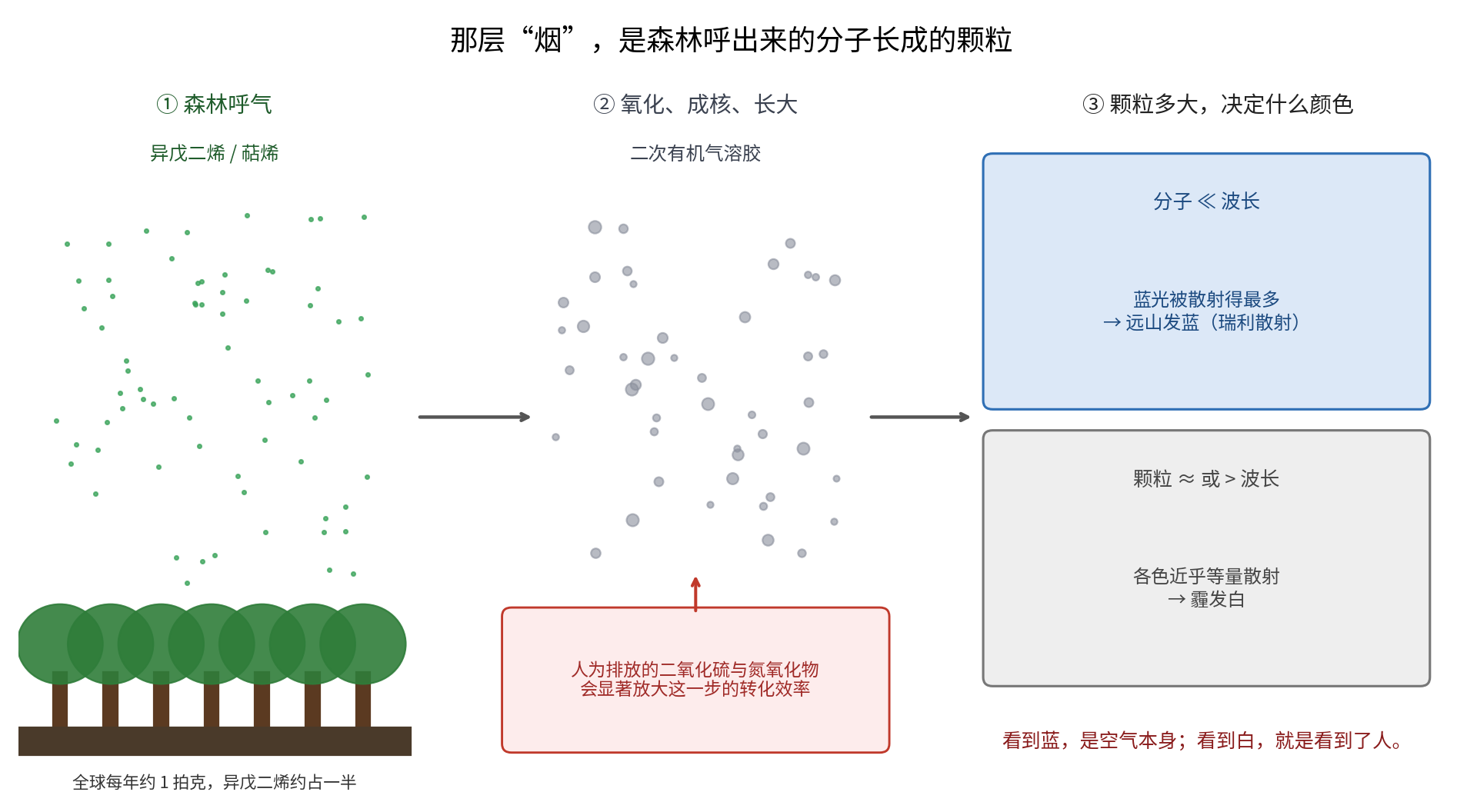
Plants exhale. Vegetation worldwide releases about one petagram of biogenic volatile organic compounds into the atmosphere each year, equal to 1,000 teragrams or 10^15 grams. Isoprene accounts for about half, according to a widely used global emissions model published in 2012. These molecules oxidize, nucleate, and grow in the atmosphere, becoming extremely fine particles known as secondary organic aerosol. The particles scatter sunlight, producing the haze.
The earliest paper to advance this line of explanation appeared in Nature on August 20, 1960, under the title "Blue Haze in the Atmosphere." The paper is behind a paywall, so only its title, not its argument, can be cited here.
The most instructive part is that natural and human-made sources are not independent. A 2015 study in PNAS reported "direct observational evidence that secondary organic aerosol formed from biogenic isoprene and monoterpenes is strongly modulated by anthropogenic emissions of sulfur dioxide and nitrogen oxides."
In other words, human sulfur and nitrogen emissions make molecules released by trees more efficient at becoming particles. The study addresses precisely how much of the supposedly natural blue smoke belongs to the forest and how much to us.
How to Distinguish Natural Blue from Human-Made White
Molecules and particles scatter light differently, and two official explanations make the distinction visible.
NASA explains that blue light is scattered more than other colors because it travels as shorter, smaller waves. Air molecules do that through Rayleigh scattering. When particles multiply and light scatters repeatedly, "all this scattering mixes the colors together again so we see more white and less blue." The NPS national visibility page defines haze in the same terms: when sunlight encounters fine particles in the air, they scatter light both into and out of the line of sight and absorb some before it reaches the eye.
Distant mountains therefore look blue mainly because of the air itself. Haze looks white because of particles. White in the view is, in large part, human influence made visible.
Great Smoky Mountains data make that distinction concrete. The park's NPS air-quality page gives 93 miles, about 150 kilometers, as natural background visibility, compared with a current annual average of only 25 miles, about 40 kilometers. Since 1948, average visibility in the southern Appalachians has declined 40% in winter and 80% in summer. At extreme moments it has fallen below one mile.
The NPS offers a practical description: pollution creates "a uniform whitish haze, different from the natural fog-like clouds."
There is an important accounting issue. The NPS national page says average visibility in eastern parks improved from 50 miles in 2000 to 70 miles in 2015, while the park page says "current" visibility is 25 miles. The numbers use different indicators and years and cannot be subtracted. No annual visibility series specific to Great Smoky Mountains was found. Neither NPS page attributes the improvement to the Clean Air Act; the park page instead says further reductions in nitrogen oxides and sulfur dioxide remain necessary.
One number is even more striking: ozone concentrations on park ridges can reach twice those in nearby cities, and have damaged as many as 90% of the park's black cherry trees and milkweed plants.
Salamander Capital of the World
The Smokies' real signature is not smoke but salamanders.
The park contains 31 salamander species, the official basis for calling it the "Salamander Capital of the World." Add 14 species of frogs and toads, and its amphibian total reaches 45.
The lungless salamander family accounts for 25 species. Half a sentence on the NPS page carries unusual weight: four of those 25 were discovered between 2020 and 2024.
Four new salamander species emerged in five years from a park walked for nearly a century by 12 million people annually.
"Lungless" is literal. The NPS says these animals have no lungs. They breathe by exchanging gases through tiny blood vessels in the skin; the linings of the mouth and throat also participate.
Why here? The NPS mechanism is concise: the Smokies' varied habitats, great range of elevations, ancient geology, and abundance of highly oxygenated streams together created ideal conditions for salamanders to diversify.
UNESCO offered another perspective when it inscribed the park as a World Heritage Site in 1983. It called the Smokies "the largest and most diversified remnant of the Arcto-Tertiary geoflora era in the world" and a window into late Pleistocene flora before recent human influence.
One official inconsistency is particularly useful. UNESCO's 1983 text lists 31 native salamander species and 24 lungless salamanders; the current NPS page says 25. That is not a contradiction. It is time. Another species was found in between, and the difference itself is evidence.
Twenty-Two Thousand Species, and How Many Remain Unknown
In 1998, the park began an All Taxa Biodiversity Inventory, or ATBI, conducted by Discover Life in America. Its goal is direct: count every species in the park.
The score so far is remarkable. More than 22,000 species are known in the park; the precise NPS count is 22,744. More than 1,000 were new to science, and more than 11,000 were new records for the park. When the ATBI began, only about 10,000 species were known there. The count has more than doubled in a little over two decades.
The estimate is even more startling. Scientists think the park actually contains 60,000 to 80,000 species, leaving roughly 60% to 70% undiscovered.
An official disagreement deserves to remain visible. The NPS FAQ estimates nearly 100,000 species, while the organization conducting the inventory gives 60,000 to 80,000. Two parties describing the same park and project differ by one-third to one-half.
Even the size of the unknown is an estimate.
China: The World's Largest Amphibian Was Not One Species After All
Great Smoky Mountains shows that new things remain hidden in the most familiar places. China has a parallel, and more dramatic, example.
The Chinese giant salamander, the world's largest amphibian, is typically about one meter long, with a historical maximum of 1.8 meters. It is Critically Endangered under the IUCN and listed in CITES Appendix I.
Over the past decade, its taxonomy has been rewritten.
A May 2018 paper in Current Biology was titled "The Chinese giant salamander exemplifies the hidden extinction of cryptic species." In 2019, another paper in Ecology and Evolution analyzed genes from historical museum specimens and identified three lineages from different parts of China. Their geographic distribution matched separation by major river systems or mountain ranges. The lineages corresponded to the Chinese giant salamander, a species named Andrias sligoi, which may actually be the world's largest amphibian, and an unnamed species. Their divergence was consistent with geological changes during the Pliocene and Pleistocene.
The heaviest conclusion appeared in the abstract of a 2022 paper in Zoological Research. It said that misguided conservation measures, including commercial breeding and the release of millions of probably non-native or hybrid individuals, had further compromised conservation efforts.
Once one species became several, decades of releasing animals without regard to origin changed from conservation into genetic contamination.
The paper also brought good news. After 18 months of field monitoring, researchers found a wild population in an enclosed nature reserve in Jiangxi. Using morphological and molecular evidence, they described it as a new species, Andrias jiangxiensis. The abstract calls it the only Chinese giant salamander species currently known to have a genetically pure population reproducing naturally in situ.
The Smokies yielded 1,000 species new to science in a little over two decades. A single Chinese giant salamander became three or four species. Both stories say the same thing: we know much less about the world around us than we imagine. They also carry the same warning. The Smokies have an introduced adelgid that has attacked Fraser firs since the 1960s; China has hybrid salamanders released into streams. Good intentions without knowledge can still do harm.
One qualification should be explicit. The commonly repeated claim that the adelgid killed 90% of mature firs could not be located on first-hand NPS or U.S. Forest Service pages, so only their qualitative wording, "widespread mortality" and "many mature Fraser firs have died," is retained here. NPS monitoring in 2024 also found that adelgid density on Fraser firs was then low.
Sources: Google Doodle official page, Celebrating National Parks Week: Smoky Mountains; National Park Service, "Kuwohi Name Restored to the Highest Peak in the Smokies" (September 18, 2024); Cherokee newspaper The One Feather, reports dated September 18, 2024, April 2, 2025, and September 9, 2025; U.S. Senate page "Expulsion and Censure"; NPS Great Smoky Mountains FAQ, plant, mountain, air-quality, amphibian, statistics, and Kuwohi pages; NPS national visibility page and National Park Week page; Went (1960), Nature 187:641; Guenther et al. (2012), Geoscientific Model Development 5:1471; Xu et al. (2015), PNAS 112(1):37; NASA Space Place, "Why Is the Sky Blue?"; UNESCO World Heritage Site No. 259, Great Smoky Mountains; Discover Life in America ATBI page; Yan et al. (2018), Current Biology 28(10):R590; Turvey et al. (2019), Ecology and Evolution 9(18):10070; Chai et al. (2022), Zoological Research 43(3):469; AmphibiaWeb; and the AmphibiaChina database of the Kunming Institute of Zoology, Chinese Academy of Sciences.