
A coincidence in the sky meets an ambition on the ground.
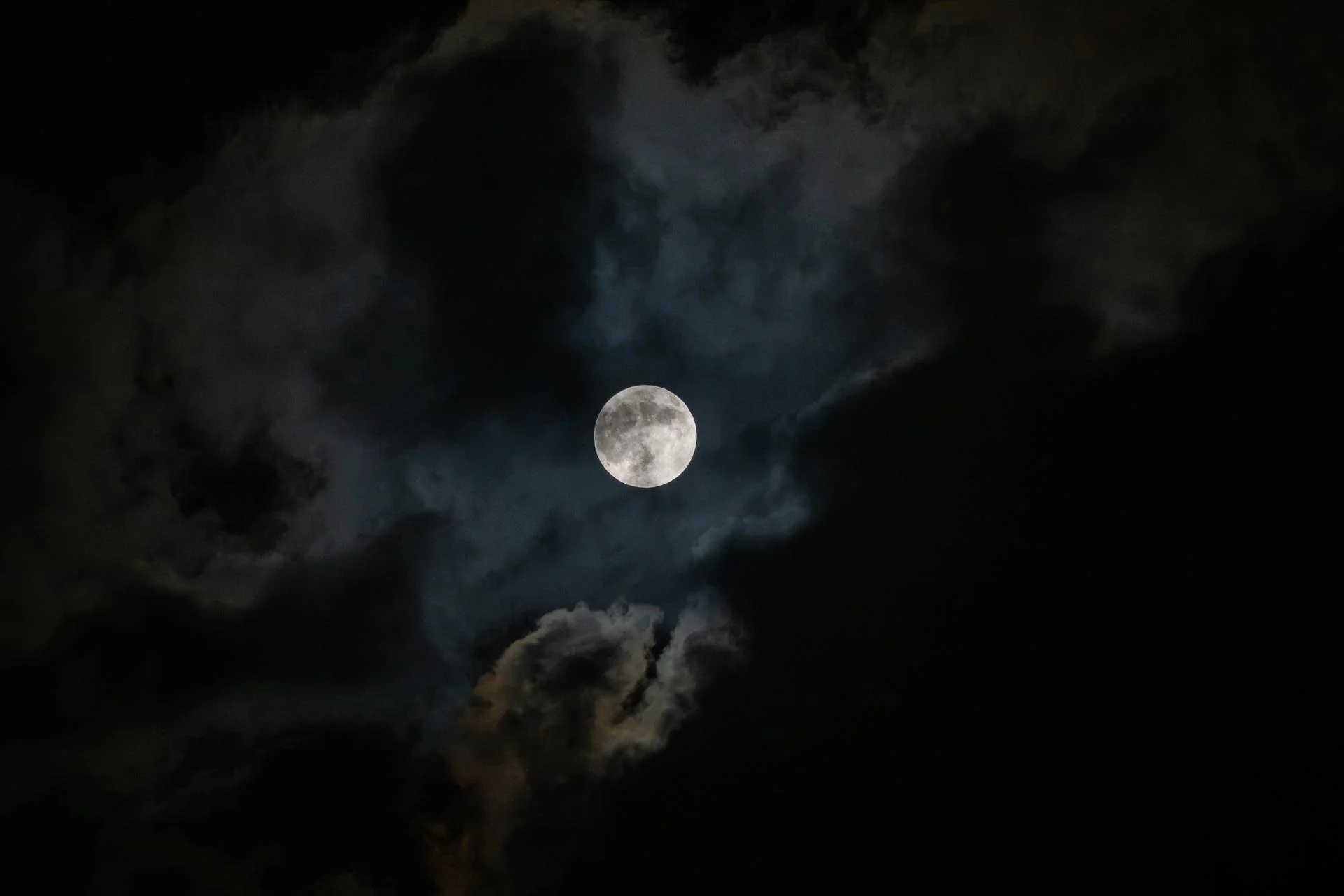
Image: NASA Image of the Day | Image credit: NASA/Eric Bordelon | Image page
On Thursday night, August 27, a strange-looking Moon rose above the horizon in southern Louisiana. Instead of its usual cool white, most of its disk was veiled in a dark red, like tarnished copper. Only a slender rim remained fiercely bright.
The photographer was Eric Bordelon, a NASA photographer who has worked since 2007 at the factory beneath the Moon in this image. A Louisiana native, Bordelon did not point his camera at the Moon alone. He let it rise above somewhere special: his workplace, NASA's Michoud Assembly Facility.
First, This Was Not a Total Lunar Eclipse
One detail about this Moon needs to be precise because it is easy to get wrong.
The eclipse of August 27-28 was a very deep partial lunar eclipse, not a total one. Earth's shadow covered 96.3% of the Moon - almost all of it, but not quite. That is why the photograph shows a stubborn bright rim: this narrow strip of lunar surface remained beyond the shadow throughout the eclipse, still lit by direct sunlight. NASA's own caption also calls the eclipse "partial."
(This year's actual total lunar eclipse was a separate event on March 3. It should not be confused with the August partial eclipse that fell just short.)
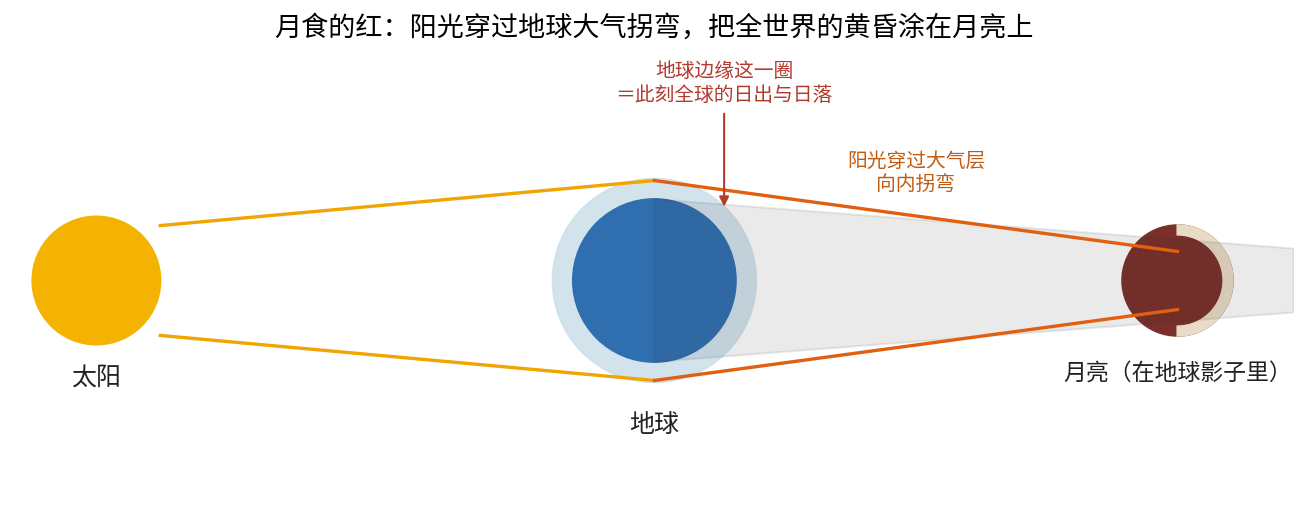
Why was the shadowed part red rather than black? Total and deep partial eclipses share this effect, and one sentence explains it: the Moon was receiving no direct sunlight there; it was illuminated by sunlight bent through Earth's atmosphere. Imagine standing on the Moon and looking up at Earth. Around its edge, you would see an entire ring of red light: every sunrise and sunset on Earth burning at once. The light of that continuous twilight bends into Earth's shadow and brushes the Moon's face. The red of a lunar eclipse is, in the end, a little color lent to the Moon by every dusk on Earth.
The Real Subject Is the Factory Beneath the Moon
Set the Moon aside for a moment and look at the place it illuminates.
The Michoud Assembly Facility, in eastern New Orleans, is one of the world's largest factories: 43 acres under a single roof, enough room for 31 football fields. Its street address is unassuming. Almost everything that leaves it is headed skyward.
The facility's history is itself a concise history of American spaceflight. The government bought the land in 1940 for wartime production, and military transport aircraft were built there first. NASA took over in 1961. Since then, Michoud has built the first stage of the Saturn V that carried people to the Moon in the Apollo era; the 15-story, orange external tanks used on all 135 Space Shuttle flights; and, today, the core stages of the Space Launch System, or SLS, the new heavy-lift rocket for the Artemis lunar program, along with structural components for the Orion spacecraft.
In other words, for more than 60 years, almost every enormous machine the United States has used to send people beyond Earth has rolled out of the factory beneath this Moon.
The site also has a defiant story from closer to the ground. When Hurricane Katrina flooded much of eastern New Orleans in 2005 and the city evacuated, a 38-person "ride-out team" of NASA and contractor employees remained at Michoud. Running four large pumps, they removed roughly one billion gallons of water from the grounds and held the facility behind a 19.5-foot levee. After the storm, the factory that builds Moon rockets temporarily housed three platoons of Marines engaged in rescue operations. The place that builds rockets has weathered storms on Earth as well.
What Makes This Photograph Work
Above is a Moon with 96% of its face bitten away by Earth's shadow. Below is a factory that builds rockets for the Moon. One is a natural coincidence that reaches Louisiana only once in decades; the other is a human ambition sustained for 60 years. They had nothing to do with each other until Bordelon pressed the shutter and brought them into the same frame.
A local man photographed the reddened Moon over his home state, and also the rockets his home state builds for a nation bound for the Moon. That is perhaps the image's most moving quality: we look up at the Moon while building, here below, the road that will take us there. Occasionally, the two meet in a single photograph.
(For a precise account of where the program stands today: Artemis II completed its crewed flight around the Moon in April 2026. NASA's current mission page schedules Artemis III for 2027 as a systems demonstration in low-Earth orbit, with the crewed lunar landing planned for Artemis IV in 2028. These dates may move as the program changes; NASA's official pages remain the current authority.)
Across the Pacific
The United States has Michoud. China has Wenchang.
Over the past year or two, both sides of the Pacific have been assembling and test-firing the enormous hardware intended for lunar missions. On February 11, 2026, China's Long March 10 launch vehicle and Mengzhou crewed spacecraft completed a flight test at Wenchang. To be clear, this was not an orbital launch but an in-flight abort test: at an altitude of about 11 kilometers, near maximum aerodynamic pressure, the spacecraft deliberately separated from the rocket to simulate carrying astronauts to safety in an emergency. The test also exercised first-stage recovery and an ocean splashdown. The entire system is being prepared for China's own crewed lunar program. According to official statements, the goal is to land Chinese astronauts on the Moon before 2030 using these three elements: Long March 10, Mengzhou and the Lanyue lander.
A little earlier, on June 25, 2024, Chang'e 6 returned humanity's first samples from the far side of the Moon.
So today's photograph also reflects a story on the other side of the Pacific: New Orleans has Michoud, and Wenchang has its launch site. In both places, workers are spending these years fastening together, piece by piece, the rockets meant to carry people back to the Moon. As the red Moon rose, factory lights were still burning on both shores.
Sources: NASA's Rising Over Louisiana image page and official Michoud Assembly Facility materials (nasa.gov); data on the partial lunar eclipse of August 27-28, 2026 (NASA Scientific Visualization Studio and timeanddate); NASA Space Place on the cause of a lunar eclipse's red color; The Advocate on Michoud during Hurricane Katrina; NASA mission pages on the current Artemis program; the China Manned Space Agency, China Central Television and the China National Space Administration on the Long March 10 flight test and Chang'e 6; timeanddate on the next total lunar eclipse visible from China.