
One name, two galaxies, six high school students.
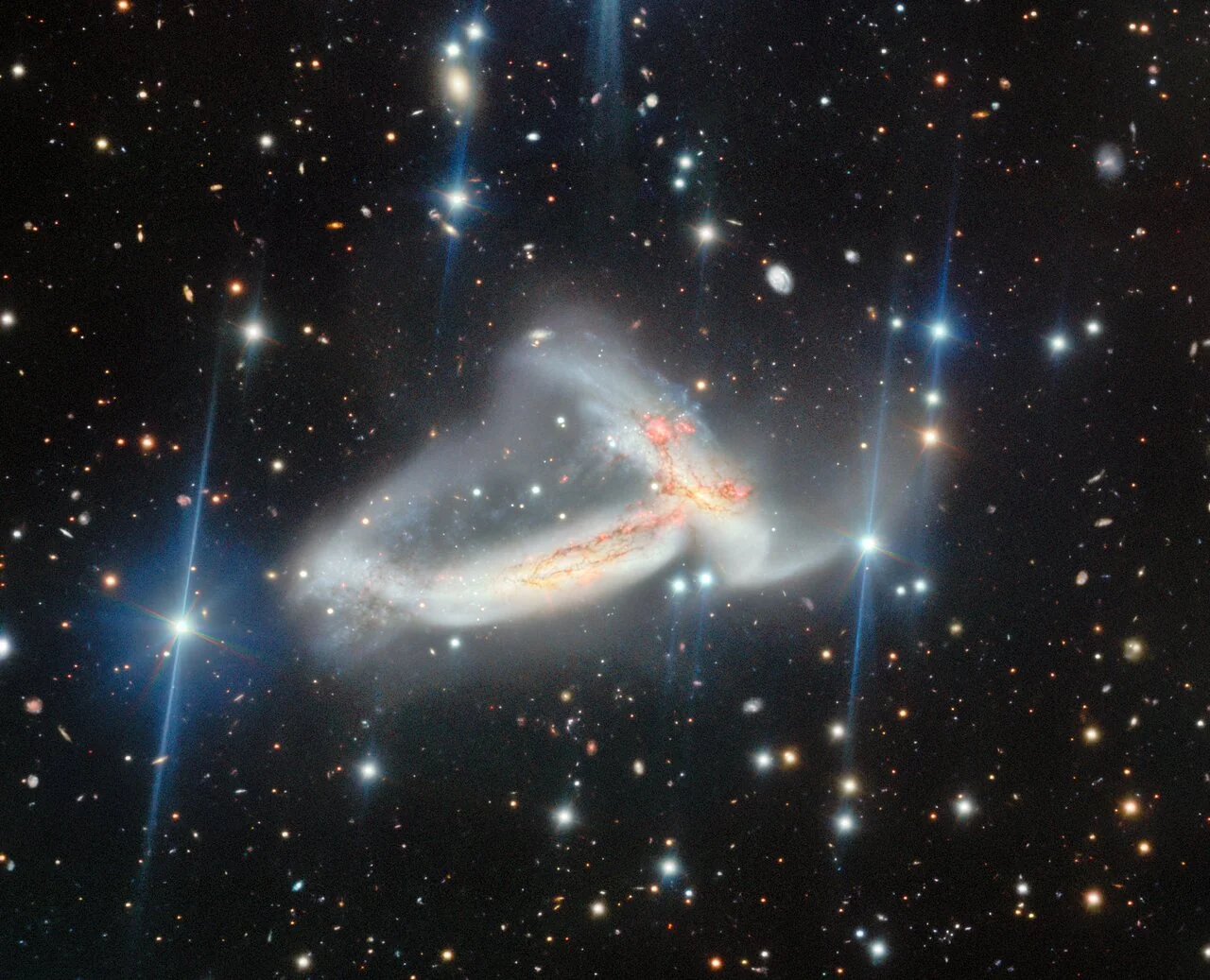
Image: NASA Astronomy Picture of the Day (APOD) | Image credit: International Gemini Observatory / NOIRLab/NSF/AURA; image processing: J. Miller & M. Rodriguez (International Gemini Observatory/NSF NOIRLab), T.A. Rector (University of Alaska Anchorage/NSF NOIRLab), D. de Martin & M. Zamani (NSF NOIRLab) | Today's page
Astronomy usually names celestial objects like this: NGC 7253. Arp 278. A catalog abbreviation followed by a number.
But the pair of galaxies in today's NASA Astronomy Picture of the Day has a real name:
Nā ʻUhane Māhoe Huki Pū i ke Ola
The official English translation is "The Twin Spirits Pulling Together Creating Life."
Six Hawaii high school students gave it that name.
What Is in the Picture
The image was taken with the 8.1-meter Gemini North telescope on Maunakea in Hawaii. Two similarly sized spiral galaxies are caught in each other's gravity, their arms stretched, pulled apart and intertwined. They lie about 200 million light-years away in the direction of Pegasus.
The most striking features are the bright pink knots. They are not decoration. They are the heart of this story, and we will return to how they formed.
Taking the Name Apart
The Hawaiian dictionary gives each word a history:
- Nā: the plural article, "the";
- ʻUhane: soul or spirit, a word also used in dirges;
- Māhoe: twin;
- Huki: to pull or tug, as on a rope;
- Pū: together;
- i ke ola: ola reaches beyond "life" to encompass health, livelihood, survival and healing.
The name contains a threefold play on words, built from Hawaiian's own astronomical vocabulary rather than translated from English.
In the Hawaiian star system, Māhoe already means Gemini. The stars Castor and Pollux are Nāmāhoe, the twins. So a pair of twin galaxies, photographed by a telescope called Gemini, was named with the Hawaiian word for twin. Gemini Observatory itself also comes as a pair: one telescope in Hawaii and one in Chile.
NOIRLab's official explanation divides the name into three parts. Nā ʻUhane Māhoe refers to the two similarly sized galaxies and their faint spiral arms, as well as the paired Gemini telescopes. Huki Pū refers both to the physical pull of gravity and to the collective effort of the people who made the project possible. i ke Ola is the life created by the merger.
Who Named It
The name did not come from a single classroom assignment. Two groups of students carried the work forward in stages.
In October 2025, three students spent a week at Gemini North's Hilo base choosing the target: Raiyan Rahman, Rafan Rahman and Alia Tamanha, from Waiākea High School and the Volcano School of Arts & Sciences.
In June 2026, three more students took on the naming: Mylin Wilson, Manu Silva-Sampaio and Samantha Silva-Sampaio, from Keaʻau High School and Kamehameha Schools.
Why did they choose this pair? Raiyan Rahman gave the best answer in the entire story:
NGC 7253 is fascinating because it shows two galaxies merging into one over billions of years. But we chose it mainly because it was one of the few objects that actually fell within a Hawaiian constellation. After spending so much time on Maunakea, choosing something with both cultural and astronomical meaning mattered to us.
That Hawaiian constellation is Ka Lupe o Kawelo, "the Kite of Kawelo," one of the four principal star lines in traditional Hawaiian navigation.
Samantha Silva-Sampaio said ʻUhane, spirit, was the group's central theme. The week's chanting, the visit to the summit and learning what remarkable discoveries Maunakea had made possible "lit a fire in our own spirits as we prepared for life after high school." Her brother Manu added: "The ʻUhane in this image reminds us that astronomy is not just science, and not just spirituality. It is both."
Project Hōkūlani
The program that put them in the control room is Project Hōkūlani: hōkū means star, and lani means sky.
It is run by the Center on Disability Studies in the University of Hawaiʻi at Mānoa's College of Education, in partnership with the International Gemini Observatory, and funded through a U.S. Department of Education grant for Native Hawaiian education. Its purpose is explicit: to support Native Hawaiian high school students entering science, technology, engineering and mathematics. The year-long program is grounded in culture and authentic work, operates across five islands, serves grades 9 through 12, costs students nothing and includes paid internships. The Gemini partnership offers just six places each year. Those six Hawaii Island high school students complete the entire process - choosing a target, processing its data and naming it - to produce an image the world will actually see.
This is the second image named through the project. The first, released in November 2025, was Ua ʻŌhiʻa Lani, "The ʻŌhiʻa Rains of the Heavens," an emission nebula in Cygnus. Student Iolani Sanches said its pale blue young stars reminded the group of rain: in the story of ʻŌhiʻa and Lehua, picking the lehua flower brings rain.
One qualification matters: the dispute between observatories on Maunakea and the Native Hawaiian community has not been resolved. The future of the Thirty Meter Telescope remains unsettled. A June 2025 National Science Foundation budget proposal withdrew support for it and recommended Chile's Giant Magellan Telescope instead. A congressional appropriations bill in March 2026 required TMT to proceed to a final design review but provided no federal funding. The University of Hawaiʻi's master lease for the summit expires in 2028, after which the new Mauna Kea Stewardship and Oversight Authority will take over; that body will decide whether new construction is permitted. Kealoha Pisciotta, a leading opponent, has said: "The law is still on our side. And it protects everybody, not just Hawaiians."
An unresolved conflict and a federally funded Native Hawaiian education program that brought six students into the control room are both real. Neither cancels the other.
Stars Miss; Clouds Collide
Now return to those bright pink knots.
The most counterintuitive fact about colliding galaxies is that their stars almost never collide. NASA puts it this way: although galaxies plow into one another, the stars within them are so far apart that they do not strike other stars during the encounter.
The scale explains why.
The Sun is about 1.39 million kilometers wide. Proxima Centauri, the nearest star, is 4.25 light-years away, or roughly 40 trillion kilometers. Divide one by the other and the separation is 29 million times the diameter.
Translate that into something tangible: if the Sun shrank to a one-millimeter grain of sand, the next grain would be 29 kilometers away. Two grains of sand inside a circle roughly the size of Beijing's Fifth Ring Road.
At that density, the chance that a star crossing an entire galaxy will strike another star is about one in 20 billion. Multiply that by the Milky Way's more than 100 billion stars and only a handful of stellar collisions should occur through the whole merger.
Clouds are different.
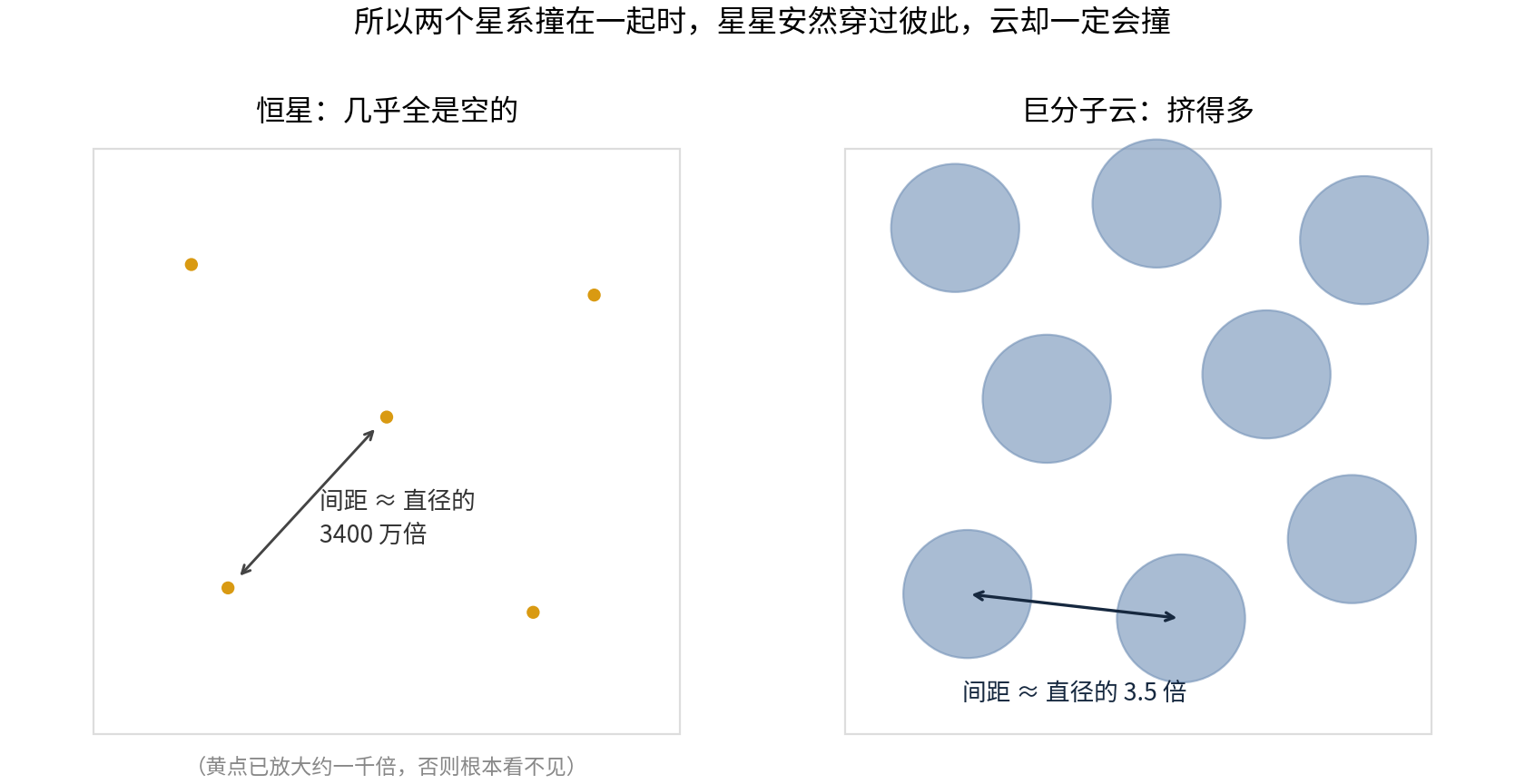
Above: two kinds of resident in the same galaxy, with crowding that differs by a factor of ten million. This is a schematic; the stars have been enlarged about one thousand times or they would be invisible.
Giant molecular clouds in the Milky Way are typically about 50 parsecs, or more than 100 light-years, across. Their average separation is only about three and a half cloud diameters. A cloud crossing a galaxy would hit other clouds more than 40 times.
The two probabilities differ by roughly a trillionfold. When galaxies collide, stars pass harmlessly between one another. Clouds are smashed, compressed and ignited.
That produces the chain of events NOIRLab describes, and the students themselves studied: gas and dust in the spiral arms collide, triggering bursts of star formation; intense radiation from the newborn stars ionizes the surrounding gas; and the ionized hydrogen forms H II regions - the bright pink knots in the image.
A galactic merger does not kill stars. It makes them. That is the source of i ke Ola, life, in the name. The elements forged in those new stellar furnaces are also the raw materials of life. A high school student's metaphor holds up physically.
How Close Are the Two Galaxies?
There is also a useful lesson here in how we know what we know.
NOIRLab's news release says the two galaxies are "about four million light-years apart." But the catalog coordinates of their nuclei place them only about 48 arcseconds apart. At a distance of 200 million light-years, 48 arcseconds corresponds to less than 50,000 light-years - smaller than the disk of the Milky Way.
Four million light-years is farther than the 2.5 million light-years between the Milky Way and Andromeda. Galaxies that distant from each other could not be intertwined as these are. The figure looks more like the difference between their separate redshift distances, 203.7 million and 200.4 million light-years. For a gravitationally bound pair, that difference reflects their orbital velocities, not their true separation in space.
Both sets of numbers are available for anyone to recalculate from the coordinates. Astronomy is often most interesting precisely where you ask how a number was produced.
What About the Milky Way?
The next question is almost inevitable: when will our galaxy collide with Andromeda?
If your answer is "inevitably, in 4.5 billion years," that was the position in 2012. It has since been revised downward.
A June 2025 paper in Nature Astronomy was titled "No certainty of a Milky Way-Andromeda collision." The team incorporated observational uncertainty across 22 variables and ran 100,000 simulations. The result: the probability that the two galaxies will not merge within the next ten billion years is close to 50%; the probability of a head-on collision within four to five billion years is only about 2%.
The reason is concrete. Andromeda's satellite galaxy M33 pulls the Milky Way slightly toward Andromeda, increasing the chance of a collision. The orbit of the Large Magellanic Cloud is perpendicular to the Milky Way-Andromeda orbital plane, pulling the Milky Way out of that plane and reducing the chance.
Lead author Till Sawala offered a line worth remembering: "It's ironic that, despite adding more precise Hubble data from recent years, we are now less certain about the outcome."
NASA's website currently hosts both the 2012 article announcing a destined head-on collision and the 2025 article revising that conclusion.
If a child asks whether science should become more certain as it learns more, this is a fine answer: not always. Sometimes accounting honestly for every uncertainty produces a more open and more truthful result.
The Same Four Stars, Seen by Three Civilizations
The easiest feature to recognize in Pegasus, where these galaxies lie, is the Great Square of Pegasus: four stars of magnitude 2.3 to 2.9 forming an enormous quadrilateral.
The Greeks saw a winged horse.
Hawaiians saw Ka Lupe o Kawelo, Kawelo's kite, a navigational star line spanning an entire quadrant of the sky.
The Chinese saw a palace chamber and a wall. Of the four stars, Alpha and Beta Pegasi form the mansion Shi, also called Yingshi, the celestial royal palace. Gamma Pegasi and Alpha Andromedae form the mansion Bi, the wall of that palace, traditionally glossed as "a wall, a library." Both belong to the Black Tortoise of the North.
The same patch of sky held mythology for the Greeks, a navigational tool for Hawaiians, and an entire bureaucracy and architectural complex for the Chinese. None was offering an "objective description." Each projected what mattered most to its own culture.
In 2026, Hawaiian students did the same thing again - only their subject was a pair of galaxies 200 million light-years away, and their instrument was an 8.1-meter telescope.
Chinese Students Have Done It Too
In 2019, the astronomy club at Guangzhou No. 6 High School named a star and a planet, with official recognition from the International Astronomical Union.
That year, marking the IAU's centenary, the NameExoWorlds campaign drew more than 780,000 participants from 112 countries and regions and received 360,000 proposals. China was assigned HD 173416 and its planet, about 440 light-years away in Lyra. Of 67 proposals nationwide, the Guangzhou students' entry won:
The star became Xihe; the planet, Wangshu.
The IAU website gives this explanation: Xihe is the goddess of the Sun in Chinese mythology and also represents the earliest Chinese astronomers and calendar makers; Wangshu is the goddess who drives the Moon's carriage and represents the Moon in Chinese mythology.
One detail completes the story: Chinese astronomers had discovered the planet around HD 173416. In 2008, Liu Yujuan, Zhao Gang and colleagues at the National Astronomical Observatories of the Chinese Academy of Sciences found it with the 2.16-meter telescope at Xinglong Observatory, working with telescopes in Japan and South Korea and using the radial-velocity method. The discovery was selected as one of China's ten leading astronomical advances that year. Zhao Fei of the discovery team said after the names were announced: "We like these two names very much. They are distinctly Chinese."
The sequel is even better. On October 14, 2021, China's first solar-observation satellite was officially named Xihe. Within two years, the same name traveled from a star named by high school students to a national solar satellite. The satellite's name was also publicly solicited: Wu Yiji, a first-year chemistry student at the University of Science and Technology of China, submitted the winning entry from more than 10,000 proposals, explaining it as "using the name of the mother of the Sun to explore the mysteries of the Sun."
Sources: NASA Astronomy Picture of the Day for September 4, 2026, and the official NASA APOD API; news releases from NSF NOIRLab and the International Gemini Observatory; the official Project Hōkūlani page at the University of Hawaiʻi; the Pukui-Elbert Hawaiian dictionary; Hōkūleʻa navigational star-line materials; NASA and the European Space Agency's Hubble newsroom; Sawala et al., Nature Astronomy (2025); the official IAU100 NameExoWorlds catalog; China News Service; Xinhua; the University of Science and Technology of China; the China National Space Administration; and reporting on the TMT dispute from Hawaiʻi Public Radio and Civil Beat.