
Today's APOD is not a photograph but an animation: a star in Andromeda blinks while the curve of its changing brightness runs below.
Today's NASA Astronomy Picture of the Day is not a still image. It is an animation.
At the center, a marked object brightens and dims. A curve beneath it moves in step: the light falls, stays low for a moment, then climbs again.
APOD's title asks: Is this star winking at us?
Then the official explanation gives us the day's essential sentence: "The central object is not one star, but two."
It is XZ Andromedae, a 10th-magnitude star in Andromeda. You cannot see it with the naked eye or binoculars; finding it takes a telescope and camera. Yet it belongs to one of the most important classes of stars we know.
It Is a Pair, and the Two Are Extremely Close
Begin with the vital statistics, all from the International Variable Star Index, or VSX, the official database maintained by the American Association of Variable Star Observers.
Its variable-star type is EA, an Algol-type eclipsing binary. Its orbital period is 1.357292 days - by our conversion, 32 hours 35 minutes. It normally shines at magnitude 9.91 and falls to 12.45 at minimum. Its spectral type is A1V.
An eclipse depth of 2.54 magnitudes translates into this: at minimum, only 9.6% of its normal light remains. Less than one-tenth.
Combined with a Gaia parallax of 1.9328 milliarcseconds, that puts it about 1,700 light-years away.
"Eclipsing binary" means something straightforward. Two stars orbit each other, and their orbital plane happens to lie almost along our line of sight. On each circuit, one passes in front of the other and blocks part of its light. The "wink" we see is that eclipse.
XZ And's stars are close enough to complete an orbit in 32 hours 35 minutes. The Moon takes more than 27 days to orbit Earth; Mercury takes 88 days to circle the Sun. These two stars complete a circuit in less time than passes between the start of work on Monday and the end of work on Tuesday.
What "Algol-Type" Means: Look for Flat Ground
"Algol-type" describes neither period nor size. It describes the shape of the light curve, as the official VSX definitions make clear.
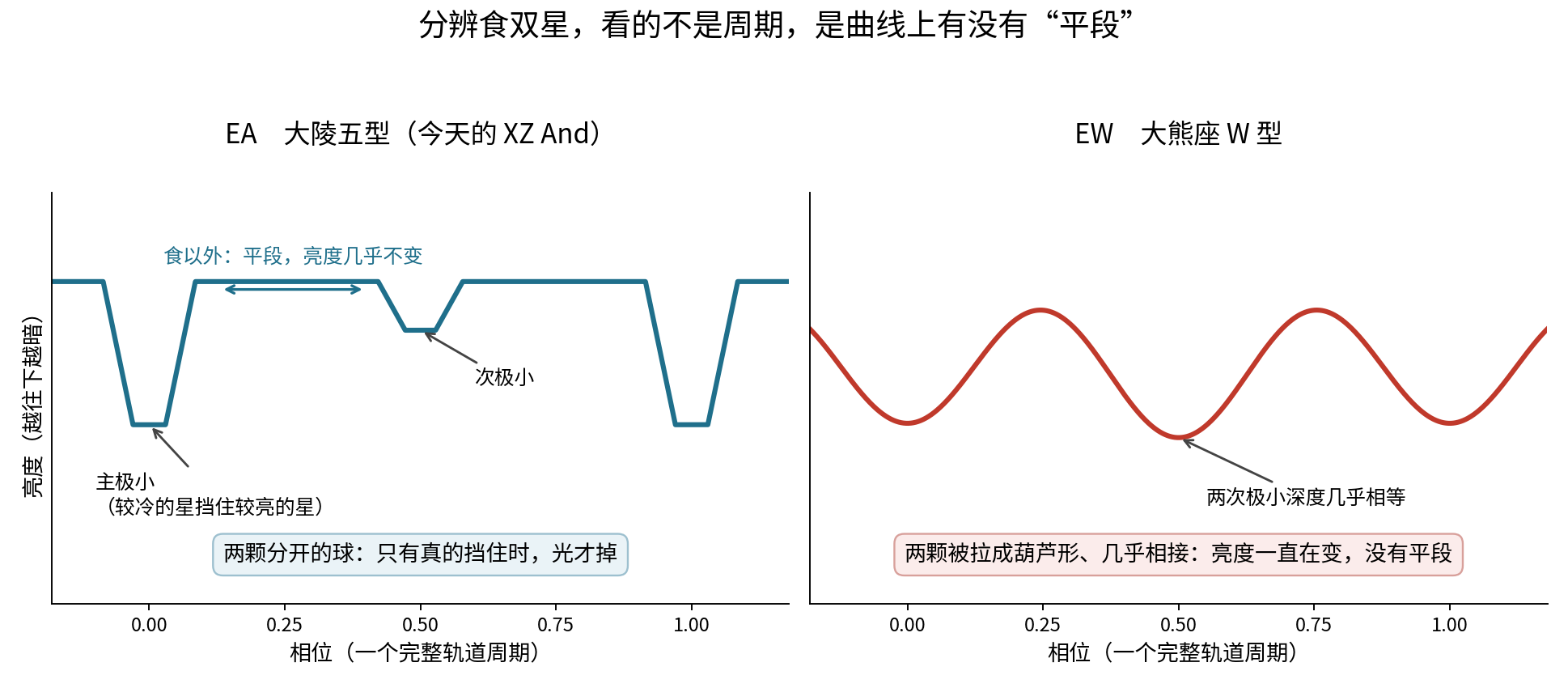
- EA (Algol type): The two stars are separate spheres, and "it is possible to specify the moments of the beginning and end of the eclipses." Between eclipses, brightness is almost constant.
- EW (W Ursae Majoris type): The two stars are nearly in contact and pulled by each other's gravity into elongated shapes. Because their combined brightness changes continuously, it is impossible to specify the exact onset and end of eclipses.
In plain language:
An Algol-type light curve looks like two potholes appearing in a flat road. A W Ursae Majoris curve looks like water that never stops heaving.
Potholes tell you that two separate spheres are blocking one another. Vacuum lies between them, so the light drops only during an actual eclipse. A wave tells you the stars have been pulled into gourd-like shapes whose visible area changes continuously as they turn. No one instant can be called the beginning of the eclipse.
The Algol Paradox: The Well-Fed Twin Is Young, the Hungry One Has Gone Gray
Now for the most elegant thing about this system.
Stars obey a hard rule: the more massive a star, the faster it burns and the sooner it dies. A massive star is a thick candle burning fiercely; a light star is a thin one conserving its fuel.
Yet Algol-type binaries appear to do the impossible. A 2018 paper in Monthly Notices of the Royal Astronomical Society by Dervişoğlu and colleagues (DOI 10.1093/mnras/sty2684) states the contradiction cleanly: their two components appear to be in contradictory evolutionary states. The less massive star is a giant or subgiant, while the more massive star remains on the main sequence.
It is as if, of two twins, the one who ate more were still a child while the one who ate less had gone gray.
The contradiction has a name: the Algol paradox. The same paper gives the answer.
The stars exchanged identities.
The star that is now light and old was originally the heavier one. It exhausted its fuel first and expanded first. But the stars are so close that when one grows beyond a critical boundary called its Roche lobe, its material no longer belongs entirely to it. Matter slides down the gravitational slope between the pair and onto the companion.
The star aged while giving its own mass to its neighbor. By the time we arrived to look, it was old and thin. The recipient had grown heavier, brighter and apparently younger.
No rule was broken. We simply arrived late, after the exchange.
(The University of Nebraska observatory's teaching page puts it even more directly: "The most massive star became the least massive, and the least massive became the most massive.")
XZ And Is Doing It Now
At this point, the usual explanation would turn to Algol itself. Today it does not need to. Our subject is a living example of the rule.
Two published models disagree in detail, so both belong here, as is often the case in astronomy.
- Ciocca 2022 (Journal of the AAVSO): The primary is an A1V main-sequence star with 2.1 solar masses, 2.2 solar radii and a temperature of 9,393 K. The companion has 1.02 solar masses but a radius of 2.40 Suns and a temperature of 5,334 K. The paper calls it a star at a more advanced evolutionary stage. The system is semidetached, with the companion filling its Roche lobe.
- A second set of values cited by Jetsu 2020: The A4 IV-V primary has 3.2 solar masses and 2.4 solar radii; the G IV companion has 1.3 solar masses and 2.6 solar radii.
The numbers differ substantially, but both solutions agree on the point that matters: the less massive star is larger and has evolved into a subgiant, while the more massive one remains on the main sequence.
How do we know mass is being transferred now?
From a ledger kept for 127 years.
A 2019 paper in Research in Astronomy and Astrophysics by Yuan and Qian (DOI 10.1088/1674-4527/19/9/128) assembled 1,131 mid-eclipse times spanning 127 years. Its conclusion is blunt:
"The secondary is transferring material to the primary. Therefore, the observed period increases."
That is the meaning of this article's title. The star's wink is not a clock that keeps perfect time. Across 127 years and more than 1,100 eclipses, observers found that it is slowing down - because one star is pouring itself into the other.
One Curve Can Weigh a Star
This is the heart of today's story.
APOD notes that the light curve was made using software for differential photometry. The term sounds dry. The technique behind it is one of astronomy's most powerful tools.
Earth's atmosphere makes stars flicker, as though someone were waving an invisible fan between you and the sky. You cannot immediately tell whether the star truly dimmed or the fan simply passed across it.
The solution is to place a star you trust not to vary beside it in the same image. When a cloud passes, both stars dim. When the air trembles, both tremble. Instead of asking, "How bright is it?" you ask, "How much brighter is it than that star beside it?"
The AAVSO's official explanation says that when a variable and comparison star lie close together in the sky, their air masses are effectively the same. The result is that the extinction term cancels out.
Imagine two people beneath one umbrella. The rain that reaches one reaches the other. Ask how wet you are, and the answer depends on the weather. Ask how much wetter you are than your companion, and the umbrella effectively disappears.
What does the curve buy you?
The eclipse duration tells you how large the stars are, because it records how long a stellar disk takes to cross the obscured region. The eclipse depth tells you how much luminous area was covered. Add a spectroscopic Doppler-velocity curve: the back-and-forth shift of spectral lines tells you how fast each star circles the common center of mass, and the ratio of those speeds is the inverse ratio of their masses.
Combine the two and you have weighed a star without ever approaching it.
How difficult is that? One number gives the scale. A standard 2010 review in Astronomy and Astrophysics Review by Torres, Andersen and Giménez (DOI 10.1007/s00159-009-0025-1) compiled the most reliable stellar mass and radius measurements available. Its abstract identified 95 detached binary systems containing 190 stars - 94 eclipsing systems plus Alpha Centauri - in which both mass and radius for each star were measured to within +/-3%.
Read that again.
The universe contains uncountable stars. Yet in that authoritative review, humanity had measured both mass and radius to 3% for only 190. Of those, 188 came from 94 eclipsing binaries. The remaining two were Alpha Centauri, close enough for direct measurement.
In other words, nearly every star humanity had genuinely weighed was measured during the few hours when one star blocked another.
The Same Idea Finds Planets and Measures the Universe
The same idea transfers directly.
Something passes in front of a star, and its brightness falls a little. The only difference is whether the object blocking the light is another star or a planet.
That was the guess of an 18-year-old British observer in 1783. He proposed that Algol dimmed because a dark body crossed in front, perhaps even a planet. More than two centuries later, humanity began finding planets by exactly this method.
NASA/JPL's Kepler press kit gives the official scale: an Earth-sized planet crossing a Sun-like star changes its brightness by only 84 parts per million, or 0.0084% - "less than one one-hundredth of one percent."
Imagine extinguishing less than one candle among 10,000 lit candles, then detecting the difference from dozens of light-years away.
(A Jupiter-sized transit reduces the light by about 1%. We calculated that value from the radius ratio; it does not appear in the NASA press kit. As a check, the same formula yields 0.0084% for Earth, exactly matching NASA's 84 ppm, so the calculation is sound. Jupiter's signal is 120 times Earth's.)
As of today, the NASA Exoplanet Archive's live count, checked September 9, 2026, stands at 6,360 confirmed exoplanets, including 2,787 confirmed by Kepler and 934 by TESS.
The same curve also does something larger: it measures the size of the universe.
A 2019 Nature paper by Pietrzyński and colleagues (DOI 10.1038/s41586-019-0999-4) was titled A distance to the Large Magellanic Cloud that is precise to one per cent. It used 20 late-type eclipsing-binary systems. Its abstract opens with the motive: in the era of precision cosmology, an empirical determination of the Hubble constant to 1% or better is vital. The result was 49.59 kiloparsecs with 1% precision, about 162,000 light-years.
Why does that matter? The Large Magellanic Cloud is an anchor for calibrating the Cepheid period-luminosity relation. Cepheids calibrate Type Ia supernovae, and those supernovae give the Hubble constant, the expansion rate of the universe.
The first section of that measuring stick is one star passing in front of another.
"Possibly Two More Stars": A Better Lesson in Science
APOD's explanation contains another line: analysis of many light curves for XZ And suggests that two more stars may orbit the system.
Tracing that statement to its source led to the most useful lesson in today's story.
The source is the Yuan and Qian 2019 paper above, written by authors at the Department of Physics, Shanxi Normal University, and Yunnan Observatories, Chinese Academy of Sciences. They used the light-time orbit effect to fit the residuals from those 1,131 eclipse timings and found two periods, 33.43 and 100.3 years, in an exact 1:3 ratio.
Then, in the same paper, the authors themselves wrote down the objection to their own result:
"The strong gravitational perturbations between the two companions invalidate the double-Keplerian model. Curiously, two Keplerian periods in a 1:3 ratio were the best-fit result obtained with this inappropriate model."
They called their result an "illogical but interesting phenomenon."
Another researcher, Jetsu, applied his own method to the same data in 2020 and read out a completely different answer: at least ten wide-orbit stars, with periods from 1.6 to 91.7 years.
One analysis says two; the other says ten. Both read the same ledger.
This is not a discovery. It is one dataset yielding two mutually contradictory answers.
That is more valuable than a simple claim of two new companions because it shows what science looks like in practice. Data do not turn into conclusions by themselves. Responsible researchers write "our model fails here" into their own paper. Until a claim is independently reproduced, it remains a claim.
The two Chinese authors hung a sign reading "this road may be closed" on their own result. It is the finest sentence in the paper.
Two Civilizations Wrote Death into the Same Sky
The Algol class takes its name from Algol, the bright star in Perseus. It is the prototype and one of the most storied stars in astronomy.
Its Arabic name, al-Ghūl, means "the demon" and shares its origin with the English word ghoul. In Greek myth, it occupies the head of Medusa carried by Perseus.
In China, the star is Daling Wu, the fifth star of the Great Mausoleum. The astronomical treatise in the Book of Jin records the asterism:
"The eight stars of the Great Mausoleum lie north of Wei. It is also called the Accumulated Capital and governs great mourning. ... Within the Great Mausoleum is a star called the Heap of Corpses; when it shines, the dead are piled like a mountain."
The Great Mausoleum was a vast burial mound. It governed great funerals, and one of its stars was literally named the Heap of Corpses.
Two civilizations that never exchanged star charts both wrote death and graves into the same region of sky.
The boundaries matter because this is easy to overstate.
- We can say that both civilizations gave this region of sky names associated with death. Each has a primary source: the Arabic name in astronomer Jim Kaler's star catalog, the Chinese name in the Hong Kong Space Museum's official bilingual star table, and the ancient passage in the Book of Jin.
- We cannot say the ancients chose those names because the star dims. No source establishes that cause.
- We cannot say the Heap of Corpses is Algol. We did not verify that identification.
- We cannot say ancient China recorded Algol's variability. We specifically checked a Chinese account of variable-star history from Xingming Observatory and the Chinese Virtual Observatory. Its chronology begins with the Italian astronomer Montanari in 1669 and never mentions an ancient Chinese observation of Algol changing brightness. This is not a scholarly dispute; we could not find the claim at all in that authoritative Chinese account.
An 18-Year-Old Deaf Observer Measured the Dance of Two Stars by Eye
Now for that 18-year-old.
John Goodricke was born in Groningen, the Netherlands, on September 17, 1764. A childhood illness left him deaf; some accounts identify it as scarlet fever.
In November 1782, he began watching Algol. The following year he published its period and proposed an explanation: a darker companion body periodically crossed in front of it.
He measured the period as "a little less than 2 days 21 hours," or 2.8750 days. The official VSX value today is 2.867343 days.
By our calculation, he missed by 11 minutes, a relative error of 0.27%.
An 18-year-old deaf observer, in an age when even telescopes were luxuries, used only his eyes, paper and pen to measure the orbital period of two stars. He came within 11 minutes of today's space-age measurement. And he identified the cause.
That same year he received the Royal Society's Copley Medal. The society's own website notes that the medal predates the first Nobel Prize by 170 years.
He died on April 20, 1786, at 21.
(His birth, death and award are supported independently by Encyclopaedia Britannica and the Linda Hall Library. His original 1783 paper appeared in Philosophical Transactions of the Royal Society, DOI 10.1098/rstl.1783.0027. We could not retrieve that page, so no wording from it is quoted here.)
One distinction: Goodricke did not discover the variability. VSX lists Geminiano Montanari in 1669 as the discoverer, 114 years earlier. Goodricke measured the period and correctly explained it.
China's Two Halves
Weighing a star, as we have seen, takes two things: a light curve and a spectroscopic velocity curve.
China is now working on both, one half at a time.
The light-curve half is the Wide Field Survey Telescope, or WFST, jointly built by the University of Science and Technology of China and the Purple Mountain Observatory. It stands at an elevation of 4,200 meters on Saishiteng Mountain near Lenghu, Qinghai. Its primary mirror is 2.5 meters across; its camera has 765 million pixels; its effective field of view is 6.5 square degrees; and it has 270 observable nights each year. An official USTC release says it can survey the entire northern sky once every three nights, making it the most capable optical time-domain survey facility in the Northern Hemisphere.
Three coincidences bring it directly into today's story.
First, its first-light image, released in 2023, was the Andromeda Galaxy, in the same constellation as today's APOD.
Second, it is a time-domain telescope: its purpose is to photograph the same sky repeatedly and find what changes. That is the industrial-scale version of making light curves.
Third, XZ And's period is 1.357 days. By the time WFST finishes one sweep of the northern sky, the star has winked twice.
Goodricke watched one star with his eyes for months. WFST watches the entire northern sky every three nights. The same act, 240 years apart.
The spectroscopic half is the Large Sky Area Multi-Object Fiber Spectroscopic Telescope, or LAMOST, also called the Guo Shoujing Telescope. According to an April 2026 release on its website, a team led by Professor Li Kai of Shandong University examined medium-resolution spectra of about 450,000 objects and found more than 20,000 previously unrecorded spectroscopic multiple-star systems, including 15,887 binary candidates and 8,771 triple-system candidates.
In August 2025, Yunnan Observatories - one of the institutions behind today's "two more stars" paper - pushed the light-curve side one step further. A team led by Dr. Ding Xu and researcher Ji Kaifan used neural networks and Markov chain Monte Carlo methods on TESS light curves. Their conclusion was that for totally eclipsing contact binaries, reliable mass-ratio parameters can be obtained from the light curve alone, even without spectroscopic radial-velocity data.
Chinese astronomers have moved the boundary of what one light curve can do by another step.
Sources: the AAVSO International Variable Star Index (VSX) and official variable-star type definitions; the AAVSO's differential-photometry principles and eclipsing-binary project; Torres, Andersen and Giménez, Astronomy and Astrophysics Review (2010); Dervişoğlu et al., Monthly Notices of the Royal Astronomical Society (2018); Ciocca, Journal of the AAVSO (2022); Yuan and Qian, Research in Astronomy and Astrophysics (2019); Jetsu (2020); Pietrzyński et al., Nature (2019); the NASA/JPL Kepler press kit; the NASA Exoplanet Archive (checked September 9, 2026); NASA's Hubble Messier catalog entry for M31; Gaia DR3 via VizieR; Encyclopaedia Britannica and the Linda Hall Library on John Goodricke; the Royal Society's Copley Medal page; the Book of Jin, "Treatise on Astronomy"; the Hong Kong Space Museum bilingual bright-star table; the Chinese Virtual Observatory's history of variable stars; the University of Science and Technology of China and the Chinese Academy of Sciences on WFST; the LAMOST website; Yunnan Observatories, Chinese Academy of Sciences; the Royal Observatory Greenwich September stargazing guide; Sky & Telescope predictions for Algol minima; the Citizen Astronomy repository readme; and the Starfront Observatories website.