
Seeing a giraffe in the stars is a story about the universe, but even more about your brain.
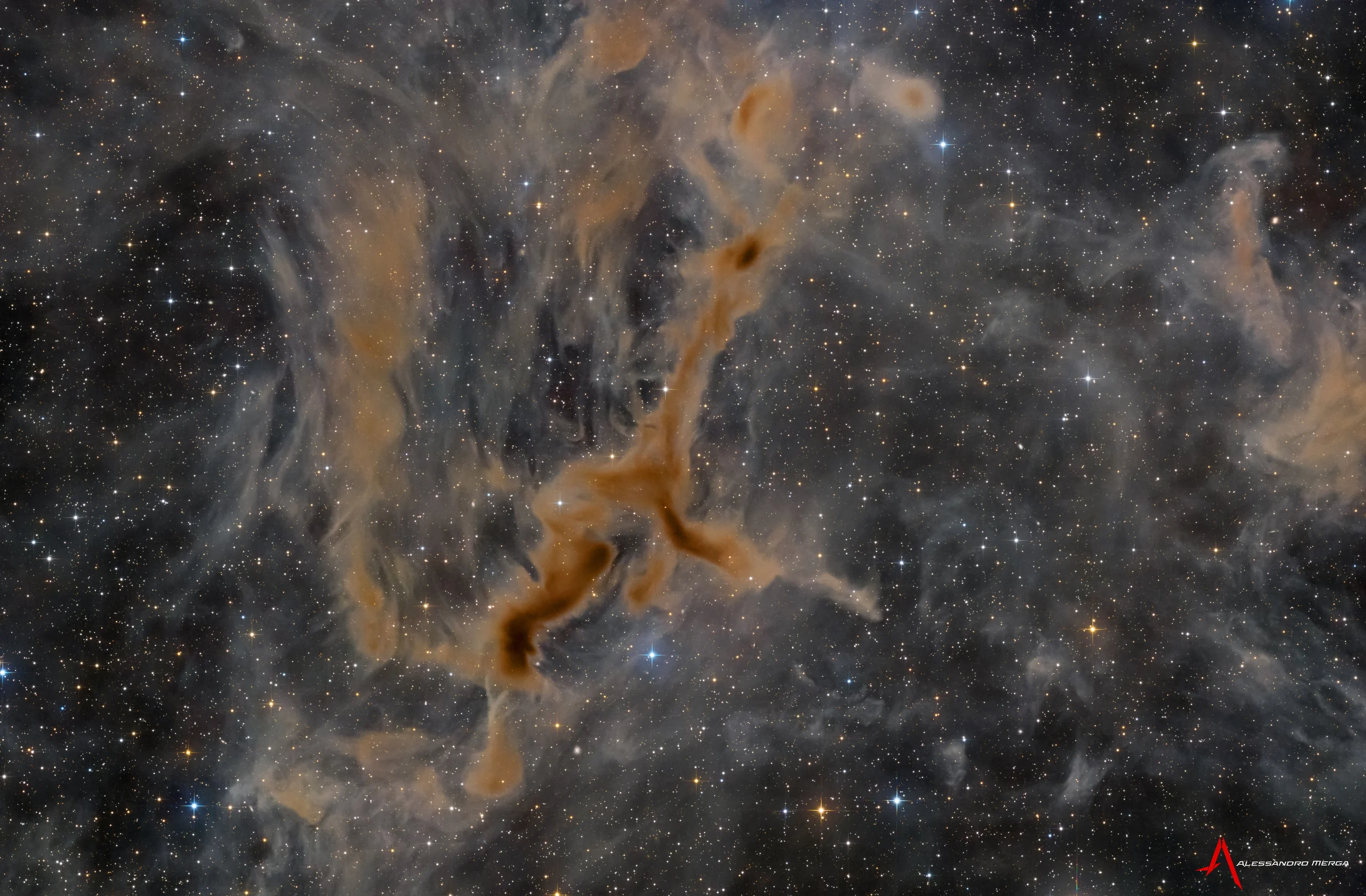
Image: NASA Astronomy Picture of the Day (APOD) | Image credit and copyright: Alessandro Merga | Text: Cecilia Chirenti (NASA GSFC, UMCP, CRESST II) | Daily page (NASA is moving APOD to science.nasa.gov. If the old address fails, adding a question-mark parameter will usually make it load.)
Before reading on, look at the image above and tell yourself what you see.
Most people see a giraffe: one facing right, its neck held high and a long leg caught in mid-stride. That is how NASA describes it today.
The giraffe's formal name is LDN 1295, in the direction of Cassiopeia. It is not a glowing object. Quite the opposite: it is a patch of darkness. Astronomers call such objects dark nebulae. Dust and gas block the light of the stars behind them, carving what looks like a void from a sky crowded with stars.
Three things about this darkness are worth telling today. One concerns your brain, another a man who refused to trust his own eyes more than a century ago, and the third the woman whose name gave this patch of darkness its LDN designation.
1. For One-Sixth of a Second, Your Brain Really Thought It Was a Face
Seeing a face in a water stain, an expression in an electrical outlet or a dog in a cloud has a name: pareidolia. The word comes from the Greek para, meaning beside, and eidolon, meaning image. NASA defines it plainly as the tendency to see recognizable shapes in clouds, rock formations or otherwise unrelated objects and data.
The phenomenon is more than simply "seeing something wrong." In 2020, researchers published a study in Nature Communications (Wardle et al., DOI 10.1038/s41467-020-18325-8) that used functional magnetic resonance imaging and magnetoencephalography together to watch what happened in the brain when a person saw a "face" in an object.
The brain has several small regions dedicated to recognizing faces. The best known is the fusiform face area. The researchers found that when someone saw an illusory face, during roughly the first 160 milliseconds, those regions responded more as they would to a real face than to an ordinary object. Only after about 250 milliseconds did the brain reclassify it: oh, that is an object.
In plain language: when you see a face on a wall, your brain really does believe it is a face for about one-sixth of a second. You know better afterward because the brain has corrected itself, not because it was never fooled.
How early does this instinct appear? Astonishingly early.
In 1991, Johnson and colleagues published a replication and extension of a classic experiment in Cognition. Their subjects were newborns an average of just 37 minutes old. The babies watched three slowly moving displays: a face with its features in place, a face with the features scrambled, and a blank panel. They turned their heads 40.6 degrees to follow the face, 30.9 degrees for the scrambled features and 16.1 degrees for the blank panel.
Half an hour after birth, before the eyes can see clearly, a human will already turn to follow a "face." Face recognition is not something we learn; it arrives with us. (The paper has an intriguing postscript: this preference declines during the second month of life as more mature brain mechanisms take over.)
Monkeys do it too. A 2017 paper in Current Biology (Taubert et al., DOI 10.1016/j.cub.2017.06.075) used infrared eye tracking on five rhesus monkeys across 1,980 trials. The monkeys looked significantly longer at face-like objects, and their gaze landed on the illusory "eyes" and "mouth." Science did not end there: a 2024 follow-up found that the monkeys were behaviorally fooled, but individual "face neurons" responded much less strongly than expected. Scientists are still arguing about it. That is a virtue in itself: children can see that science is not an answer book whose final page has already been written.
Why Evolution Kept a Brain So Easy to Fool
Because the cost of a false alarm is far lower than the cost of a miss.
The Taubert paper gives a clean explanation. A broadly tuned template creates an extremely sensitive face-detection system at the cost of more frequent false positives, and that cost is relatively small.
The version for children is shorter:
Mistake a rock for a tiger and you get a fright. Mistake a tiger for a rock and you do not get another chance.
Evolution therefore left us inclined to see a few faces that are not there. When you see a giraffe in today's nebula, you are using the same circuitry.
2. The Face on Mars
That brings us to astronomy's most famous case of pareidolia.
On July 25, 1976, the Viking 1 orbiter was scouting landing sites for Viking 2 when it photographed a region of Mars at northern latitude called Cydonia. At the center of the developed image, a rock formation about 1.5 kilometers wide looked like a human face, complete with eyes, nose and mouth.
For the next two decades, the face inspired countless stories about an alien civilization.
But almost everyone misremembers one detail: NASA's original 1976 caption said on the very day of release that the illusion was caused by shadows. Its wording was explicit: the huge rock formation resembling a human head was formed by shadows giving the illusion of eyes, nose and mouth.
This was never a case of NASA concealing something and later being exposed. The explanation was there from the first day, and people still wanted to believe.
On April 5, 1998, Mars Global Surveyor photographed the formation again at ten times the resolution. The face disappeared. It was simply a small mountain of slopes and ridges that, from far away and in particular light, could sometimes look like a face.
3. In the Same Sky, China Saw a Charioteer
Now turn back to Cassiopeia, where today's image lies.
Cassiopeia is easiest to recognize by five bright stars arranged like a capital W. The Greeks saw in that W a queen seated on a chair and punished for boasting by being hung upside down in the sky.
China saw something entirely different.
In the Hong Kong Space Museum's official bilingual star table, the asterisms in this region include Wangliang, Ce, Gedao and Fulu. Wang Liang was a legendary charioteer of the Spring and Autumn period; Beta Cassiopeiae is Wangliang I. Nearby Gamma Cassiopeiae belongs to Tiansi, one of the four horses drawing Wang Liang's chariot, while Ce literally means the whip.
One sky, then: the Greeks saw a queen, the Chinese saw a man driving four horses through the night with a raised whip, and today's astrophotographer saw a giraffe.
Three cultures, the same darkness and three entirely different things. That is pareidolia itself.
One recent detail belongs in the record: on November 13, 2025, the International Astronomical Union's Working Group on Star Names formally approved Tiansi as the official name of Gamma Cassiopeiae Aa. A name from ancient China's sky entered the table shared by the whole world.
The Chinese sky as a whole was notably practical. One page from the Hong Kong Space Museum puts it beautifully: among the 306 traditional Chinese asterisms, emperors and generals, everyday objects and all the life of society were arrayed across the heavens. Its official table really does include Tusi, a butcher's shop; Liesi, a jewelry market; Tiancang, a granary; and a pestle and mortar. The Greeks looked up and saw mythology. The Chinese looked up and saw a city.
(There is another delightful coincidence. The constellation beside Cassiopeia is Camelopardalis, from Greek words describing something with a camel-like neck and leopard-like spots: a giraffe. Today's Giraffe Nebula happens to live next door to the actual "giraffe constellation." It is only a coincidence, of course; the constellation boundaries were not fixed until 1922.)
4. More Than a Century Ago, One Man Refused to Trust the Darkness He Saw
In 1919, American astronomer E. E. Barnard published a catalog of 182 "dark markings of the sky" in The Astrophysical Journal.
The paper contains a passage that remains moving today. In essence, he wrote:
At first I did not believe in these dark obscuring masses. The evidence was not conclusive. But the accumulating evidence from my own photographs, and especially my visual observations of some of them, eventually convinced me that many of these markings were not simply places where stars were absent, but real obscuring bodies lying closer to us than the distant stars.
What gives the passage its weight?
Barnard's first judgment was exactly the opposite of pareidolia. Other people might see darkness and imagine all kinds of things. He saw it and thought, "There is nothing there. It is only a hole." The idea was simple and reasonable. It was also wrong.
His own photographs, one after another, changed his mind. And even after they did, he added a careful qualification in the same paper: one could not assume every dark place in a photograph of the sky was obscuring matter; some were undoubtedly genuine vacancies.
"At first I did not believe." Science at its best may look something like that.
5. The L
Now return to the name of today's object: LDN 1295.
LDN means Lynds' Dark Nebula. The L belongs to Beverly Turner Lynds.
She was born in Louisiana on August 19, 1929, and died in Oregon on October 5, 2024, at age 95.
Her story begins with an admission that was withdrawn.
She had been offered a place at the University of Chicago. Then the university discovered she was a woman and rescinded the offer. They had to "discover" it because Beverly sounded like a man's name at the time, and nothing on paper had revealed her sex. Instead, she went to work at Lick Observatory, built up her credentials and earned her doctorate at the University of California, Berkeley, in 1955. She was 26. Her adviser was Otto Struve.
Then came the 1962 catalog.
The way she made it is difficult to imagine today. Read this slowly; the American Astronomical Society and Sky & Telescope obituaries use identical wording:
She spent countless hours tracing onto paper, one by one, the outlines of every dark nebula she could see on the Palomar survey plates. She recorded their coordinates, measured their areas with a calibrated planimeter, and estimated their darkness on a scale from 1 to 6.
Tracing paper. A planimeter. Her eyes.
The plates came from the National Geographic Society-Palomar Observatory Sky Survey: 879 fields photographed in red and blue with the 48-inch Schmidt telescope. Her task was to find every dark patch across those hundreds of glass photographs, trace it, measure its area and assign it a grade.
Grade 1: a cloud only barely visible on both the red and blue plates, with just a slight reduction in background brightness.
Grade 6: the darkest class, where only about 120 background stars per square degree remained visible.
Her final count was 1,802.
Forty-three years earlier, Barnard had cataloged 182 objects from his own photographs. Using a systematic all-sky survey, Lynds increased that count by nearly tenfold and, for the first time, assigned darkness a scale.
In 1962, a woman sat at a table with tracing paper, outlined 1,802 dark patches in the universe one by one, and gave each a grade. The image NASA features today is called LDN 1295. The L is hers.
She later spent 15 years at Kitt Peak National Observatory, where she also held administrative posts. In retirement she devoted much of her time to science education. Her obituary mentions another choice quietly, but it carries weight: when she served as a traveling lecturer for the American Astronomical Society, she specified that she wanted to visit minority-serving colleges.
A person once barred from a door because of her sex spent her later life knocking on other people's doors.
6. How Dark Is This Darkness?
One last figure can stop you short.
Why are dark nebulae dark? It is easy to assume they are packed so densely with material that nothing can get through.
The opposite is true.
According to an Ohio State University astronomy course, interstellar dust has a number density of roughly one grain per million cubic meters. The course offers an excellent analogy: that density is like a few dust grains floating inside the entire Ohio Stadium.
A stadium built for 100,000 people, with a few flecks of dust inside.
That is how sparse it is, and it blocks an entire patch of sky.
The darkness comes not from density but from depth. The distances between those grains are measured in light-years, but light must cross the cloud for tens of years. Over that entire journey, it encounters enough dust to be stopped.
(Two other figures help establish the scale. The air we breathe contains about 10^19 molecules per cubic centimeter. The sparsest interstellar space holds only about 0.1 atom per cubic centimeter. Each grain blocking the starlight is less than 500 nanometers across, more than a hundred times thinner than a human hair.)
7. China Is Now "Listening" to These Dark Clouds
Lynds found dark patches by eye on photographic plates. Today there is another method: instead of watching what a cloud blocks, listen to what the cloud itself is saying.
Since 2011, the Purple Mountain Observatory of the Chinese Academy of Sciences has used its 13.7-meter millimeter-wave radio telescope in Delingha, Qinghai, for a survey called the Milky Way Imaging Scroll Painting, or MWISP. It detects spectral lines emitted by carbon monoxide molecules inside molecular clouds. On December 11, 2025, the first data release became public: three spectral lines across 2,310 square degrees, covering Galactic longitudes from 10 to 230 degrees and latitudes of plus or minus 5.25 degrees, for a total of more than 100 million spectra. Officials called it the most complete existing millimeter-wave CO molecular-line database.
From tracing paper in 1962 to 100 million spectra in 2025. The same clouds have changed from invisible darkness into voices that can be measured.
Sources: NASA Astronomy Picture of the Day for September 10, 2026; Wardle et al., Nature Communications (2020), DOI 10.1038/s41467-020-18325-8; Johnson et al., Cognition 40 (1991); Taubert et al., Current Biology 27 (2017), DOI 10.1016/j.cub.2017.06.075; E. E. Barnard, The Astrophysical Journal 49 (1919); B. T. Lynds, ApJS 7, 1 (1962); the American Astronomical Society (BAAS) obituary for Beverly Lynds; the Sky & Telescope obituary; NASA Science's "Face on Mars" and the original Viking 1 caption; the Hong Kong Space Museum's English-Chinese Glossary of Chinese Star Regions, Asterisms and Star Names and Chinese Star Myths; the Purple Mountain Observatory's announcement of the MWISP survey data release; the U.S. Naval Observatory's Moon phase tables; an Ohio State University astronomy course; and Johns Hopkins University's Hub magazine.