
A light mistaken for dawn for more than a thousand years, and the question behind it that remains unsettled
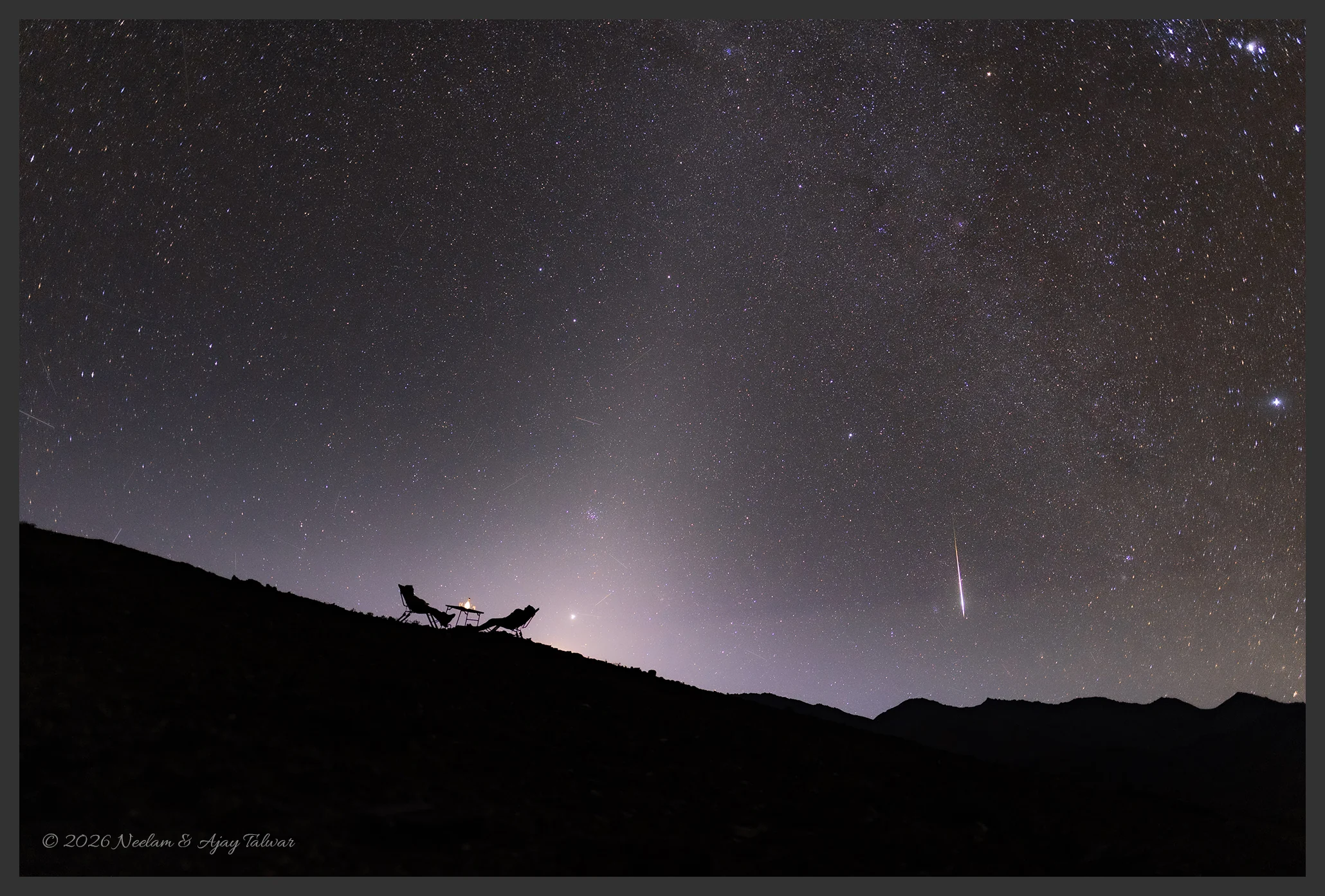
Image: NASA Astronomy Picture of the Day (APOD) | Image credit and copyright: Neelam and Ajay Talwar (TWAN) | Today's page
Start at the lower right of the photograph.
A beam rises diagonally from the horizon, fading as it climbs, as though someone had thrown a splash of very thin milk across the sky. It is not city light: there are no cities for dozens of kilometers around the place where this photograph was made. Nor is it the coming sunrise. Astronomical twilight had not yet begun.
It is zodiacal light.
And for more than a thousand years before it had a scientific name, people called it something else: the false dawn.
What Is in the Photograph
The setting is the Hanle Dark Sky Reserve in Ladakh, India, at an elevation of about 4,500 meters. The photograph was taken during a September 2026 stargazing festival. The fourth Hanle Star Party ran from September 7 to 12, and the image filename is dated September 9.
Follow the beam upward. Several meteors cross the frame. The bright point nearest the eastern horizon, embedded in the glow, is Jupiter. This September it lies in Cancer at about magnitude -1.8, rising between three and four in the morning and outshining everything in the predawn sky except the Moon. Higher up, near the center of the frame, is a fuzzy patch with no clear boundary. That is the Beehive Cluster, M44, about 610 light-years away and visible to the naked eye under dark skies. The yellowish point beside it is Mars, at roughly magnitude 1.1, much dimmer than it appears at opposition.
Their alignment is not a coincidence. All of them crowd close to the ecliptic, the plane of the solar system's great disk. The beam lies in that same disk.
What It Actually Is
Dust.
A layer of dust drifts through the solar system, concentrated near the ecliptic plane like a flattened pancake. Its grains range from nanometers to millimeters across; near Earth's orbit, grains tens of micrometers wide are common, roughly the thickness of a human hair. The entire cloud has a mass of about 3.5 x 10^16 kilograms. That sounds formidable, but spread across the solar system it is equivalent to grinding up an asteroid with a radius of 15 kilometers and scattering it through a volume billions of kilometers wide.
Sunlight strikes this dust and scatters. Some of it reaches us. That is zodiacal light.
How bright is it? At a wavelength of 550 nanometers and an angular distance of about 30 degrees from the Sun, zodiacal light is brighter than the brightest part of the Milky Way. You have probably never noticed it, not because it is faint, but because it is broad, diffuse and edgeless. The human eye is remarkably insensitive to a large field of even, weak light, and the slightest light pollution erases it entirely.
One detail in today's official description deserves qualification. It says that the dust "back scatters" sunlight to produce the zodiacal light. At about 30 degrees from the Sun, where zodiacal light is brightest, the geometry is dominated by forward scattering: light skims past the dust and bends slightly toward our eyes. The true backscattering enhancement occurs in the direction opposite the Sun, at angular distances of about 165 to 180 degrees. That phenomenon has its own name, the gegenschein: a diffuse patch just brighter than its surroundings and even harder to see than zodiacal light. Zodiacal light, the zodiacal band and the gegenschein are three faces of the same dust seen from three different angles.
What This Article Is Really About
Now for the important part.
These grains do not orbit the Sun undisturbed. When sunlight strikes one, it applies an extraordinarily weak but constant backward drag called the Poynting-Robertson effect. The force is tiny, but it never stops. As a result, the dust slowly spirals into the Sun.
At Earth's distance, a typical dust grain takes a few million years to fall all the way in.
A few million years sounds long. But the solar system is 4.6 billion years old. If this dust had been left over from the solar system's formation, it should have vanished long ago - a thousand times over.
So if you can still see this light tonight, something must be continually adding more dust.
That is the thought worth keeping. Zodiacal light is not an antique. It is the trace of an active production line. The solar system is shedding material right now: things are breaking, grinding and evaporating, steadily replenishing that pancake of dust. The light itself is the evidence.
So what is supplying it?
A Question That Is Not Settled
The prevailing answer is comets, especially Jupiter-family comets. Several independent lines of evidence support it. Clementine observations indicate that at least 89% of the interplanetary dust within one astronomical unit comes from comets. Models based on the infrared satellites IRAS and COBE attribute 85%-95% of the mid-infrared emission to Jupiter-family comets, with asteroids and long-period comets each contributing less than 10%. Estimates derived from the extraterrestrial material reaching Earth's atmosphere put the Jupiter-family contribution at 87% +/- 17%. In the language of one review paper, a consensus is emerging.
Then, in 2020, a spacecraft bound for Jupiter accidentally complicated that consensus.
Juno carries star trackers whose actual job is to photograph stars and determine the spacecraft's attitude. John Leif Jørgensen of the Technical University of Denmark and Jack Connerney of NASA Goddard noticed that these cameras occasionally recorded something unexpected: fragments knocked from the spacecraft's own solar panels. Working backward, they found that dust grains were striking the panels at about 16,000 kilometers per hour and blasting pieces loose.
Juno had inadvertently become a dust counter spanning the inner solar system. From those impacts, the researchers mapped the cloud's boundaries: its inner edge was near Earth's orbit, where Earth's gravity sweeps up nearby dust, while its outer edge lay at roughly two astronomical units, just beyond Mars.
The paper's authors reasoned that only one known body follows a near-circular orbit around two astronomical units: Mars. The natural inference was that Mars might be one source of the dust.
It was a beautiful accident. But two cautions matter.
First, this result sits in tension with the comet-dominated model above. It is less an addition to the consensus than a new variable that has yet to find its place. Second, the paper's authors acknowledged a large hole in the idea: they could not explain how the dust would escape Martian gravity.
An unresolved question is more honest than a story made artificially tidy. We can look up and see this light, yet still cannot say with certainty who scattered it there.
The Name "False Dawn"
Return to that old name.
In the Arabic astronomical tradition, dawn was divided into two kinds. The false dawn, al-fajr al-kādhib, was described as mustaṭīl: upright and rising, like a wolf's tail. The true dawn, al-fajr al-ṣādiq, was mustaṭīr: spreading horizontally along the horizon.
The distinction was not aesthetic. It answered a specific practical question: during Ramadan, when should eating stop, and when should the dawn prayer begin? Mistake one light for the other, and the whole day's observance shifts.
Academic work in Islamic astronomy has matched that description to modern phenomena. The upright, rising false dawn is zodiacal light, produced as interplanetary dust scatters sunlight along the ecliptic plane. More than a thousand years ago, people distinguished with the naked eye between light from two entirely different sources: sunlight scattered through Earth's atmosphere and sunlight scattered by a layer of dust hundreds of millions of kilometers away.
Intriguingly, the same research also corrects one detail in the traditional account. Classical legal texts describe a dark interval between the two dawns, with the false dawn disappearing before the true dawn begins. Modern observations show that the two overlap. There is no dark interval between them.
The View from China
No record of zodiacal light has been found in the searchable body of ancient Chinese texts. Chinese-language discussions are generally modern popular-science retellings or confuse the phenomenon with the ecliptic coordinate system, so they do not justify a claim that ancient observers recorded it.
But ancient Chinese observers did see the fuzzy patch in this photograph, and they named it.
In the traditional Chinese system of asterisms, the Beehive Cluster M44 belonged to the Ghost mansion, one of the Twenty-Eight Mansions. Its hazy, edgeless naked-eye glow was called the Exhalation of Piled-Up Corpses. The name is widely repeated, though publicly available sources do not identify the earliest primary text in which it appears.
Set the two names beside each other and the pairing is strange: the "false dawn" and the "exhalation of piled-up corpses." Both were names given by people who did not yet know the cause of an indistinct light and worked from its appearance. One glow was mistaken for day arriving early; the other for vapor rising from the ground. In reality, they are a thousand young stars 600 light-years away and a layer of dust within a few hundred million kilometers.
China's current work has a connection to the question of where that dust comes from. Tianwen-2, launched in May 2025, is intended to return samples from the near-Earth asteroid 2016 HO3 and explore the main-belt comet 311P. Comets are the leading candidate in the replenishment debate above. The mission is not measuring zodiacal dust directly, but it is going to the kinds of places from which those grains may begin their journey.
Why Today
The Northern Hemisphere has a distinct seasonal window for zodiacal light, for reasons of pure geometry.
The angle between the ecliptic - the projection of the solar system's pancake across the sky - and the horizon changes with season and latitude. On autumn mornings in the Northern Hemisphere, that angle is at its steepest. The cone of light stands nearly upright, rising far above the eastern horizon and passing through as little atmosphere as possible. In spring the geometry reverses, and the best view comes in the west after sunset. When the angle is shallow, the same light lies pressed against the horizon and is swallowed by the atmosphere and ground glow.
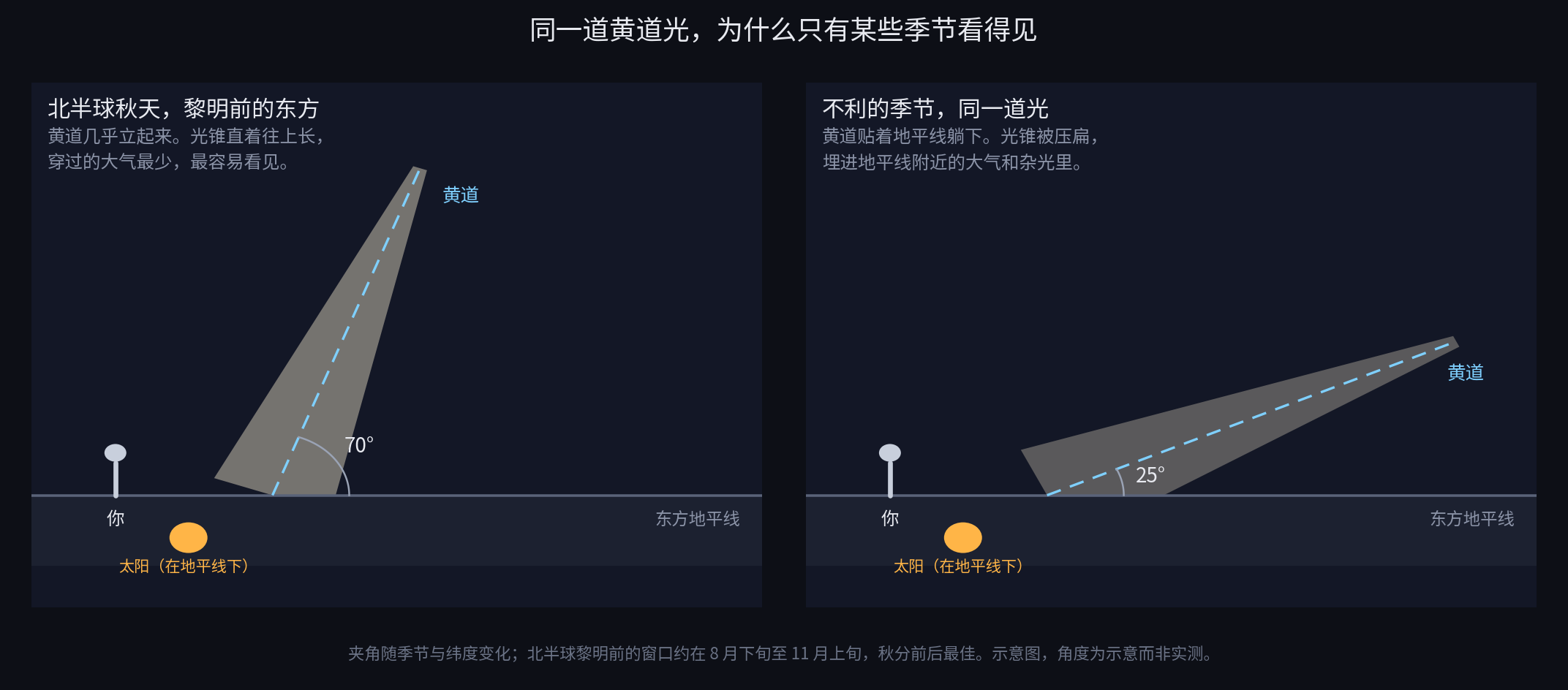
The 2026 September equinox falls at 00:05 UTC on Wednesday, September 23, or 8:05 that morning in Beijing. We are now at the center of the viewing window. The Northern Hemisphere's predawn season lasts roughly from late August to early November.
One Last Thing
The place where this photograph was taken deserves one final note.
The government of the Union Territory of Ladakh formally established the Hanle Dark Sky Reserve on December 1, 2022. It covers 1,073 square kilometers, including Hanle and six surrounding settlements. At an elevation of 4,500 meters, the region is sparsely populated and bitterly cold in winter. After the reserve was established, the Indian Institute of Astrophysics recruited and trained 24 local residents as "astronomy ambassadors." Two-thirds were women. Each received an eight-inch telescope and learned to guide visiting stargazers.
The sky was not merely placed under protection. It became work for the people living beneath it.
Sources: NASA Astronomy Picture of the Day, September 19, 2026; review of zodiacal light, arXiv:2005.07480; NASA on Juno's accidental detections; JPL on the same findings; Al-Hilal: Journal of Islamic Astronomy on false and true dawn; Ladakh government gazette establishing the Hanle Dark Sky Reserve; Indian Institute of Astrophysics, official HDSR page; EarthSky's guide to observing zodiacal light; and Chinese Academy of Sciences on Tianwen-2.