
The least conspicuous object in this photograph is a sheet of aluminum foil. Its job was to bring a small piece of the Sun back to Earth - and it was planted in lunar soil before the flag.
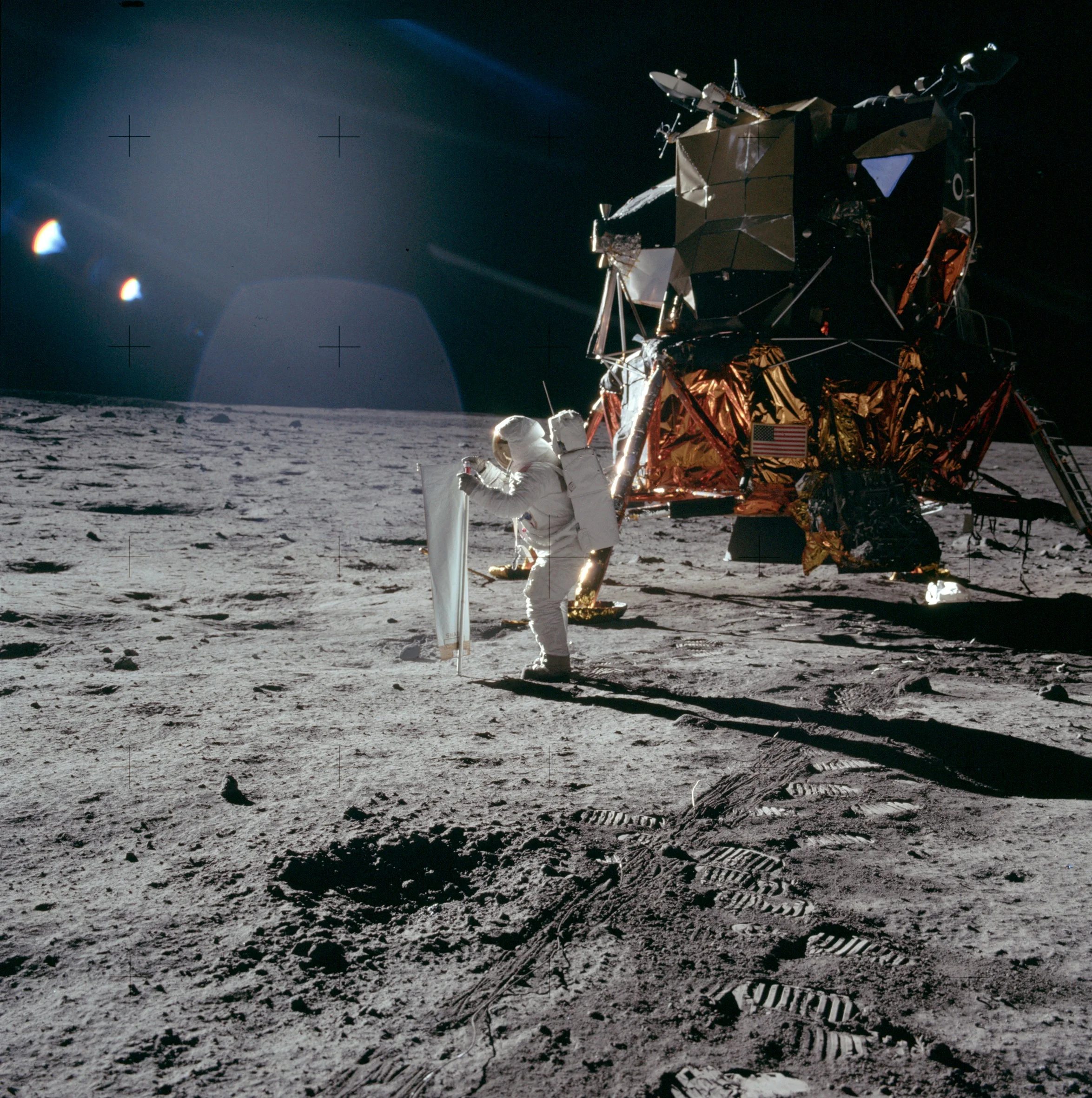
Image: NASA Astronomy Picture of the Day (APOD) | Image credit: Apollo 11, NASA; image scanned by Kipp Teague | Today's page
The sunlight is hard and the shadows are long.
This is the lunar surface on July 20, 1969. Neil Armstrong, the first person to step onto the Moon, took the photograph. The lunar module Eagle stands in the frame. The astronaut in the extravehicular suit is lunar module pilot Buzz Aldrin, doing something that looks distinctly odd: unfurling a long strip of aluminum foil and facing it toward the Sun.
Not a flag or a box of instruments. Just a sheet, as if someone had hung tinfoil out to dry on the Moon.
It had a formal name: the Solar Wind Composition Experiment. Its purpose was to catch the Sun itself.
A 0.42-Square-Meter Sheet of Foil Stood for 77 Minutes
The foil was extraordinarily simple.
According to the Apollo Program's preliminary science report, it was an ultra-pure aluminum sheet 30 centimeters wide and 140 centimeters long, about 4,000 square centimeters in area, roughly a quarter the size of a single bed. It was fixed to a pole and pointed at the Sun. That was the entire apparatus: no power, no circuitry, not one moving part.
During Apollo 11, it remained exposed for 77 minutes, then was rolled up and brought back to Earth.
It could be so simple because what it caught arrived in a simple, forceful way. The Sun constantly blows outward a plasma of protons and electrons known as the solar wind. Fast streams travel at 500 to 800 kilometers per second; slow streams move at around 400 kilometers per second. Earth's magnetosphere shields the ground from it. But the Moon has no global magnetic field and almost no atmosphere. In NASA's words, most of its surface is directly exposed to the solar wind and other space radiation.
On the Moon, then, all you have to do is hold up a clean sheet toward the Sun. Solar-wind particles drive into the aluminum lattice and become firmly trapped.
Back in the laboratory, heat the foil, release those atoms and count them one by one with a mass spectrometer.
This was not detecting the Sun. It was sampling it.
Why It Went Into the Ground Before the Flag
The experiment was designed and its data analyzed by Johannes Geiss of the University of Bern's Physics Institute in Switzerland. The European Space Agency calls it the only non-American experiment on the Apollo landings. That claim was found only in ESA's account, with no corresponding statement on NASA's website, so it is presented here specifically as ESA's description.
Two European institutions do agree on another point, and one was the home of the experiment itself: the Swiss foil was deployed and planted in lunar soil before the American flag.
The University of Bern's official account says that the first thing Aldrin did after leaving the module was unfurl the Bern solar-wind sail and plant it in the lunar ground, "even before the American flag." ESA adds a more revealing detail: Geiss persuaded NASA to arrange the sequence that way.
Consider the weight of that image. On a mission the world treated as a national symbol, the first object planted on the Moon was a scientific instrument.
Strictly speaking, the order could not be independently confirmed from NASA's own lunar-surface activity timeline, so this account comes from the experiment's institution and ESA. You may also see two dates. Bern gives July 21, 1969, while APOD gives July 20. That is the difference between Universal Time and US Eastern time, not a contradiction.
One Sheet of Foil Measured the Density of the Universe
What did it find?
The central result was a ratio: the number of helium-4 atoms to helium-3 atoms. The weighted average from foils flown on five Apollo missions was 2,350 +/- 120. For every 2,350 atoms of helium-4 in the solar wind, there was one atom of helium-3.
There is an easy error to avoid here. Individual missions did not produce identical values. Apollo 11 reported 1,860 +/- 140 at the time, and Apollo 12's initial value was 2,600 +/- 200. The figure 2,350 is the later summary across five missions. The differences among them are real, not measurement mistakes.
An isotope ratio can sound like a small number consigned to the corner of a chemistry textbook. The International Space Science Institute's obituary for Geiss described its significance differently: analyzing the captured ratio of helium isotopes was equivalent to measuring the mean density of the entire universe, a pioneering result.
The leap works like this. Helium-3 in the solar wind reflects the primordial helium-3 present when the Sun formed. Most helium-3 and deuterium in the universe were made during the first few minutes after the Big Bang, and their abundance depends directly on the density of ordinary matter at the time. Stand on the Moon with a sheet of foil for 77 minutes, and what you bring home can constrain the Big Bang.
For that work, Geiss later shared the 2001 Albert Einstein Medal in Bern with Hubert Reeves.
The Essential Insight: The Moon Is Itself a Sheet of Foil
Now pull the view back.
The 1969 Apollo preliminary science report contains a sentence that anticipated the next half-century. It says the mean value has major astrophysical significance because it can be compared with the ancient helium-4/helium-3 ratio inferred from solar-wind gases trapped in the lunar surface or in meteorites.
The implication is striking.
The Bern foil measured today's solar wind. Lunar soil measures the solar wind of long ago.
With no magnetosphere and no atmosphere, the Moon has been exposed directly to the solar wind for billions of years. Every grain of its soil is a tiny sheet of foil that has been lying there all along.
The effect is even visible. NASA has a page devoted to the Moon and solar wind. It explains that solar radiation darkens some regions of the lunar surface, effectively giving the Moon a kind of suntan. Where local magnetic fields provide protection, the ground remains relatively bright. Just outside those shielded areas, radiation-driven chemistry darkens the surface.
The Moon's mysterious pale swirls are therefore a map of where the solar wind did and did not strike. The ground beneath a magnetic umbrella remains white; the unshielded ground turns dark.
One correction is essential, and it comes from Chinese samples. A 2025 study of grains returned by Chang'e 5 and Chang'e 6 found that an individual grain records only about a million years of solar-wind exposure, because impacts continually churn and "garden" the lunar soil.
The more accurate version is this: the Moon is a sheet of foil that has lain open for billions of years while constantly being turned over. The surface as a whole has been exposed for more than four billion years, but a grain picked at random often records only the past few hundred thousand years.
Fifty-Three Years Later, China Did It Again
Follow this line forward and it reaches Chang'e 5.
In 2022, a team from the Institute of Geology and Geophysics at the Chinese Academy of Sciences published Abundant solar wind-derived water in lunar soils from the middle latitude in the Proceedings of the National Academy of Sciences. The first author was Xu Yuchen and the corresponding author Lin Yangting. An official release from the National Space Science Center put the conclusion plainly: water on the lunar surface is formed when hydrogen ions emitted by the solar wind are implanted into it at high speed.
The specific figure was about 46 parts per million of solar-wind-derived water in soil from the Chang'e 5 landing site, equivalent to 46 grams per tonne. Extrapolated to high latitudes, the concentration could reach about 560 parts per million, consistent with remote-sensing observations.
NASA's lunar page supplies the connecting sentence: the solar wind delivers another essential ingredient for making water, hydrogen. The wind brings hydrogen; lunar soil contains oxygen.
Care is needed here because a point has been repeatedly misstated on the Chinese internet. Chang'e 5 produced another famous paper, by Liu Jianjun and colleagues in Nature Communications in 2022, the original study behind the figure of about 120 grams of water per tonne of lunar soil. But that paper's abstract actually downplayed the solar wind's contribution. At that young mare landing site, a substantial share of the additional hydroxyl may have come from apatite.
The papers do not conflict. One addresses water formed by solar-wind implantation in the surfaces of grains; the other asks where the water across that region as a whole came from. Combining them into the claim that "Chang'e 5 proved lunar water comes from the solar wind" would be wrong.
Chang'e 6, incidentally, returned 1,935.3 grams of samples from the Moon's far side. They provided the first evidence of volcanic activity there at about 4.2 billion and 2.8 billion years ago, and showed that the far-side mantle is drier than the near-side mantle.
How to Read a Number: Helium-3 in Lunar Soil
The mention of helium isotopes leads to a widespread claim: the helium-3 in lunar soil could power humanity for thousands of years.
How should that sentence be read?
First, China did measure it. In July 2021, the Beijing Research Institute of Uranium Geology received 50 milligrams of lunar samples and made China's first measurement of the helium-3 content and extraction temperature in Chang'e 5 soil. But the official announcement disclosed neither the numerical concentration nor the extraction temperature.
Second, the "thousands of years" figure did not come from that Chinese measurement. The official announcement contains a qualifier rarely preserved in retellings: according to foreign lunar-sample studies and remote-sensing observations, the Moon may hold more than one million tonnes of helium-3, enough to provide energy for all humanity for thousands or even tens of thousands of years. Another official account attributes the figure to an estimate by academician Ouyang Ziyuan. This is an extrapolation from remote sensing and limited samples, not a measured reserve.
Third, and most easily overlooked, the denominator is even less certain than the numerator. "Thousands of years of use" assumes helium-3 fusion, and no engineerable helium-3 fusion reactor currently exists.
This is not meant to dismiss the Moon. It illustrates something every science-minded child should learn: when a number is astonishing, look for its qualifier. It often sits in the same sentence, omitted by everyone who repeats it.
Why Today: Two Anniversaries on September 12
Many APOD selections have no particular reason to appear on their date. This one has two.
On September 12, 1962, John F. Kennedy stood in the stadium at Rice University in Houston and delivered the speech quoted ever since:
Not because they are easy, but because they are hard.
Today is the speech's 64th anniversary. Today's APOD shows the scene in which those words became real seven years later. The foil planted in lunar soil is what "hard" looked like after the work was done.
On September 12, 1959, the Soviet Union launched Luna 2. It struck the Moon the next day, becoming the first human-made object to reach another celestial body. Today is its 67th anniversary.
The two dates are exactly three years, or 1,096 days, apart. First someone crashed a lump of metal into the Moon. Three years later someone said people would go there. Seven years after that, a person stood on it and unfurled a sheet of foil.
There is one gentler coincidence. Johannes Geiss, who designed the foil, was born on September 4, 1926. The centenary of his birth passed eight days ago.
Sources: NASA Astronomy Picture of the Day; NASA Commons official caption for AS11-40-5872; Apollo Preliminary Science Report, Solar Wind Composition Experiment; Geiss et al., Space Science Reviews (2004); International Space Science Institute obituary for Johannes Geiss; University of Bern official release; European Space Agency, First flag on the Moon; NASA, Solar Wind and Voyager Interstellar Mission; US National Oceanic and Atmospheric Administration Space Weather Prediction Center; Xu et al., Proceedings of the National Academy of Sciences (2022), DOI 10.1073/pnas.2214395119; National Space Science Center, Chinese Academy of Sciences, official release; Liu et al., Nature Communications (2022), DOI 10.1038/s41467-022-30807-5; Liu et al., Nature Communications (2025), DOI 10.1038/s41467-025-64239-8; China National Space Administration Chang'e 6 results announcement; China News Service report on the Beijing Research Institute of Uranium Geology helium-3 measurement; John F. Kennedy Presidential Library, Address at Rice University on the Nation's Space Effort; NASA History, 60 Years Ago: Luna 2 Makes Impact in Moon Race; China Meteorological Administration National Center for Space Weather Monitoring and Warning; Guangming Online report on the May 2024 geomagnetic storm; NASA eclipse-observation safety guide; US Naval Observatory 2026 equinox and solstice data