
A river that is usually green has turned brown. The boundary at its confluence runs on for hundreds of yards. And the human body can learn to remember cold water.
Screenshot: National Geographic Photo of the Day · Photograph: Aleksey Kondratyev · Original page
National Geographic's Photo of the Day was made in Chongqing.
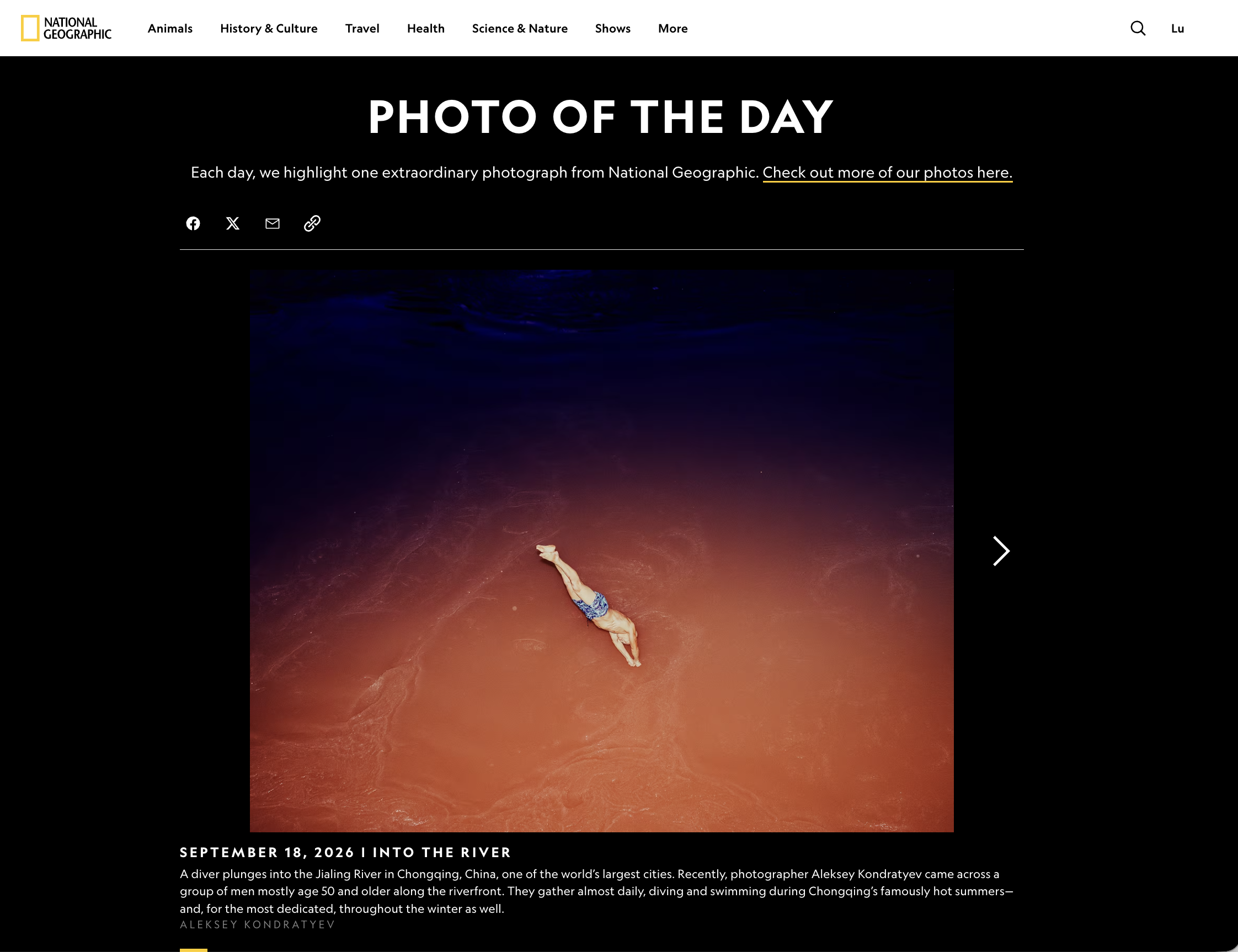
A man is diving into the Jialing River. The water is brown. Photographer Aleksey Kondratyev recently encountered a group of men along the waterfront, most of them over 50. They meet almost every day to dive and swim through Chongqing's famously hot summers. The most dedicated keep going all winter.
Start with the color, because it poses a question.
Why Is the River Brown?
If you have visited Chaotianmen in Chongqing, you may have heard the confluence compared to a yuanyang hot pot: the Jialing arrives from the north, the Yangtze from the west, and the two rivers meet below the headland in visibly different colors.
Most of the year, the Jialing is the clear half of the pot and the Yangtze the muddy half.
From June through September, that arrangement can reverse.
A report from the China Meteorological News Press explained one such reversal. Heavy rain had fallen twice in Bazhong and Dazhou, upstream on the Jialing, sending more water and sediment toward Chongqing. At the same time, there had been relatively little rain over the Tuo, Min and Jinsha river basins upstream on the Yangtze. The Yangtze became the clear broth; the Jialing became the cloudy one.
The Chinese newspaper Popular Science Times put it even more vividly in August 2023: during flood season, the Yangtze was the clear broth and the orange-red Jialing the spicy broth.
The key is not which river is cleaner. It is which river's upstream country has been getting rain.
That is a useful distinction to make for a child. Something that looks like a permanent personality turns out to be a traceable event. Neither river is naturally clear or naturally muddy. The color you see is a receipt for rain that fell hundreds of miles away several days earlier.
This photograph was made on the brown Jialing in mid-September, near the end of the reversal season. The color is neither an error nor a damaged photograph. It is exactly what the season can produce.
Why Don't the Two Rivers Mix Immediately?
From Chaotianmen, the strangest sight is often not the contrast itself but how far the boundary continues downstream. The rivers have joined, yet they appear to keep moving side by side, the line between them extending beyond the point where it can still be seen.
Isn't water supposed to mix as soon as it meets?
Mixing has to work outward from a narrow interface.
A 2025 review in Advances in Science and Technology of Water Resources describes the central feature as a shear layer. It forms where the main channel and tributary meet and becomes the principal zone of momentum exchange. The two flows do not mix everywhere at once. They exchange water little by little across a thin boundary where their velocities differ.
Two other factors help preserve the division.
One is density. Water carrying more sediment is heavier. Hydraulic engineers use the densimetric Froude number to describe the balance; when the flow is relatively slow, the density contrast can do more to hold the two streams apart.
The other is velocity. Rivers rarely arrive at a junction at the same speed. After they meet, the difference can create a separation zone along the tributary side and even helical currents, the cross-sectional signature of three-dimensional secondary flow.
There is also something that can accelerate mixing sharply: a difference in bed elevation. One study cited by the review found that a step between the beds of the main channel and tributary could shorten the distance needed for complete mixing by a factor of five to ten.
How many miles downstream of Chaotianmen do the Yangtze and Jialing finally become uniform? I found no primary field measurement, so this article will not supply a number. The observable claim is enough: the boundary runs farther than the eye can follow from the confluence.
The Jialing River
The Jialing is the largest left-bank tributary of the upper Yangtze. It is 1,345 kilometers long and drains roughly 160,000 square kilometers across Shaanxi, Gansu, Sichuan and Chongqing. Its Chongqing section runs for 152 kilometers, about 11.3 percent of the river's total length.
There are two competing accounts of its source. The conventional administrative account places it at Mount Daiwang in Feng County, Shaanxi, on the northern side of the Qinling Mountains. In 2014, a Chinese Academy of Sciences team combined satellite imagery with fieldwork and argued that the Bailong River should instead be treated as the main source. That would place the headwaters at an elevation of 4,070 meters near Baozuo Township in Ruoergai County, Sichuan, on the western slope of the Min Mountains. Both descriptions remain in use.
The name is disputed too, and that argument may be more interesting than the one about the source. The familiar popular explanation says the river was named after the Jialing Valley in Feng County. A 2016 paper in Forum on Chinese Culture makes the reverse case. It argues that Jialing first named an auspicious mountain in pre-Qin times, then a Han-dynasty road called Jialingdao, and only later the river. In that account, the Feng County valley became a supposed source only after the older meaning of Jialingdao had faded from memory.
The honest version for a child is simple: scholars are still arguing about how this river got its name.
For water quality, official figures are the safest guide. A July 2025 report to the Chongqing Municipal People's Congress said that all 74 nationally monitored sections had met the good-water standard for two consecutive years, and that the main stem of the Yangtze in Chongqing remained Class II.
That was not always the case. Monitoring in January and February 2021 found 16 Jialing sections in Sichuan and Chongqing at Classes I through III, three at Class IV and two at Class V.
In other words, the river in the photograph has also been restored. That matters later in the story.
How the Body Remembers Cold Water
The caption's phrase about the most dedicated swimmers continuing through winter has a rigorous study behind it.
In 2024, the Journal of Thermal Biology published a systematic review and meta-analysis titled "Habituation of the Cold Shock Response." Its authors included Michael Tipton and Clare Eglin, two leading researchers of human physiology in cold-water immersion.
Across the existing experiments, repeated cold-water immersion gradually reduced the cold-shock response. The change began after roughly four brief whole-body immersions. Across the studies in the meta-analysis, the pooled reductions were 14 beats per minute in heart rate and 8 breaths per minute in respiratory frequency. One four-immersion experiment found reductions of about 18 percent and 23 percent in those two measures. After eight immersions in another study, respiratory frequency and minute ventilation fell by 49 percent and 56 percent, respectively, while heart rate fell by 34 percent.
More surprising was how long the adaptation lasted. The effect could still be measured after seven months, when cardiopulmonary responses remained an average of 31 percent lower. Fourteen months later, part of the effect persisted: the heart-rate response was still 18 percent lower.
These swimmers are not relying on willpower alone. Their bodies really have changed, and some of that memory can last more than a year.
The next point, however, matters more.
Adaptation Is Not Safety
Habituation reduces the cold-shock response. It does not eliminate it.
The Royal National Lifeboat Institution defines water below 15 C as cold enough to seriously affect breathing and movement. Blood vessels in the skin constrict, resistance to blood flow rises and the heart rate accelerates. Most dangerous of all is an involuntary gasp, followed by breathing that can become ten times faster than normal.
Cold-water shock can trigger a heart attack even in someone young and apparently healthy. Its initial effects usually pass in less than a minute, but one minute is long enough.
The RNLI also notes that only half a pint of seawater in the lungs can cause an adult man to begin drowning. That is about 284 milliliters, less than a small bottle of soda.
This is why hypothermia is not the main cause of many cold-water deaths. A widely used summary devised by Canadian thermophysiologist Gordon Giesbrecht is the 1-10-1 principle:
- 1 minute: Cold shock. A sudden gasp is followed by uncontrolled hyperventilation; ventilation can rise by 600 to 1,000 percent.
- 10 minutes: Cold incapacitation. Effective use of the fingers, arms and legs is lost, and purposeful movement becomes difficult or impossible.
- 1 hour: Even in ice water, it may take about an hour before hypothermia causes unconsciousness.
The first minute and the next ten are often what kill. By the time hypothermia takes the stage, many victims have already drowned.
One official RNLI warning directly contradicts the action in today's photograph: never jump or dive straight into open water, because doing so can cause cold-water shock.
That does not make the men in Kondratyev's photograph foolish. They know this stretch of river intimately and have adapted over years or decades; the paper above measured precisely that physiological process. But both statements must stand together: their ability does not make the same act safe for you. This article offers no instructions for beginning winter swimming.
A river also contains dangers that a pool does not. Chongqing's transport and maritime authorities warn about shipping channels, shoals, rapid currents, slippery or uneven banks, and changing flood-season water levels. Their clearest instruction is not to enter navigable waters.
Diving adds another risk. Beneath an unfamiliar surface there may be a shallow shelf, a rock or an unseen obstruction. Injuries of this kind often happen on a first attempt.
Chongqing's current Regulations on Public Security in Waters took effect on August 1, 2023. Three verified provisions are relevant here. Rafting during a river flood peak is prohibited and can draw a fine of up to 500 yuan. Organizers must notify the local public-security authority in advance for non-large-scale events involving at least 30 people on the water, or at least 200 people in other waters. The regulation also calls for a joint government-school-family system to prevent drowning and protect minors. I found no citywide general ban on swimming, but I also could not verify every district-level notice, so this article makes no broader legal claim.
The strongest warning comes from a swimmer who had just been rescued. In August 2026, several swimmers formed a relay to save a man stranded in the middle of the Yangtze in Chongqing. He had trained in a pool for years, he said, but had not expected the river's current to be so powerful. The river was nothing like the pool.
What Evidence Supports the Claimed Benefits of Winter Swimming?
This needs precision because the claims often outrun the evidence.
In 2022, a team at UiT The Arctic University of Norway published a review in the International Journal of Circumpolar Health titled "Health Effects of Voluntary Exposure to Cold Water - A Continuing Subject of Debate."
Its overall conclusion was that the evidence was too limited to be definitive. Samples were small, many studies included only one sex, definitions of water temperature varied, and a basic bias was difficult to exclude: people who swim in cold water year after year may already be healthier than average.
There are promising signals. Cold exposure appears to increase adiponectin released by fat tissue. Repeated winter immersion has been associated with higher insulin sensitivity and lower insulin concentrations. Those findings justify more research.
But the review's essential warning was that many claimed benefits of regular cold exposure may not be causal. Other explanations include an active lifestyle, practiced stress management and social contact.
A group of people meeting in the same place every day for decades, entering the water together and noticing who did not show up may itself be part of the benefit. That social ritual is also what Kondratyev's photograph contains.
Claims about immunity, depression and fewer colds do not yet have strong causal support. Brown fat may change, but the central problem remains: separating the effect of cold water from the swimmers' broader way of life.
Paris Spent 102 Years Buying This Back
The photograph contains an easily overlooked fact: in many of the world's great cities, what these men are doing has not been possible.
Paris banned swimming in the Seine in 1923.
One hundred and two years later, on July 5, 2025, it reopened three public bathing areas: Bras Marie near the Ile de la Cite, Grenelle near the Eiffel Tower and Bercy in eastern Paris. A regional government briefing put the cleanup program's cost at about 1.4 billion euros.
The work had been undertaken for open-water events at the 2024 Olympics, and public bathing became part of its legacy. In summer 2026, a Paris city release reported 216,000 visits to bathing sites across the city, with attendance at the three Seine sites up 20 percent from 2025. That season opened on July 4 and ended early at the Seine sites, on August 29, after several rainstorms.
Even on reopening day, Paris officials were blunt: the Seine remains a dangerous environment.
Copenhagen's account is shorter. Its harbor had swimming facilities in the 18th and 19th centuries. Rising pollution led first to a ban for minors in 1953 and then a complete harbor-swimming ban in 1954. The Islands Brygge Harbour Bath opened on July 15, 2002, after a 48-year prohibition.
London chose a different intervention. The Thames Tideway Tunnel began operating in October 2024. The 25-kilometer "super sewer" cost 4.5 billion pounds. During a single storm in September 2024, it captured 219,000 cubic meters of sewage that otherwise would have entered the Thames.
What About Chongqing?
It would be tempting to write a perfect contrast: Paris spent 102 years and 1.4 billion euros buying back the right to enter its river, while these Chongqing swimmers never stopped.
The second half cannot be verified.
What can be said is that I found no general municipal prohibition on swimming in Chongqing's rivers. The current regulation restricts rafting during flood peaks and governs shipping channels and reporting for organized water activities. Local winter-swimming groups appear in reports going back more than a decade, including gatherings of hundreds and long-used entry points such as Niujiaotuo in Yuzhong District.
What cannot be said is "they never stopped." I could not obtain every original notice from the city's public-security and transport departments, nor every district-level rule. Absence from a search is not proof that no restriction existed. Water conditions in Chongqing also changed significantly after the Three Gorges project began impounding water; seasonal levels, navigation and management all shifted, and I do not have the data to quantify those changes here.
The earlier water-quality figures matter too. Five monitored sections of the Jialing in Sichuan and Chongqing still failed to meet Class III or better in early 2021. The record of all 74 national sections reaching the good-water standard for two consecutive years is recent.
So the honest version is this:
Paris spent 102 years and 1.4 billion euros making public river swimming legal again; Copenhagen took 48 years. Chongqing did not follow that path, not because its rivers were always clean, but because the city never shut the river away entirely. The Jialing was restored too. It was restored without first ceasing to be treated as a river.
The boundary, the color and the swimmers are different sides of the same fact: a river running through a city of more than 20 million people can still be used as a river.
Nine Days Later
Today is not a river holiday. Nine days from now is.
World Rivers Day falls on the fourth Sunday of September. In 2026, that is Sunday, September 27. River advocate Mark Angelo proposed the observance in 2005, when the United Nations launched the Water for Life Decade. Its roots lie in British Columbia Rivers Day, which Angelo founded in western Canada in 1980. Events now take place in more than 100 countries.
China's own annual observance comes in spring: World Water Day is March 22, followed by China Water Week from March 22 through 28. In 2026, those marked the 34th World Water Day and China's 39th Water Week.
Sources
National Geographic Photo of the Day, September 18, 2026, "Into the River"; Aleksey Kondratyev's website and the San Francisco Airport Museum's Ice Fishers exhibition page; China Meteorological News Press on the reversal of Chongqing's "yuanyang hot pot" confluence; Popular Science Times, August 25, 2023; Zeng Cheng et al., "Research Progress on Hydrodynamic and Mixing Characteristics at Open-Channel Confluences," Advances in Science and Technology of Water Resources 45(1), 2025; research by the Chongqing Municipal People's Congress and its July 30, 2025 water-ecology report; People's Daily, January 24, 2014, on remote-sensing work at the Jialing source; Tang Xubo, "Jialing, Jialingdao and the Jialing River," Forum on Chinese Culture 2 (2016); Barwood, Eglin, Tipton et al., "Habituation of the Cold Shock Response: A Systematic Review and Meta-Analysis," Journal of Thermal Biology 119 (2024), 103775; Royal National Lifeboat Institution guidance on cold-water shock and open-water swimming; Canadian Safe Boating Council, the 1-10-1 principle; Mercer et al., "Health Effects of Voluntary Exposure to Cold Water - A Continuing Subject of Debate," International Journal of Circumpolar Health (2022), DOI 10.1080/22423982.2022.2111789; Chongqing transport and maritime safety guidance; Regulations of Chongqing Municipality on Public Security in Waters, effective August 1, 2023; Ile-de-France regional government's bathing-plan materials; City of Paris releases on the 2026 swimming season; New York City Global Partners' Copenhagen harbor-bath case study; Tideway, October 2024; World Rivers Day; and the Shanghai Water Authority's 2026 World Water Day and China Water Week notice. The 2026 date of World Rivers Day was checked independently against the calendar.