
After sunset, the opposite side of the sky still tells us where the sun is.
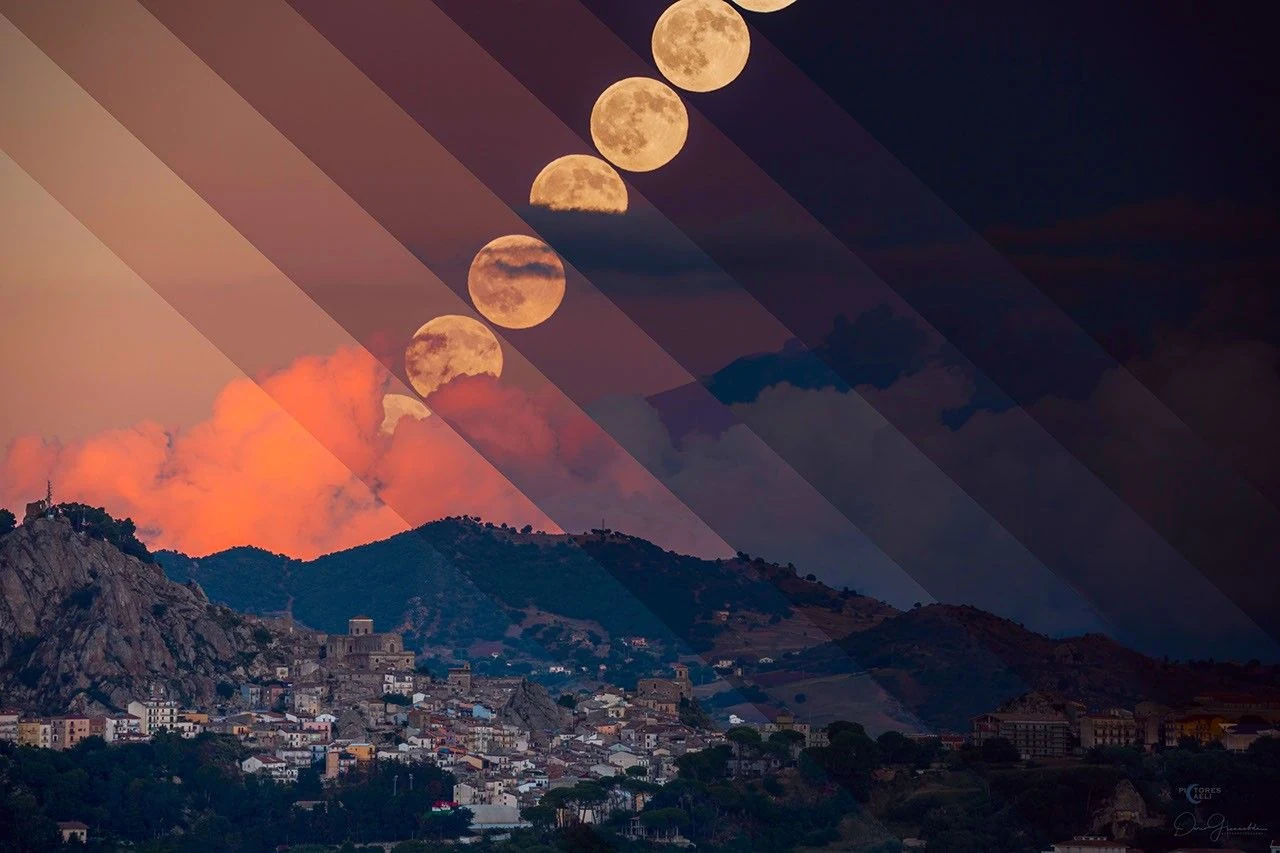
Image: NASA Astronomy Picture of the Day | Credit & Copyright: Dario Giannobile | Original page
This is not one moment frozen by a single exposure. Dario Giannobile combined stages of moonrise and darkening twilight, photographed near Nicosia in Sicily. Ash and gas rise from Mount Etna, while the pink Belt of Venus colors the lower sky.
Pink above a Shadow
A full moon lies roughly opposite the sun, so it often rises around sunset. Look toward that rising moon and you are looking approximately away from the sun. Earth's shadow extends in the same general direction.
After sunset, a blue-gray band may appear low in the east, where Earth blocks sunlight from the atmosphere. Higher air still receives sunlight reddened by its long path through the atmosphere. Scattering sends some of that light toward the observer, making the pink band above the shadow.
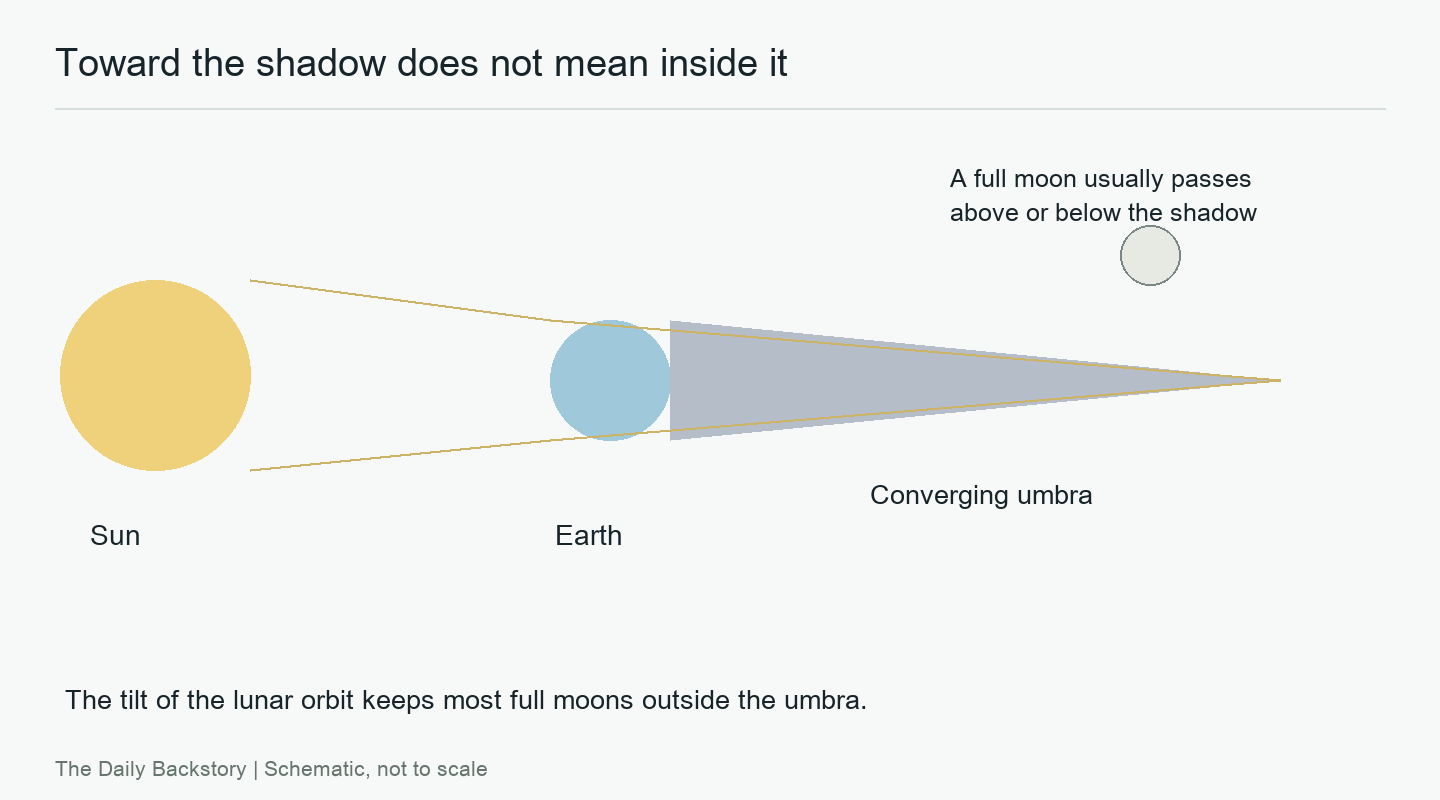
Diagram: The Daily Backstory; not to scale. An ordinary full moon is outside Earth's umbra.
"In the same direction" is not "inside the shadow." The moon's orbit is tilted relative to Earth's orbit around the sun. Most months, it passes above or below the umbra; a lunar eclipse requires a closer alignment.
The Belt of Venus is also a name, not an effect caused by Venus. The planet stays relatively near the sun in our sky, while this twilight band appears on the opposite side.
An Ancient Description of the Dark Region
The Eastern Han scholar Zhang Heng discussed reflected sunlight as the source of moonlight in his treatise Ling Xian. He also linked lunar eclipses to Earth blocking sunlight, calling the shadowed region opposite the sun an xu, or "dark void."
That ancient account was not a complete theory of modern atmospheric optics, but it recognized an important part of eclipse geometry. In the modern explanation, an eclipse and the twilight shadow both begin with Earth intercepting sunlight. One shadow reaches the moon; the other is visible in nearby air.
The Harvest Moon is generally the Northern Hemisphere full moon closest to the autumn equinox, not necessarily a September full moon. Around the equinox, shorter intervals between successive moonrises at some middle and high latitudes supplied several evenings of extra moonlight for agricultural work.
A moonrise composite connects the moon, the atmosphere and the ground beneath the camera. Beside the bright lunar disk is a less obvious presence: the shadow of our own planet.
Sources
NASA: Original page and lunar phases and eclipses; Zhang Heng's Ling Xian, original text.