
One catalog number can be a night's assignment. A whole catalog becomes the work of many clear nights.
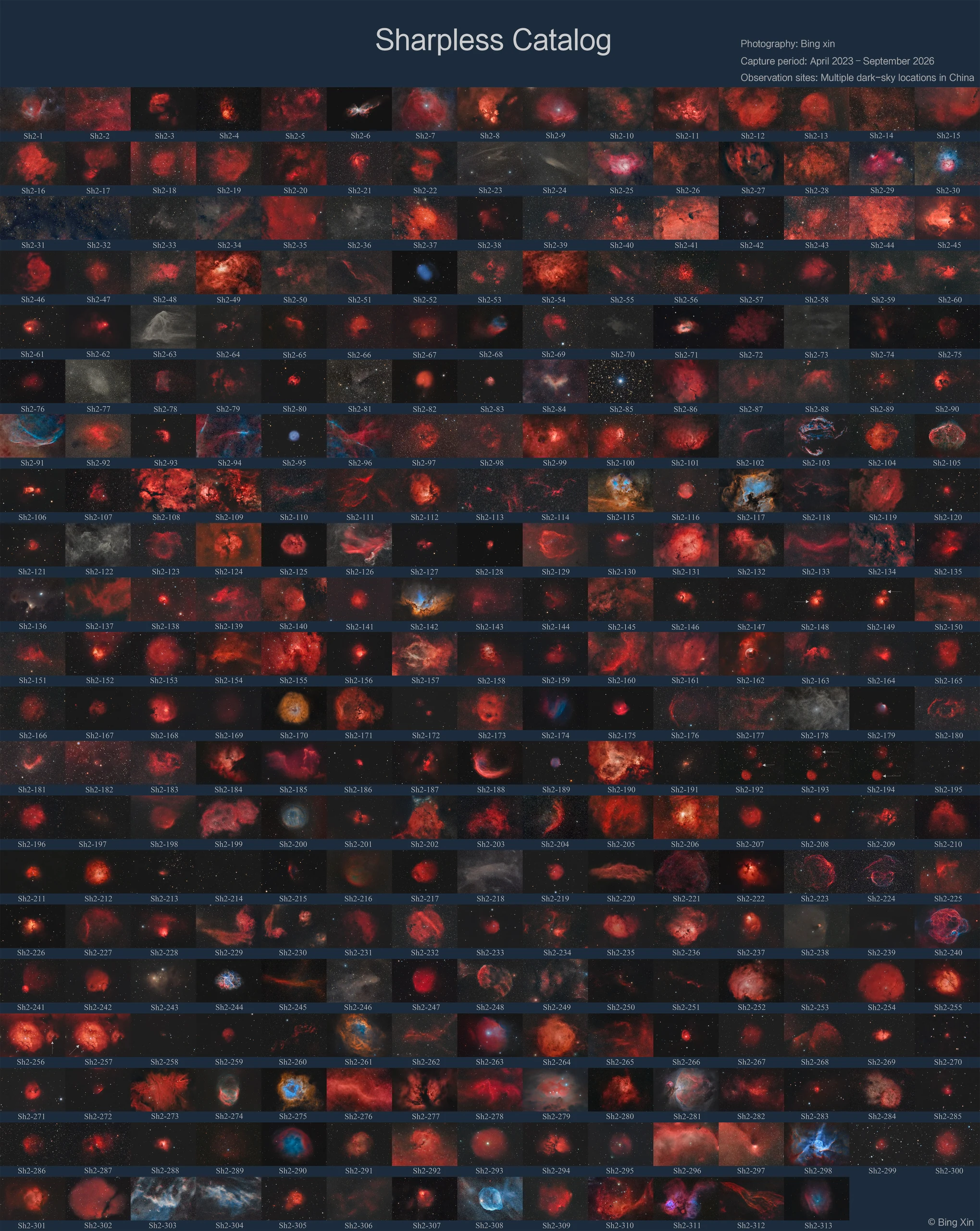
Image: NASA Astronomy Picture of the Day | Credit: Bing Xin | Original page
NASA describes this photographic collection as 313 objects, with two to six hours devoted to each and about 800 hours of total exposure. Bing Xin photographed them under dark skies in eastern China and Inner Mongolia, using narrowband filters for hydrogen and oxygen emission alongside red, green and blue filters.
Eight hundred hours is about 33 days of open-shutter time. It was not one continuous exposure, nor does it include all the travel, setup and waiting for suitable weather.
A Shared Number Does Not Mean a Shared Origin
Stewart Sharpless published his second catalog in 1959, the source of the familiar Sh2 designations. That paper lists 312 objects. NASA uses 313 for this photographic collection; the two counts should not be silently treated as identical.
Most targets are H II regions, where ultraviolet radiation from young, massive stars ionizes surrounding hydrogen. When electrons recombine with hydrogen nuclei and move between energy levels, they can emit light at particular wavelengths. H-alpha, at about 656.3 nanometers, is one source of nebular red light. Final composite colors also depend on the filters and processing.
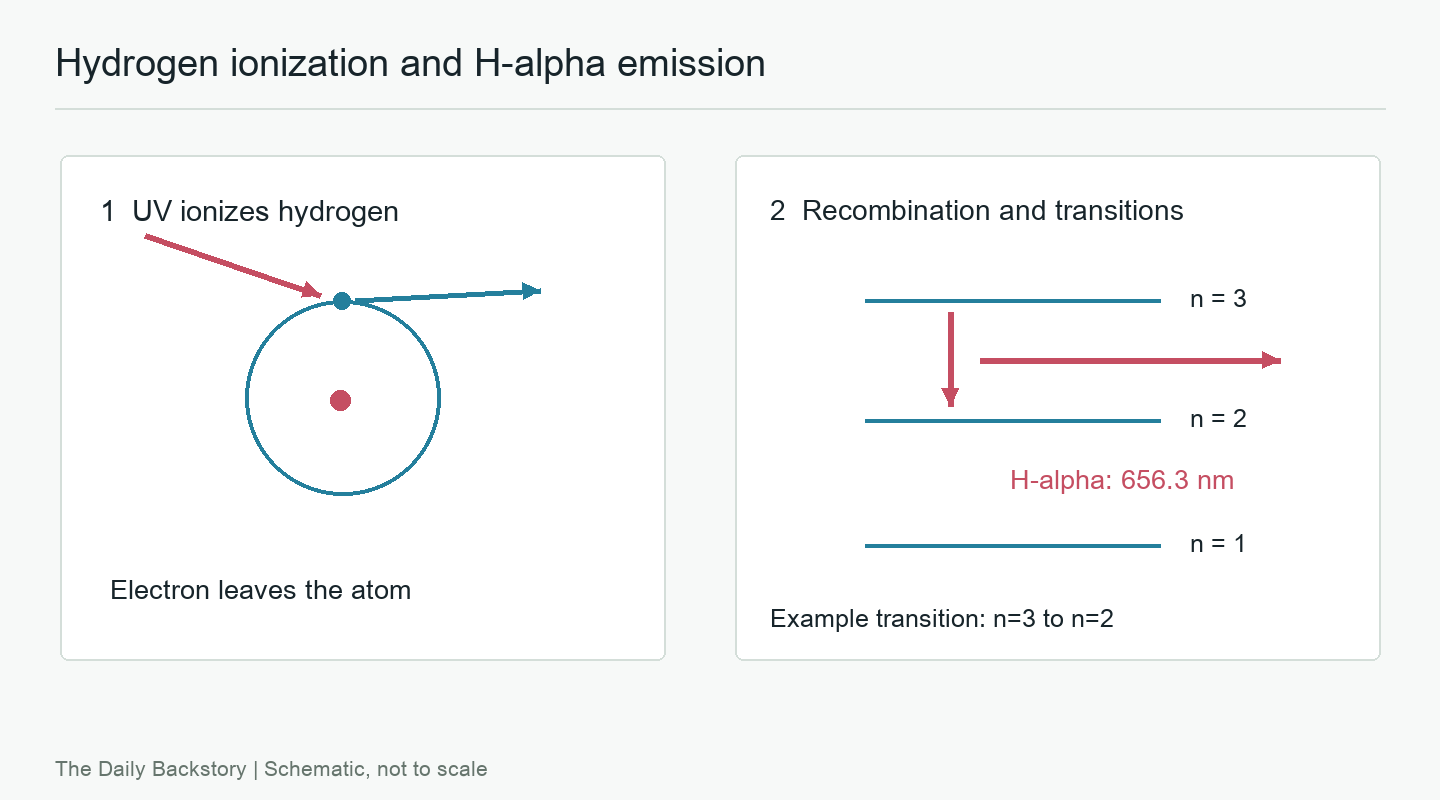
Diagram: The Daily Backstory; energy-level spacing is not to scale.
Some catalog members have different histories. Sh2-274 is the Medusa planetary nebula; Sh2-240 is the Spaghetti supernova remnant. A shared numbering system does not make every object the product of the same process.
Selecting Light, Not Creating It
A narrowband filter passes a limited wavelength range, reducing broadband background and making an emission line easier to distinguish. It also attenuates some target light within its passband. The result depends on bandwidth, transmission, background and equipment. A filter twenty times narrower does not establish a universal requirement for ten times the exposure.
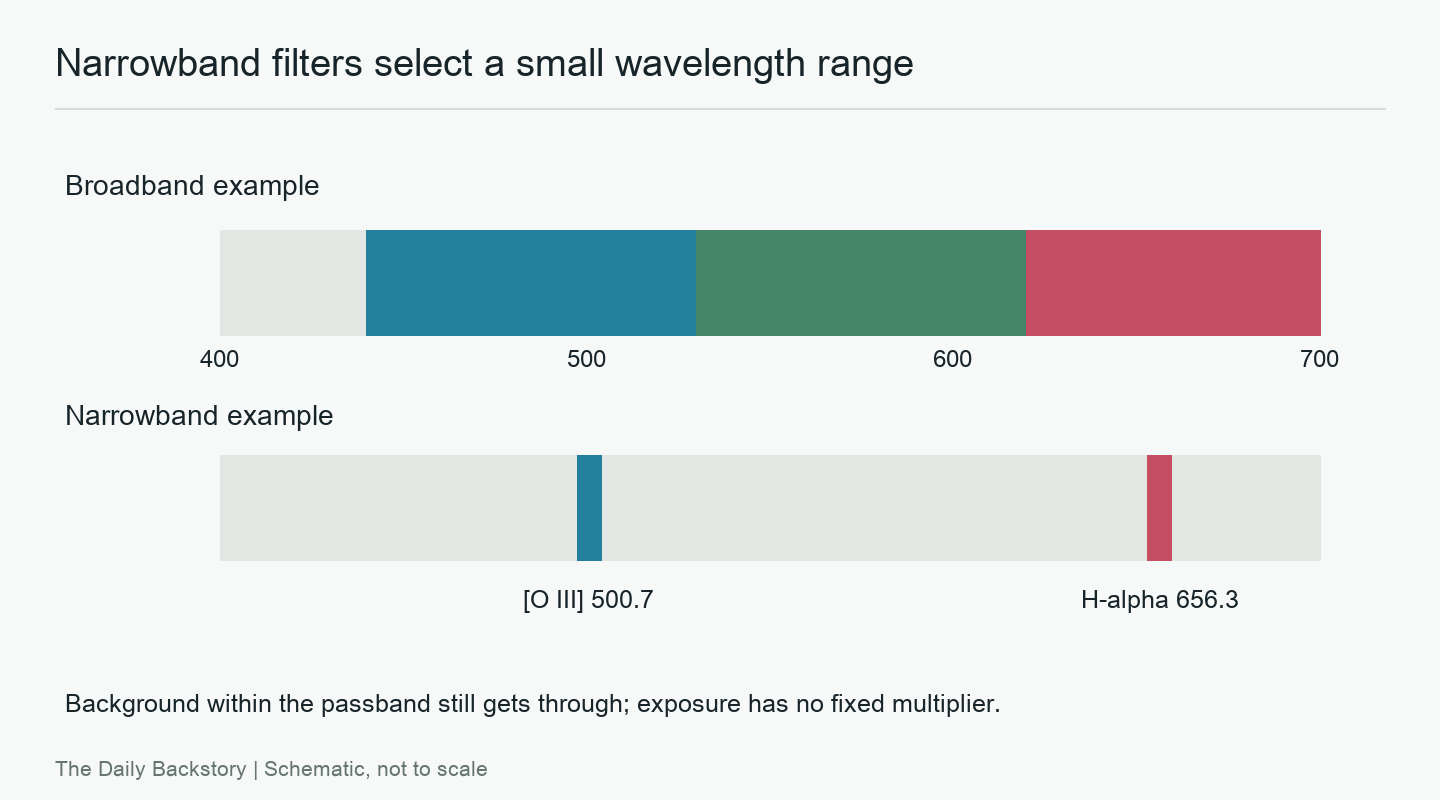
Diagram: The Daily Backstory; example passbands. Background within the selected band still gets through.
A List That Keeps Growing
On May 22, 2026, the Chinese Academy of Sciences released the 2026 Catalogue of Life China. It contains 155,266 species and 13,605 infraspecific units, totaling 168,871 entries. The net increase over the previous edition is 6,154 species and infraspecific units.
Not every addition represents a newly discovered organism. Expanded coverage and taxonomic revisions contribute too. Stable astronomical identifiers make repeated observations easier; an evolving biological catalog records changes in our knowledge of diversity. Both depend on someone doing the patient, item-by-item work that a finished list can hide.
Sources
NASA: Original page; Sharpless's original 1959 paper; Chinese Academy of Sciences: 2026 Catalogue of Life China.