
Sometimes a cold case waits years for a better reference book. Here, the crucial update was a more complete account of atomic spectral lines.
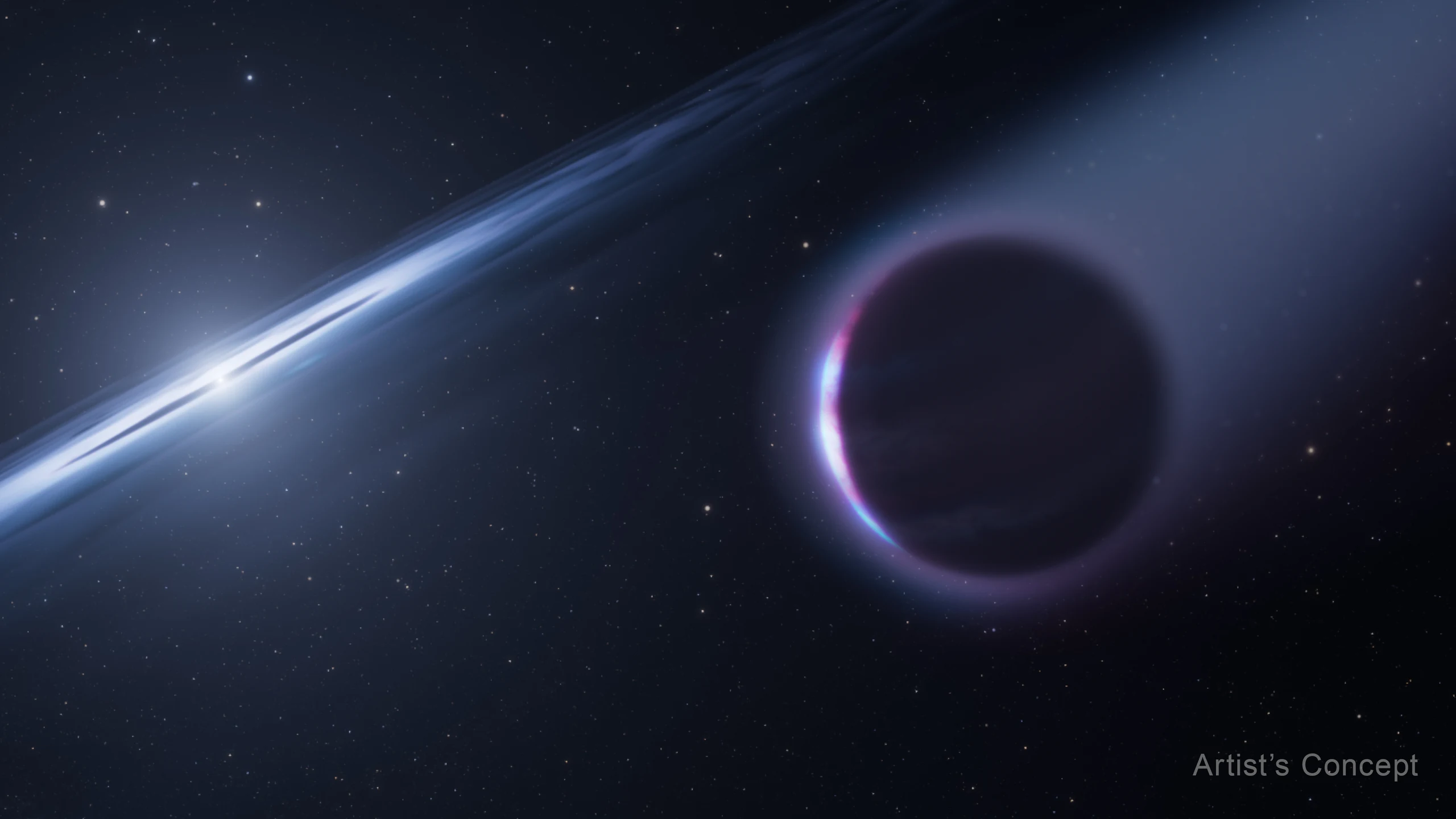
Image: NASA Image of the Day | NASA, ESA, Leah Hustak (STScI) | Original page. This is an artist's concept, not a photograph of the planet.
NASA's Image of the Day for October 6 imagines a white dwarf beside a candidate planet. Material flows from the planet, collects in a disk around the star, and falls onto its surface. The picture illustrates a possible explanation; the planet has not been confirmed through direct imaging.
Some of the evidence behind it is twenty-seven years old.
The Unidentified Lines of 1999
The white dwarf is HS 0209+0832. White dwarfs are the dense cores left by lower-mass stars after they lose their outer layers. The core remains hot but no longer shines through its original supply of nuclear fuel.
In 1999, Hubble's STIS instrument recorded this star's ultraviolet spectrum. Different elements absorb light at particular wavelengths, leaving dark lines. Comparing those lines with laboratory measurements and theoretical calculations reveals the contents of a stellar atmosphere.
About a hundred lines initially resisted identification. The signal was there; the tools to explain it were incomplete.
University of Warwick doctoral researcher Jamie Williams later revisited the archive. Updated atomic line data and stellar-atmosphere models matched many of the unknown features to copper and niobium.
Niobium is element 41. Its unusually high abundance matters more than its mere presence. In NASA's account, co-author Boris Gaensicke explains that niobium had not previously been reported in another analyzed white dwarf. Archival observations from the retired FUSE ultraviolet mission independently supported the identification.
Chemistry Reveals the Incoming Meal
Strong gravity causes many heavy elements to sink out of a white dwarf's visible atmosphere. An external supply can replenish them. Radiation from a hot star can also support some elements, so a metal line cannot automatically be read as evidence of a recent meal.
The study calculated this effect element by element. At the measured abundances in HS 0209+0832, it found radiation's support negligible for niobium and several other elements. Ongoing accretion is needed to explain their presence.
The harder puzzle is the incoming material's recipe. Niobium, copper and zinc are enriched, while iron was not detected and silicon appears only in traces. The combination differs from familiar rocky Solar System bodies.
The team compared it with the chemistry of late stellar evolution. During the giant phase, processes including slow neutron capture can change heavy-element abundances. The enriched outer material is then expelled into space.
The proposed explanation follows a loop: matter leaves the white dwarf's progenitor, becomes part of a planet containing "second-generation" material, and is now being stripped from that planet and returned to the star.
Niobium already exists in our Solar System. Finding it alone does not prove a second-generation planet. The case rests on the unusual abundance pattern, the combination of other elements and independent evidence from brightness variations.
A Small Rhythm Suggests a Close Orbit
The researchers analyzed about four months of TESS observations and found a tiny brightness variation repeating roughly every 4.4 days. Their planetary interpretation places a strongly irradiated giant about 6 million kilometers from the white dwarf, far inside Mercury's roughly 58-million-kilometer distance from the Sun.
NASA's account describes the candidate as approximately Jupiter-sized. The young white dwarf's energetic radiation may strip its atmosphere. Gas could form a disk and fall onto the star, producing the chemical signatures in its spectrum. The illustrated tail flowing toward the star makes that proposed connection visible.
There is more than one possible formation route. The paper discusses a new planet forming in a later disk, but also an older, first-generation core entering that disk and gaining a second-generation atmosphere. A dead star making another planet is a compelling hypothesis, with details still to test.
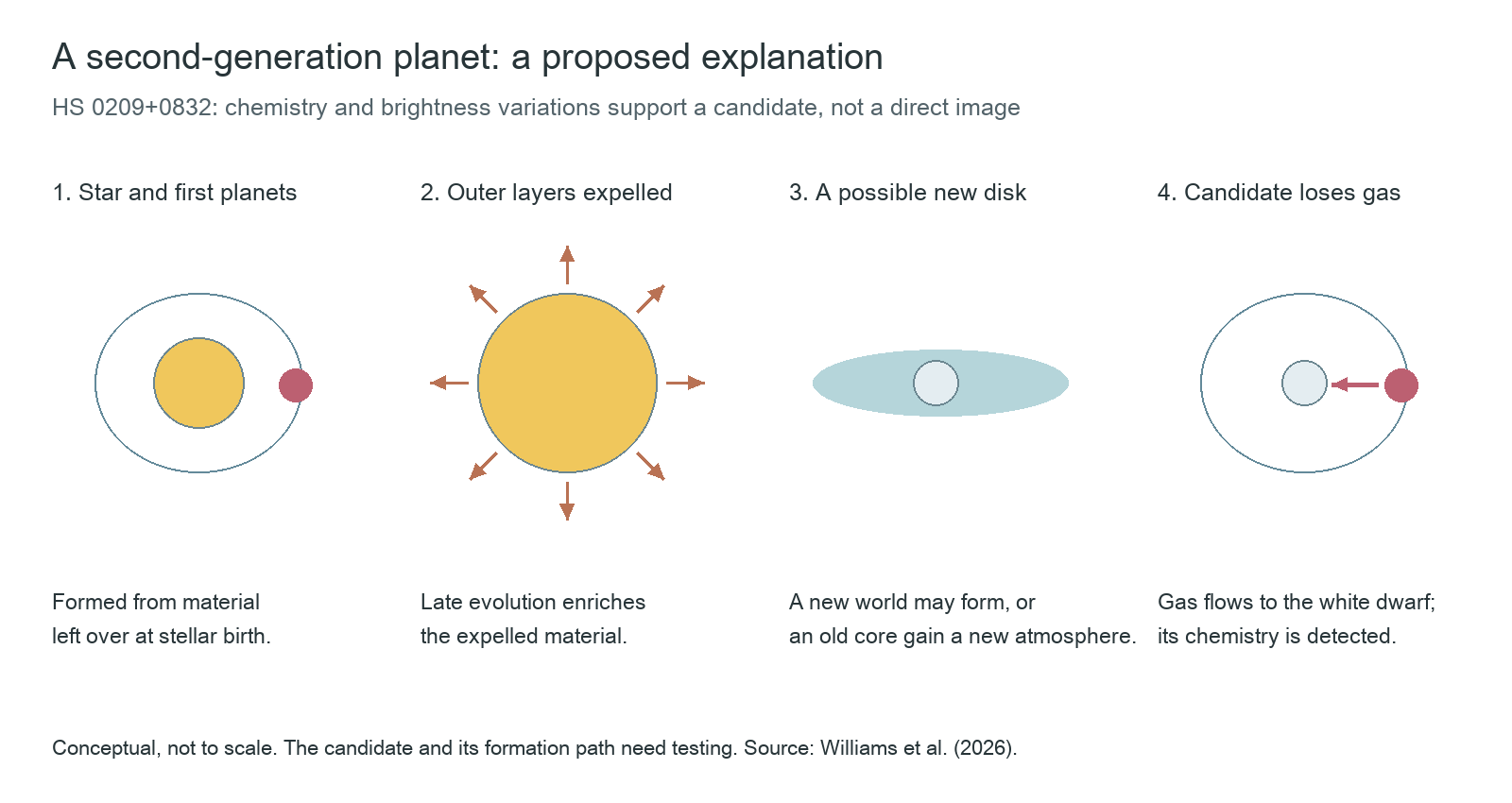
Diagram: The Daily Backstory, based on Williams and colleagues (2026). Not to scale; the candidate and its formation path still need testing.
An Archive Gives a Question Another Chance
The study appeared in Nature Astronomy on October 5. It brought together old spectra, updated atomic data, model calculations and another telescope's brightness records.
The 1999 measurements did not change. Researchers' ability to recognize the signal changed, along with the evidence they could compare it with.
Many Hubble and other mission datasets are available through NASA's MAST archive, operated by the Space Telescope Science Institute. Later researchers can reuse them to ask questions the original observations did not settle.
Discovery can happen beside a telescope. It can also happen on the day an archive is reopened. Preserving the data leaves the next person something to work with.
Sources
NASA Image of the Day: Astronomers Solve Cosmic Cold Case with NASA Hubble Data; NASA Science: research announcement; ESA/Hubble: research and images; Williams et al.: Discovery of a second-generation planet candidate accreting onto a white dwarf; STScI: MAST archive.