
On October 6, Google gives its homepage to a flower that has yet to open. World Space Week runs from October 4 through 10, making today its third calendar day.
Image: Google Doodle, "World Space Week 2026: The Rosebud Nebula" | Original page.
Google says the Doodle celebrates the technology behind astrophotography, using a new view from the James Webb Space Telescope.
The nebula is NGC 7129, about 3,300 light-years away in Cepheus. Google's description places more than 130 young stars there. The Spitzer mission had already introduced it as a pink cosmic rosebud in a Valentine's-themed release in 2004.
A Flower Full of Growing Stars
Spitzer's earlier release described a stellar nursery about ten light-years across. Roughly half the observed stars had circumstellar disks, rings of gas and dust that can supply the materials for planets.
Webb separates different stages of stellar growth within the cloud. The prominent central object, LkHalpha 234, is a pre-main-sequence star with about five to eight times the Sun's mass. It is contracting and heating under gravity; NASA says it will eventually begin fusing hydrogen as our Sun does.
Earlier outflows helped excavate a cavity about 3.5 light-years wide to its left. The red region on the right contains younger protostars. While gathering mass, these objects also eject material that strikes the surrounding gas.
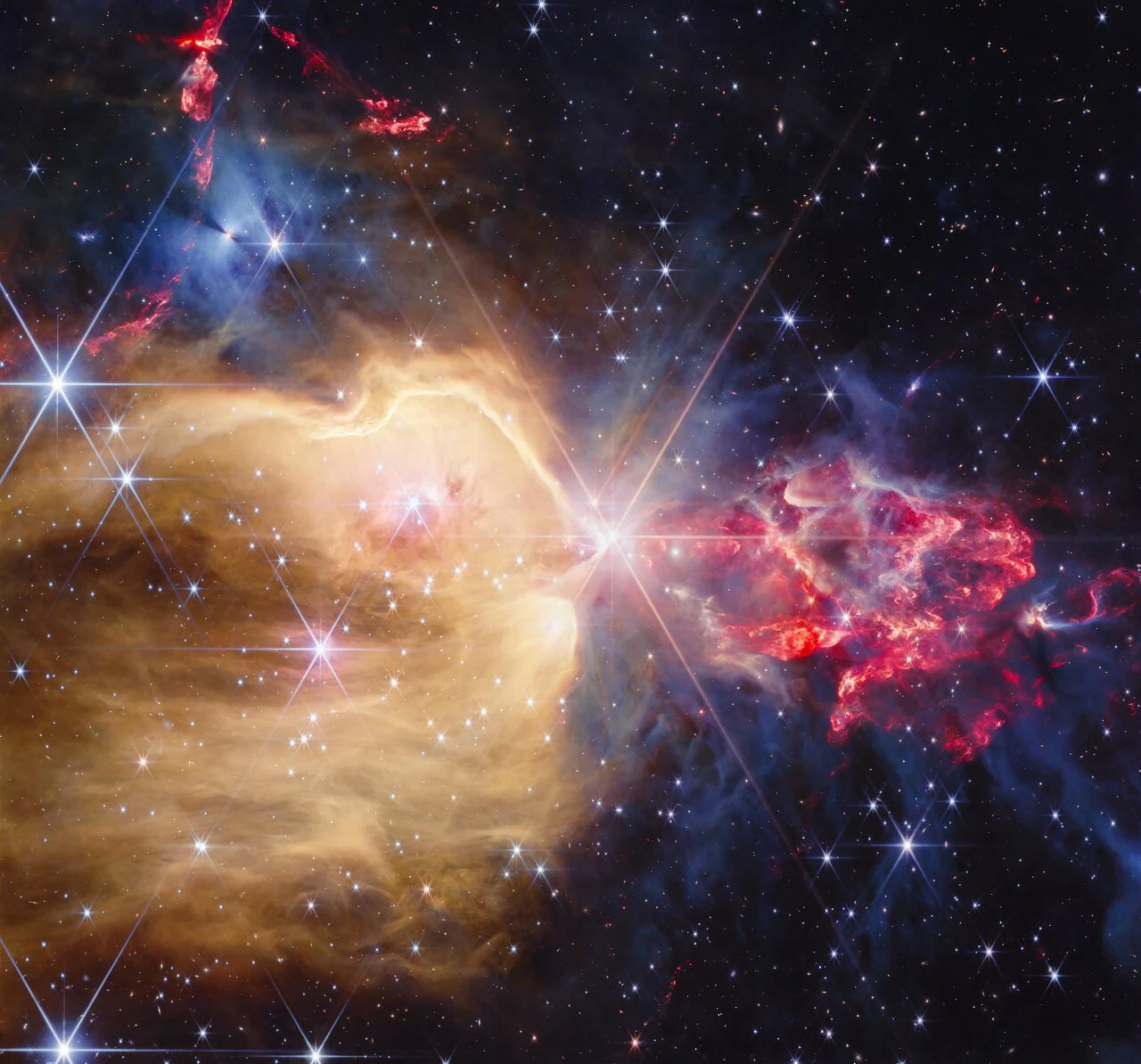
Image: NASA, ESA, CSA, STScI | Image processing: Alyssa Pagan (STScI) | Webb image and explanation.
Pink Is a Translation
Webb detects infrared light, beyond the range of human vision. At many wavelengths, infrared passes through interstellar dust more readily than visible light, revealing young stars previously hidden in clouds. That ability depends on wavelength and the dust itself; infrared does not see through everything.
To display the measurements, image makers assign visible colors to different infrared bands.
Spitzer's 2004 image mapped 3.6 microns to blue, 4.5 to green, 5.8 to orange and 8.0 to red. Its familiar pink rosebud emerged from that combination of infrared data. It was not a promise that a nearby human observer would see the same pink.
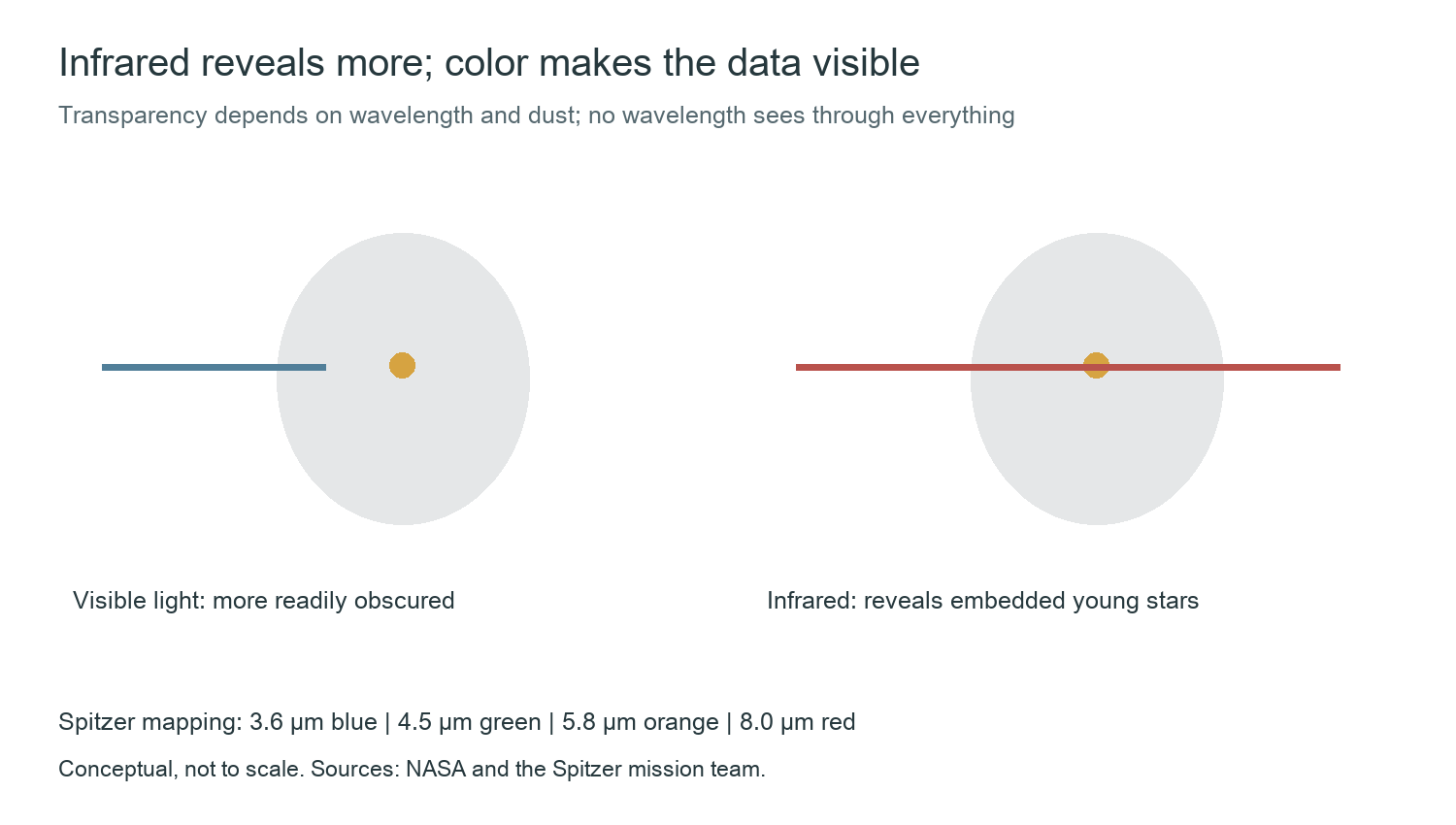
Diagram: The Daily Backstory, based on NASA and Spitzer mission material. Conceptual illustration, not to scale.
NASA describes today's Webb rendering just as explicitly. Hot atomic hydrogen is represented in gold; cooler molecular hydrogen shocked by embedded protostars appears red.
The same nebula can yield different colors through different instruments and mappings. Those choices organize measurements into something we can read. The new detail is the discovery; color helps us see it.
Another Message in the Light
Cepheus also contains Delta Cephei, known in Chinese as Zaofu Yi. It is the prototype of the Cepheid variables.
Their brightness changes periodically, and the relationship between pulsation period and intrinsic luminosity helps astronomers estimate distances. AAVSO's observing guide describes Delta Cephei's cycle as roughly five and a half days and explains how its brightness can be compared with nearby stars.
This is another way of separating information carried by light. Webb distinguishes wavelengths; variable-star observers distinguish moments in time.
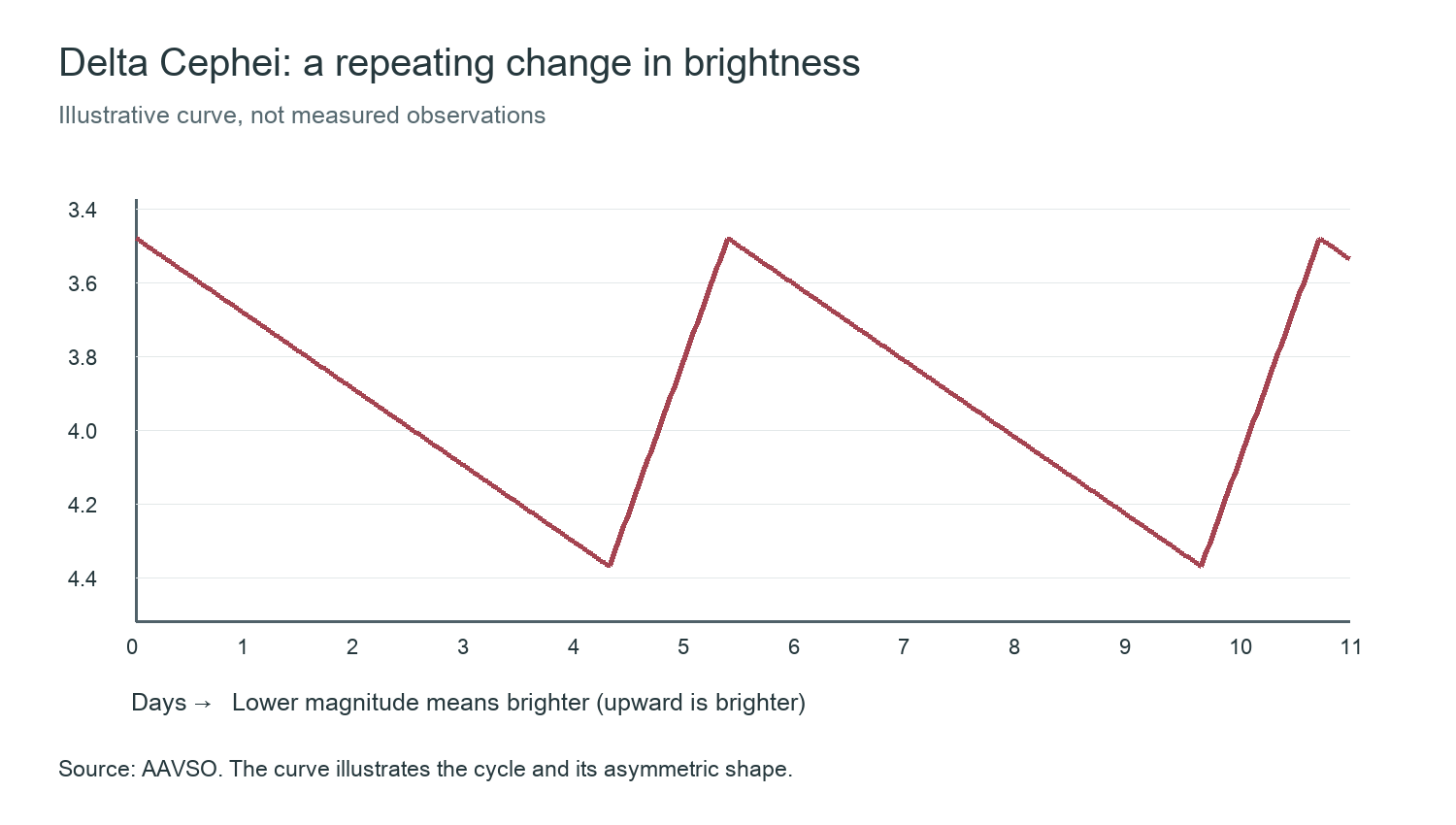
Diagram: The Daily Backstory, based on AAVSO variable-star material. The curve illustrates the cycle and its shape; it is not measured observational data.
A nebula's colors, a young star's outflow, and another star's changing brightness are all information carried by light. What changes is our ability to read it.
Sources
Google's Doodle explanation; United Nations: World Space Week; NASA: Webb captures NGC 7129's stellar jets; ESA/Webb: accompanying release; Spitzer's 2004 release and image color mapping; AAVSO: Delta Cephei observing guide.