
A few lines in old records and delicate filaments photographed from a mountain observatory are helping tell the same story.
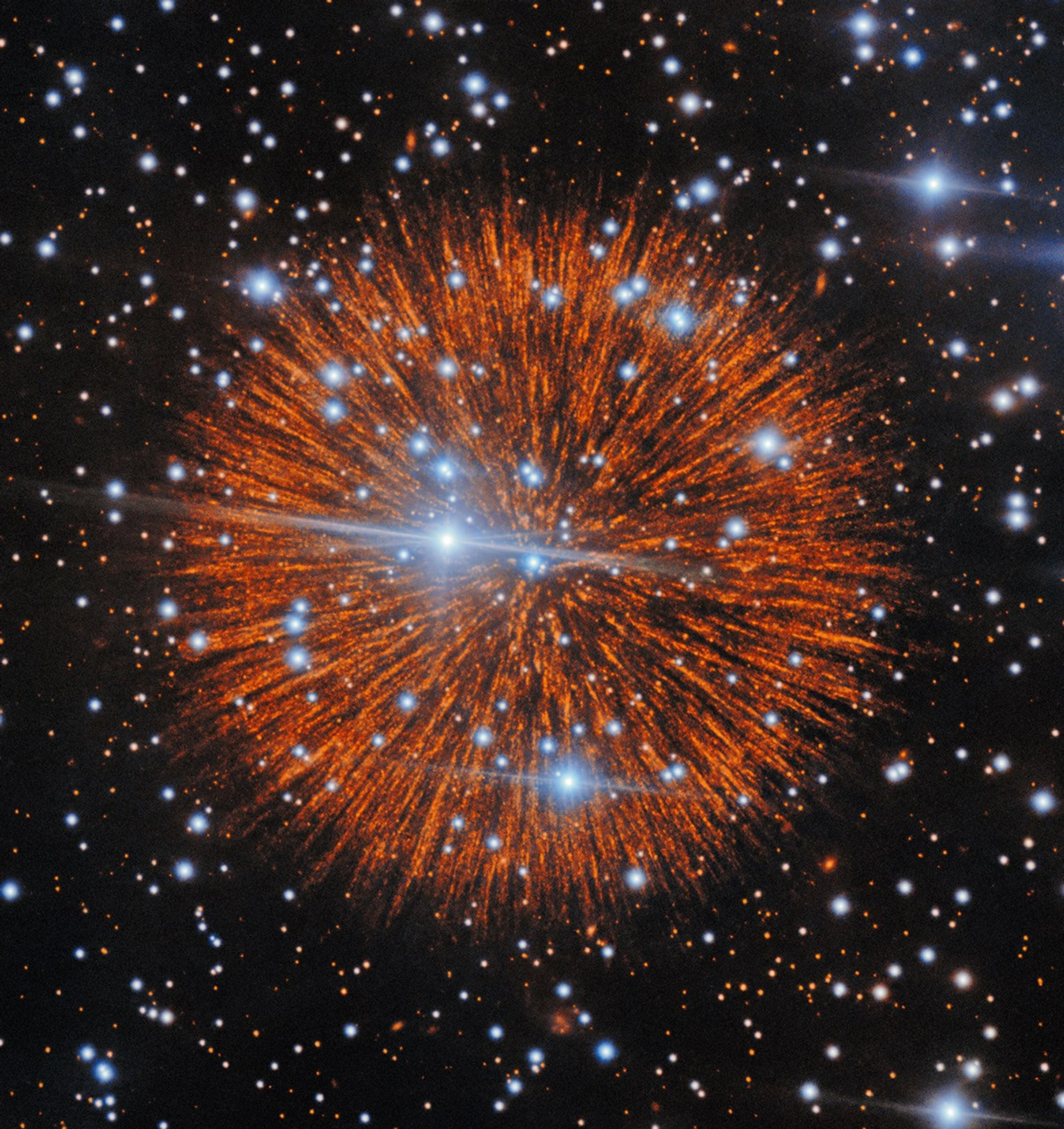
Image: NASA Astronomy Picture of the Day | International Gemini Observatory/NOIRLab/NSF/AURA. Acknowledgment: PI T. Cunningham (Center for Astrophysics - Harvard & Smithsonian). Image processing: J. Miller and M. Rodriguez (International Gemini Observatory/NSF NOIRLab), T.A. Rector (University of Alaska Anchorage/NSF NOIRLab), D. de Martin and M. Zamani (NSF NOIRLab) | Original page.
Today's APOD looks like a firework caught before it fades. Uneven filaments radiate from a central point. This is Pa 30, a nebula roughly 7,500 light-years away toward Cassiopeia, and a strong candidate for the remnant of the supernova seen in 1181.
That year dates the light's arrival on Earth. It had already been travelling for thousands of years. Even the apparent birthday of a cosmic firework depends on where the observer stands.
A Guest Near the Guest House
In August 1181, observers in China and Japan independently noticed a star that had suddenly appeared. Chinese records called such temporary visitors "guest stars."
In 2023, astronomer Bradley Schaefer reanalyzed the historical accounts. Chinese works including the Wenxian Tongkao, Songshi and Jinshi, and Japanese records including Meigetsuki and Gyokuyo, describe its position in relation to ancient asterisms such as Chuanshe and Huagai. Together, the descriptions point toward the area of modern Cassiopeia.
Chuanshe represents celestial guest houses. The name makes a memorable setting for a guest star, but converting the old accounts into a location requires care. Reconstructions disagree about exactly which stars belonged to some ancient asterisms. A historical description is evidence to interpret, rather than a ready-made modern coordinate.
Time matters alongside position. The star remained visible for about 185 days, with no reported movement across the sky.
That helps exclude moving Solar System objects. Remaining stationary for months does not, by itself, prove a supernova. Researchers compare duration, brightness, historical position and the objects now present in that region to narrow the possibilities.
The observers could not explain the explosion. They could leave evidence someone else would eventually test.
An Amateur Discovery Reopens the Question
In 2013, amateur astronomer Dana Patchick found the nebula in WISE infrared survey data. It became Pa 30, Patchick's thirtieth nebula discovery.
Researchers then compared its location, expansion age and unusual properties. A 2021 Chinese Academy of Sciences account reported work linking Pa 30 to the guest star of 1181. An earlier proposed counterpart, 3C 58, faced difficulties including evidence that it was too old.
Pa 30's central star is extraordinary in its own right. The research team's announcement gives a temperature of about 200,000 degrees Celsius and stellar winds moving at roughly 16,000 kilometers per second. Something survived the explosion.
Astronomers associate the system with a Type Iax supernova, an incomplete explosion whose survivor is often nicknamed a "zombie star." A merger of two white dwarfs is one proposed explanation. The precise mechanism remains unsettled.
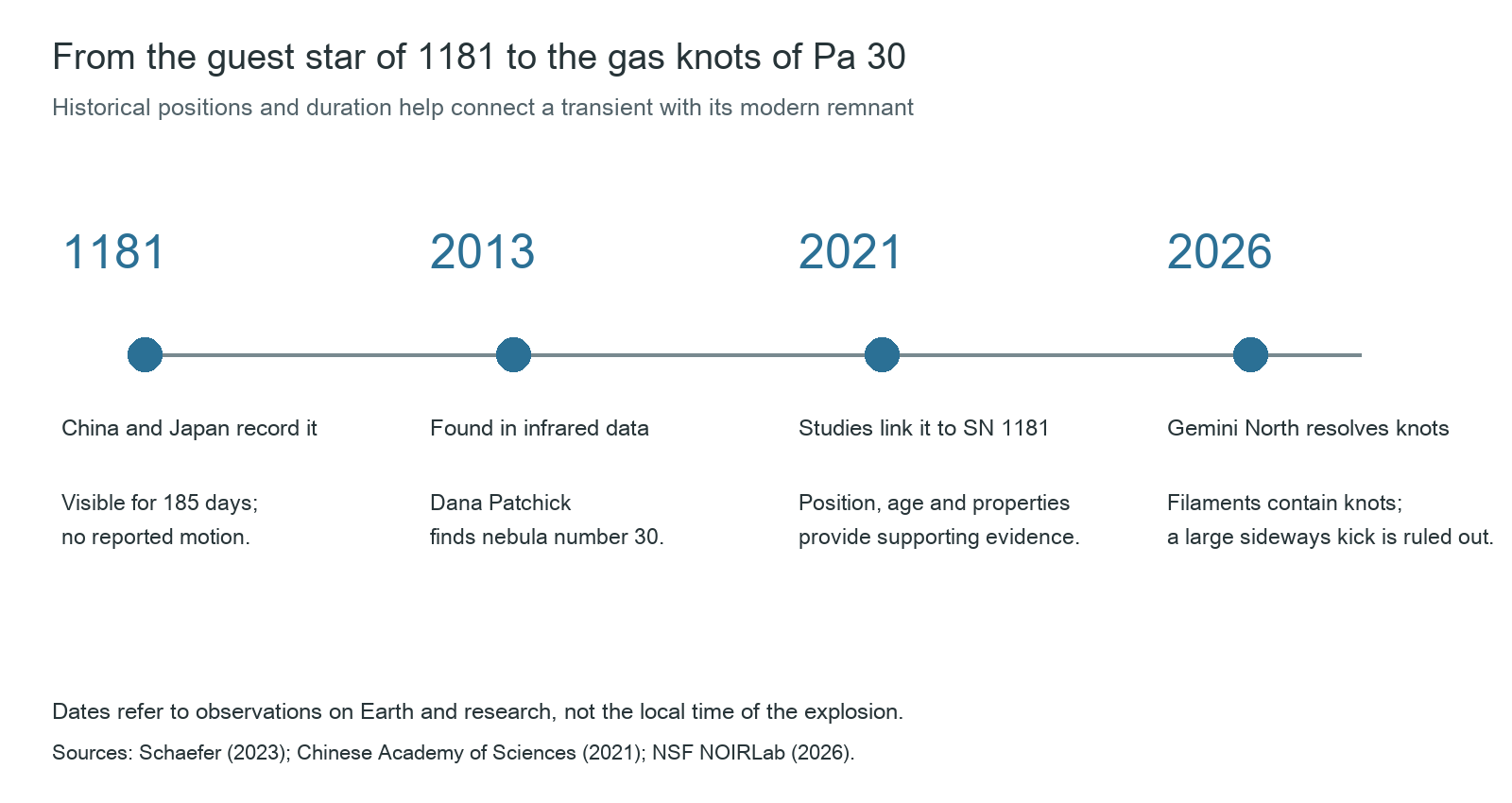
Diagram: The Daily Backstory, based on Schaefer (2023), the Chinese Academy of Sciences (2021) and NSF NOIRLab (2026). Dates refer to observations on Earth and research, not the local time of the explosion.
The Filaments Are Strings of Pearls
New results announced on October 6 come from a study co-led by Tim Cunningham and Ilaria Caiazzo, using Gemini North's GMOS instrument in Hawaii.
The image maps sulfur emission to red and oxygen emission to blue-green. It resolves about ten times more filamentary structure than earlier images. The apparently smooth rays break into chains of gas knots, like pearls on a string.
APOD describes the knots as about four light-days across. Light needs four days to travel from one side to the other. That is roughly eleven times the diameter of Neptune's orbit: a small dot in the picture exceeds the width of the planetary Solar System.
The knots are surprisingly similar in size. Temperature or density variations in surrounding material might help shape them, but their formation still needs to be explained through modeling.
A quieter clue lies at the center. The surviving star sits almost exactly at the remnant's center, allowing researchers to constrain its sideways velocity and rule out a large kick in the plane of the sky.
That supports a relatively symmetrical explosion. It does not establish perfect symmetry in all three dimensions. Constraining the survivor's movement also constrains which explosion models can work.
Look Toward the Old Address
Pa 30 is not a naked-eye target, but Cassiopeia's five bright stars are easier to recognize. On autumn evenings at northern midlatitudes, their tilted W often appears in the northern to northeastern sky. Its height and orientation depend on location and time.
Seeing that region offers a way to think about the observers of 1181. They did not know why the new star appeared. They recorded where it was and how long it lasted. More than eight centuries later, those observations still participate in the research.
An observation does not have to supply its own explanation. Recording what happened gives someone in the future a place to begin.
Sources
NASA APOD: Supernova Remnant Pa 30; NSF NOIRLab: new image and research announcement; Cunningham et al.: Detection of knots in the supernova type Iax remnant Pa 30; Center for Astrophysics | Harvard & Smithsonian; Institute of Science and Technology Austria; Schaefer (2023): the Chinese and Japanese historical observations; Chinese Academy of Sciences: identifying the guest star's remnant.