
Beneath four broad parachutes, the capsule looks like a small, dark pendant. Clouds and sky fill the photograph; the Pacific is still outside the frame. The four astronauts have left the space station, but there is one last stretch before they are back on Earth.
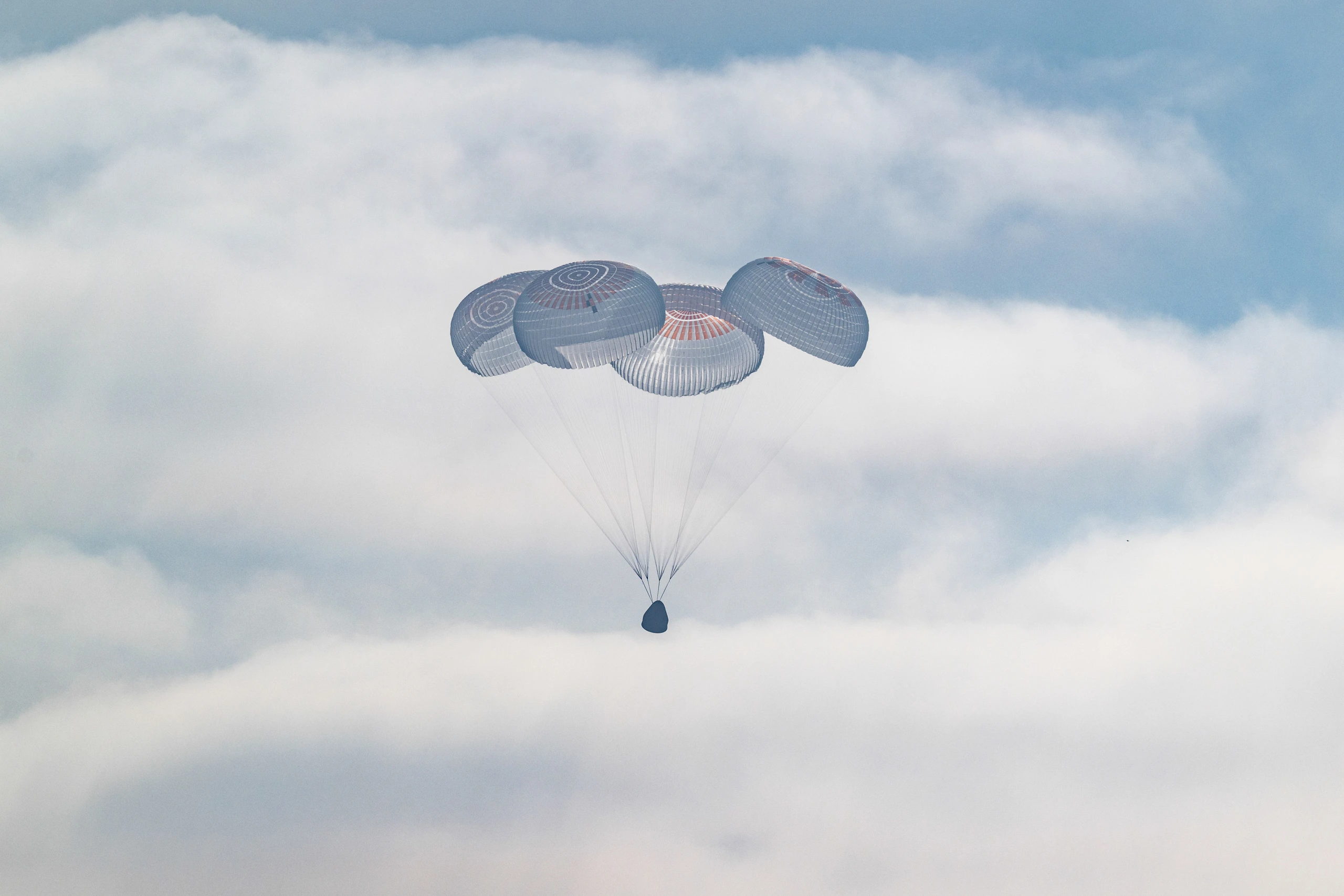
Image credit: NASA/Keegan Barber. Original page. Both the photograph and NASA's image article are dated October 8, 2026.
Inside were NASA astronauts Jessica Meir and Jack Hathaway, ESA astronaut Sophie Adenot, and Roscosmos cosmonaut Andrey Fedyaev. Their SpaceX Crew Dragon, Freedom, returned off Los Angeles. NASA's splashdown record gives the time as October 8 at 11:34 a.m. EDT: 8:34 a.m. in California and 11:34 p.m. in Beijing.
NASA's mission release records a total mission of 237 days, while the splashdown blog reports 235 days aboard the station. Travel to and from the station accounts for the difference. The release also records more than 3,792 orbits and more than 100 million miles traveled.
The crew worked on research involving stem cell production, making intravenous fluids on demand, heart damage associated with pneumonia, nutrition and blood flow. Meir completed four spacewalks; Adenot completed three and became the first French woman to walk in space. That long working schedule ends here in a single photograph of the journey home.
Parachutes handle the final stretch
A spacecraft cannot begin its return from orbit by opening its parachutes. First comes a deorbit burn, which changes its trajectory so that its path enters the atmosphere. NASA's updates that day confirmed that Freedom had completed the burn.
Atmospheric drag then slows the capsule. Gas ahead of it is strongly compressed and heated, and the thermal protection system protects it during this part of the descent. Parachutes take over only after its speed and altitude have fallen.
NASA's deorbit-burn update described the planned sequence: small drogue parachutes first, to stabilize and slow the capsule, followed by the main parachutes. The broad canopies in the photograph catch air and slow the last part of the descent. They do not take the capsule directly from orbital speed to splashdown speed.
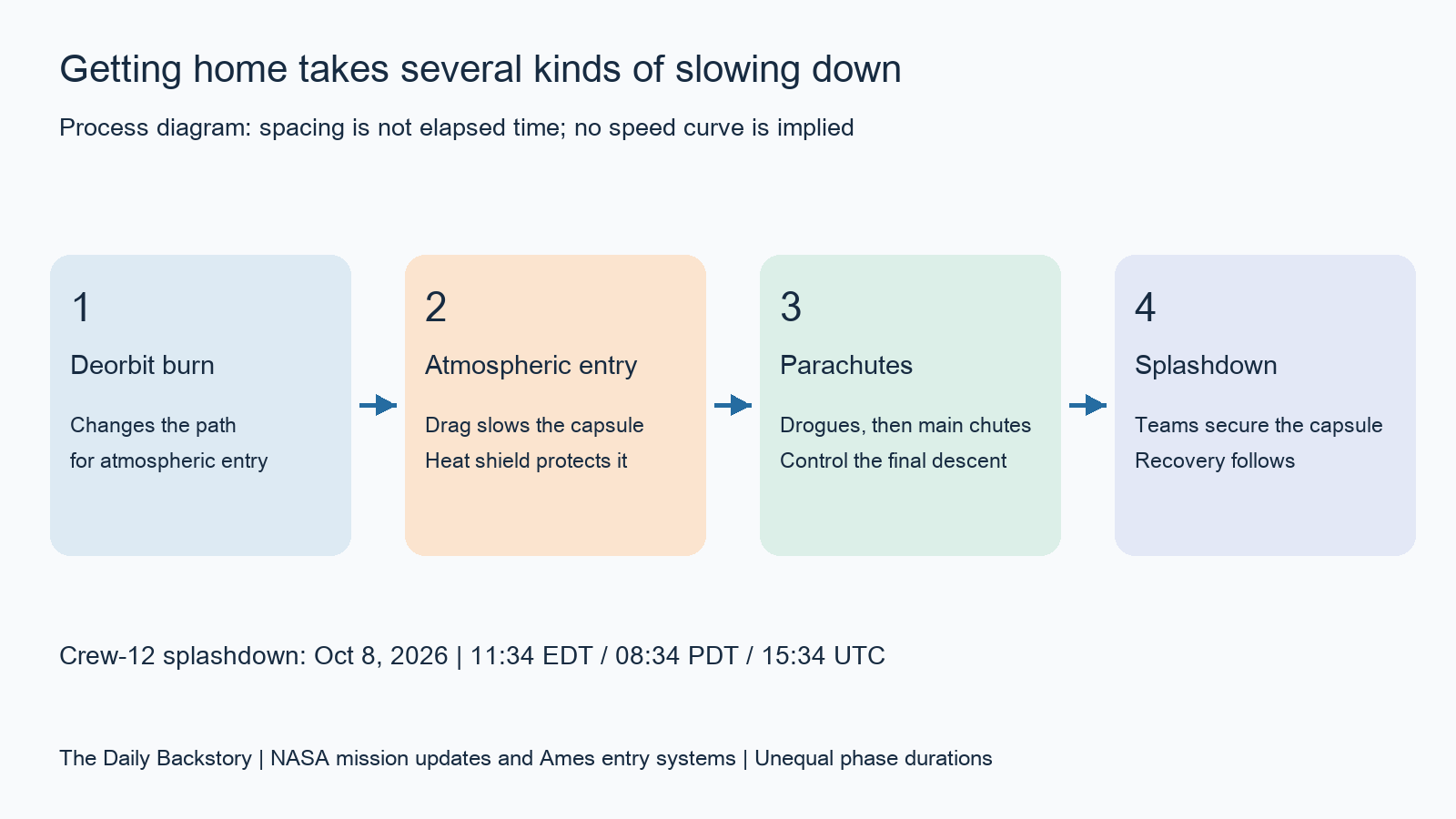
Diagram: Laili. Each stage has a different job. Spacing does not represent elapsed time, and this is not a measured speed curve.
Reaching the water is not the whole homecoming
NASA's update after splashdown said that the recovery ship's team and two fast boats were securing the spacecraft and making sure it was safe to recover. After the astronauts reach the water, crews still have to stabilize the capsule, approach it, check it and bring them aboard.
This quiet-looking photograph catches one moment in that process. Follow NASA's updates through deorbit preparations, completion of the burn and splashdown, then browse the photo collection for what changes before and after landing. Parachutes, capsule, boats and people take their turns.
You can also look for the station yourself. NASA's Spot the Station provides location-based sighting information, with times in the selected location's local time zone. On a clear evening or morning, look for a bright point moving steadily across the sky without an aircraft's blinking lights. Visibility depends on the station being sunlit while the sky below you is dark enough.
NASA has scheduled a mission briefing for October 15 at 3:30 p.m. EDT, or October 16 at 3:30 a.m. in Beijing. Meir, Hathaway and Fedyaev will attend; Adenot is returning to Europe and will not join this briefing. Check the mission release for the latest details closer to the date.