
A brilliant crescent fills the lower part of the photograph. Above it hangs a bright point with four smaller points nearby. Count the moons: there are five. The large one orbits Earth; the other four belong to Jupiter.
NASA chose this photograph by Chirag Upreti for its Astronomy Picture of the Day on October 12, 2026. Taken from Westchester, New York, it consists of a series of exposures near an alignment of the Moon and Jupiter. Their apparent closeness is a trick of our viewing direction. They occupy very different neighborhoods of the solar system.
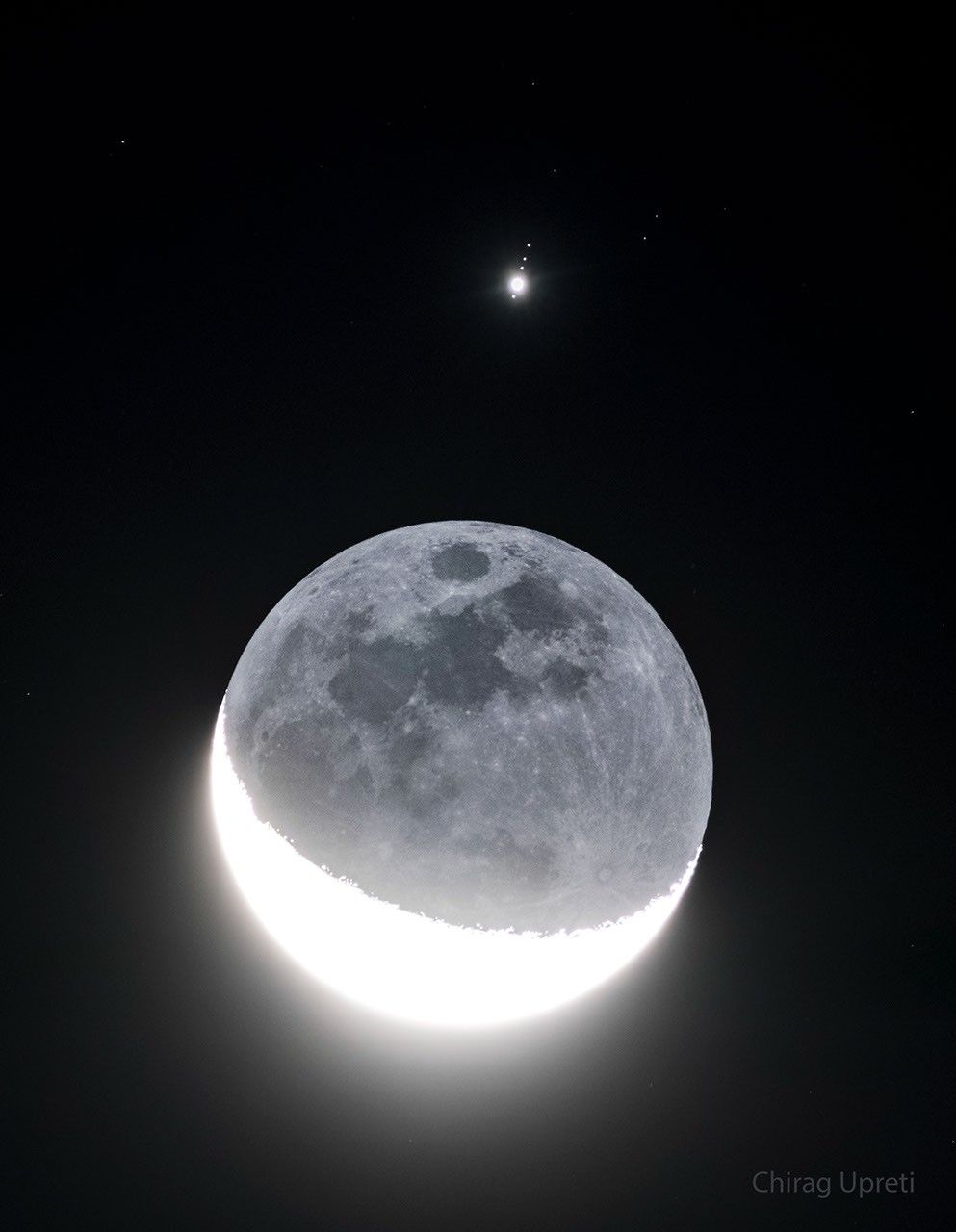
Image: NASA Astronomy Picture of the Day. Credit & Copyright: Chirag Upreti. Original page.
When the Moon crosses Jupiter
APOD explains that Earth's Moon passed in front of Jupiter the previous week. Astronomers call that an occultation: a nearby object hides something farther away, much as a finger held in front of your eye can cover a distant lamp. This photograph shows the objects near alignment, with Jupiter still visible.
Whether you see an actual disappearance depends on where you stand. From another part of Earth, the nearby Moon shifts against the distant background. A view photographed in New York does not establish that observers everywhere saw the same event.
A lamp on the lunar night side
The sunlit crescent is overexposed, glowing almost white. But look beyond it. The portion of the Moon facing away from the Sun is visible too, as though someone has turned on a dim lamp.
That lamp is Earth. Sunlight reaches our planet, some of it reflects toward the Moon, and the lunar surface reflects it back to us. This roundabout illumination is called earthshine. Even a lunar night can be lit by a bright Earth in the sky.
When we see a thin crescent Moon, an observer on the Moon would see a nearly full Earth. That geometry sends plenty of reflected sunlight toward the lunar surface facing us. Nearly full matters: a visible lunar crescent does not require a completely illuminated Earth.
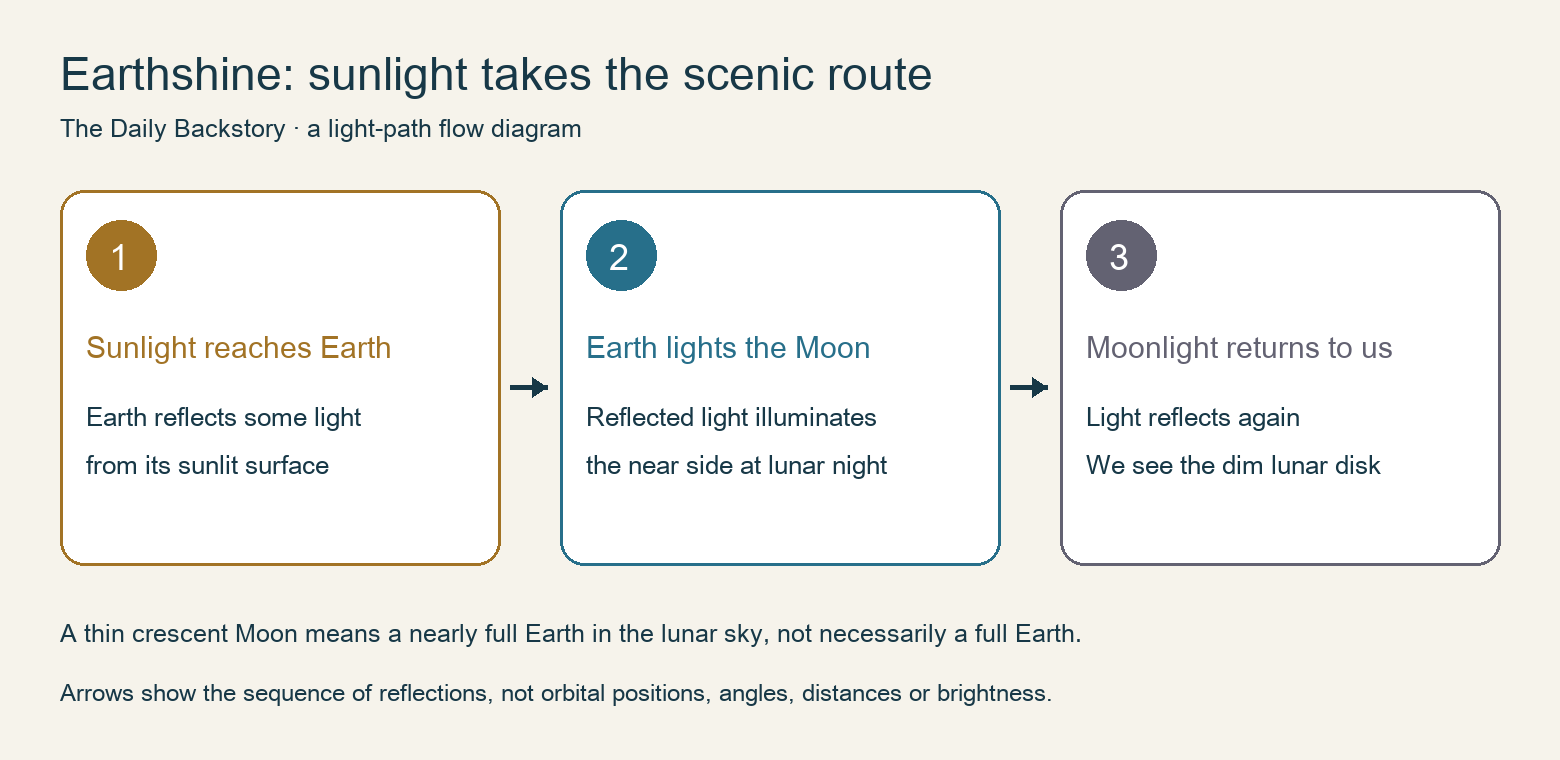
Explanatory diagram: The Daily Backstory, based on NASA's earthshine explanation. Arrows show the sequence of reflections, not orbital positions or relative brightness.
The explanation has a long history. In its account of earthshine research, NASA recalls Leonardo da Vinci's explanation of the phenomenon. Researchers also use the Moon as a natural mirror to study how much sunlight Earth reflects. Changes in clouds, snow, ice and land surfaces can change the light that returns.
Four points, four worlds
APOD identifies the Jovian moons in this photograph, from bottom to top, as Ganymede, Io, Callisto and Europa. This is their projected order at the time of the exposures. Their orbits will rearrange the pattern on another night.
NASA's guide to Jupiter's moons calls these four the Galilean satellites, after Galileo's observations in 1610. A NASA historical account records that he saw three points near Jupiter on January 7, then identified a fourth. By January 15, he had concluded that they were moons orbiting Jupiter. Here was concrete evidence of celestial bodies circling something other than Earth.
Their individual names came from someone else. A NASA educational guide credits Simon Marius with publishing the mythological names in 1614, following Johannes Kepler's suggestions. Observation, interpretation and naming can leave different people's fingerprints on a discovery.
The moons look tiny because they are far away. Ganymede is the solar system's largest moon, bigger even than Mercury. Ganymede, Callisto and Io all exceed Earth's Moon in diameter; Europa is slightly smaller. Beneath those similar points of light lie very different places. Io is famous for intense volcanic activity, while Europa may harbor a liquid ocean below its ice. A point in a photograph can be an entire world.
Spacecraft can go closer. Juno flew past Ganymede on June 7, 2021, and Europa on September 29, 2022. Its close Io encounters followed on December 30, 2023, and February 3, 2024. NASA reports that both Io flybys came within about 1,500 kilometers of the surface. What appears as a dot from Earth can reveal ice, terrain or volcanoes to a passing probe.
To recognize these moons yourself, try a telescope session at a planetarium or astronomy club when Jupiter is visible. Sketch the little points beside the planet, then return another night. A moon can hide behind Jupiter or cross in front of it, so counting fewer than four does not mean one has vanished. Keep telescopes and binoculars well away from the Sun.
NASA's October 2026 skywatching guide offers two other outings: the Orionid meteor shower's October 21-22 peak, and the Moon's approach to the Pleiades on October 27-28. The meteors come from debris left by Halley's Comet; NASA recommends watching before dawn after the bright Moon has set. For the Pleiades encounter, use a sky chart set to your own location. Times on NASA's US-oriented illustrations should not be transferred directly to another time zone, and whether the Moon actually covers the cluster depends on where you observe.