
A blue lake sits inside a ring of gold and orange woodland. At its edge, water spills over a low barrier covered in vegetation, separating into small waterfalls. In Bing's October 13 China wallpaper, one of the most interesting parts of Croatia's Plitvice Lakes National Park lies just beneath the water's feet.
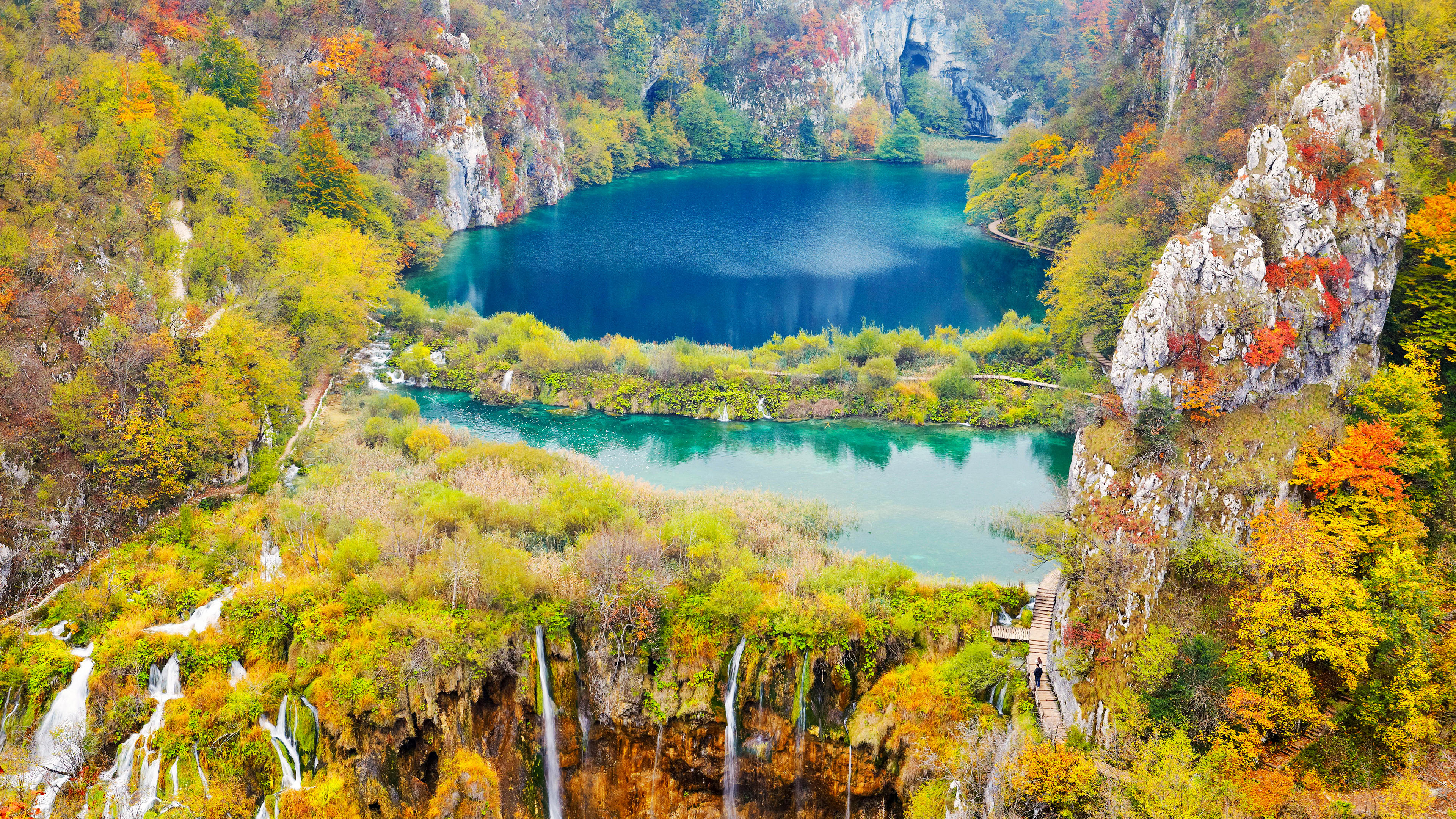
Image: Plitvice Lakes National Park, Croatia (© Jan Wlodarczyk/Alamy). Original page.
There are 16 larger named lakes and other, smaller unnamed waters. Water passes from one lake to the next over barriers of tufa, a porous rock made from calcium carbonate. Deposition builds those barriers; erosion wears them away. The park entered the UNESCO World Heritage List in 1979 in recognition of a natural process still at work, as well as the landscape it creates.
Building materials carried by water
Plitvice belongs to the Dinaric karst region. Water containing carbon dioxide seeps through cracks and dissolves carbonate rocks, carrying their ingredients into streams. Under suitable conditions, calcium carbonate comes out of solution as tiny crystals. The park's account of its geology connects these two sides of the story: water can cut a canyon and build a threshold that holds a lake.
Tufa forms in fresh water near ambient temperature. The park uses that term to distinguish its deposits from the hot-spring settings often associated with travertine.
As water tumbles, churns and splashes, carbon dioxide escapes more readily. The resulting change in chemical balance encourages calcium carbonate to precipitate. A study of tufa formation at waterfalls identifies this degassing as a key mechanism. Strong flows also erode barriers, so a faster waterfall does not necessarily mean faster net growth.
Living things help give the accumulating rock its structure. Bacteria and algae form communities on stones, moss and other submerged surfaces. Their secretions bind calcite crystals, providing starting points for further deposits. A moss plant's lower parts can become coated in mineral while its upper parts continue to grow. Soft green cushions leave their shapes in stone.
The park's description of these organisms includes an unexpected contributor: caddisfly larvae. Even their protective cases can provide places for crystals to attach.
How two lakes become one
A rising barrier can raise the water behind it, but every barrier has its own history. Beneath Kozjak, the largest lake, lies an old barrier about 400 meters wide and 36 meters high. Its top is roughly 6 meters below the surface. On sunny days, passengers on the lake's boat can sometimes see its pale trace below them.
The park's 2023 account explains that this was the site of two lakes until about 400 years ago. A theory proposed in 1958 held that a downstream barrier grew faster, raising the water until it submerged the upstream one. Dives in autumn 2019 found a place where part of the old barrier probably broke away, leaving a channel about 4 meters deep. That supplied another explanation for the merger. A plausible story still has to answer to the evidence underwater.
Water levels and flows can also reveal changes in barriers. Radišić and colleagues' 2021 study used records from 2001 to 2020 to estimate that Kozjak's outlet barrier fell by about 11 centimeters over that period, an average of roughly 5.5 millimeters a year. This was a hydrological inference, not a direct ruler measurement of the crest. Growth in earlier records and erosion in a later period both belong to the landscape's history.
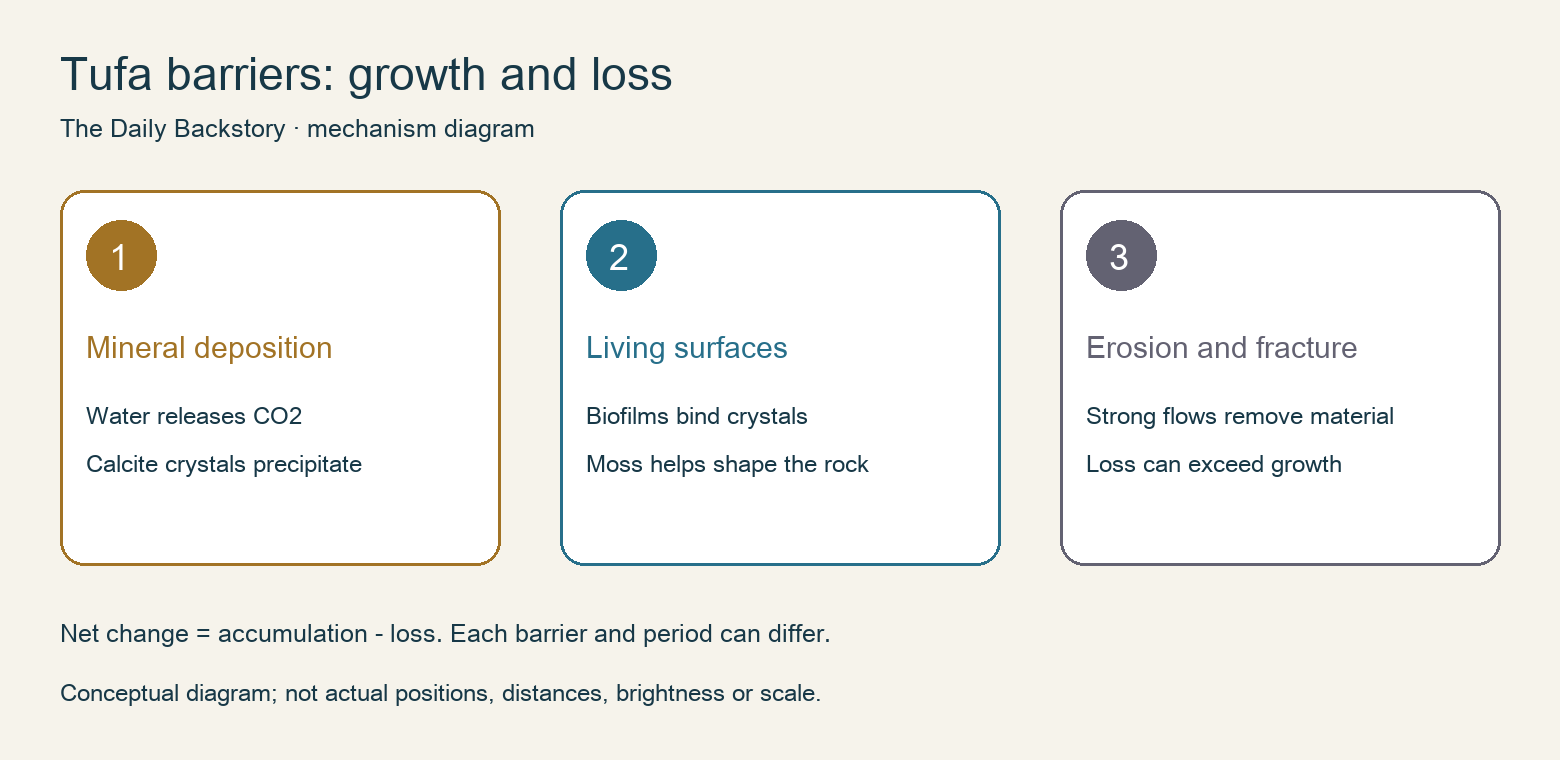
Explanatory diagram: The Daily Backstory. Accumulation and loss can occur together; their balance determines the net change. Not to scale.
The park's tufa overview estimates the age of active barriers at 6,000 to 7,000 years. That describes a different object from the lake system, estimated at 12,000 to 15,000 years. Older barrier remains at higher elevations beside today's watercourses fall into two age groups: roughly 90,000 to 130,000 years and 250,000 to 300,000 years. Asking how old a landscape is first requires deciding which part you mean.
Related processes appear in China's scenic lakes, too, although Jiuzhaigou's lakes cannot all be attributed to tufa: rockfalls and landslides can also dam water. A study of tufa degradation there describes degassing and biological activity in deposition, and substances such as phosphate that can inhibit it. Pool edges offer clues as well as beautiful colors.
In its 2025 conservation assessment announcement, Plitvice reported an improved overall outlook: "good with some concerns." Water quality remained good and tufa formation continued. That broad assessment can coexist with a particular barrier losing height during a particular period.
The narrow boardwalk in the photograph offers a place to look closely. Notice where water crosses a crest, where it remains still, and where moss grows beside a cascade. If you visit, follow the park's rules of conduct: stay on marked paths and leave plants in place. Some of those small green things are helping build the view.