
A tight spiral is embedded in stone, its ribs spreading around the coil. It resembles a snail shell, but its owner lived in the Jurassic sea. Today's Bing wallpaper shows ammonite fossils.
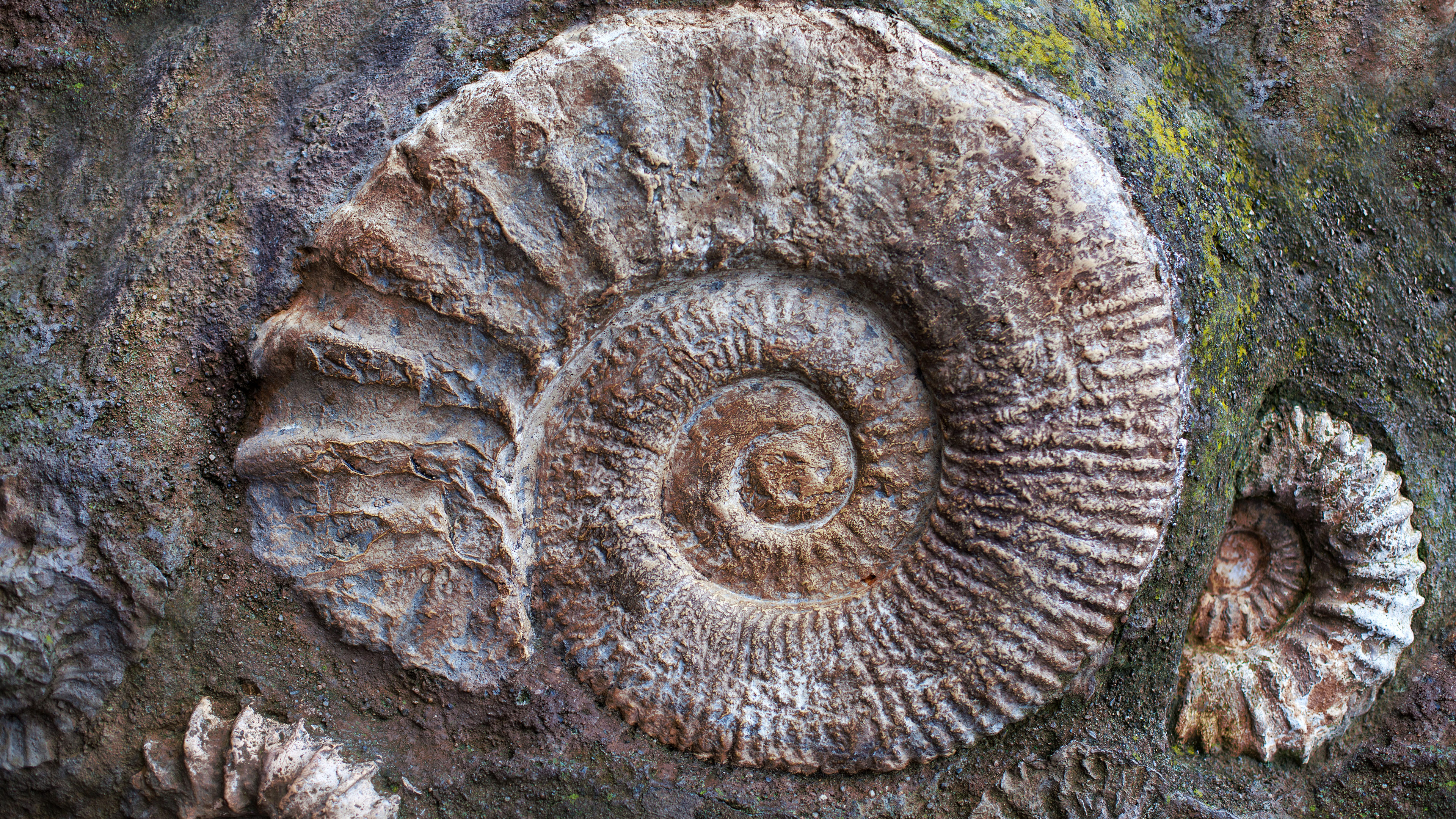
Image: Bing daily wallpaper. Jurassic ammonite fossils (© J Nemchinova/Getty Images). Original page.
A shell with rooms
Ammonites were extinct cephalopods, members of the wider group that includes squid and octopuses. A shell does not make an ammonite another name for a living nautilus.
The Natural History Museum's guide describes how the animal began with a tiny shell and added larger spaces as it grew, closing older ones with partitions called septa. Its body occupied the outermost living chamber. Behind it remained a series of chambers involved in buoyancy, allowing the animal to carry its shell through water.
The ribs visible on the fossil's surface cannot simply be counted as internal partitions. A cut section or a scan is better for examining the chambers. They are no dependable monthly calendar, either: twelve chambers do not establish a year of life.
Many ammonites formed a flat spiral, but the group produced much more variety. Some coils were loose; some shells straightened later in growth; others developed knotlike forms. Shape and ornament are both worth examining.
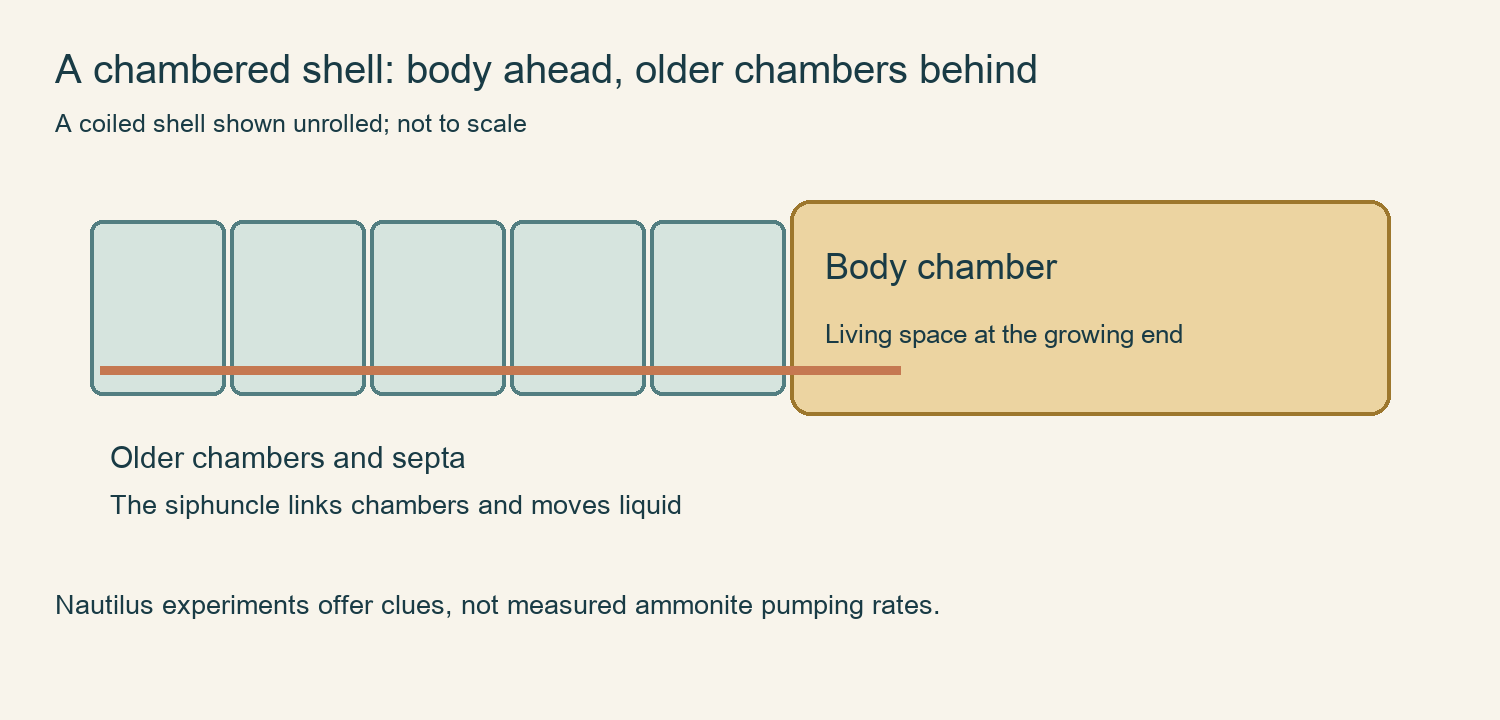
Diagram: The Daily Backstory. The body occupies the growing end; a siphuncle connects older chambers. Shown unrolled, not to scale.
What a living nautilus can tell us
A thin organ called the siphuncle passes through the chambers and helps move liquid. Removing liquid can offset the increasing weight of shell and body. This process should not be imagined as a submarine rapidly flooding and emptying ballast tanks.
In a 1981 experiment, Peter Ward, Lewis Greenwald and Yves Magnier used repeated X-ray observations of living Nautilus macromphalus. Nine specimens emptied chambers at an average rate of about 0.75% of total volume per day, reaching half-empty in roughly 67 days. Combining that rate with the later emptying stage, the authors estimated complete liquid removal at about 135 days for animals at the surface. Chamber-formation events in these aquarium animals occurred about 70-120 days apart.
Those are measurements and estimates for living nautiluses. They do not establish how long an ammonite took to empty a chamber. Nautiluses provide a useful comparison, while the elaborate architecture of ammonite shells may have behaved differently.
A 2021 study by David Peterman, Kathleen Ritterbush and colleagues tested another part of that architecture with 3D-printed models. Could more folded partition edges retain more water through surface tension? Comparing shapes, including models with a water-attracting coating that imitated a biological membrane, they generally found greater liquid retention along complex edges. This supports an explanation involving buoyancy management. The models measured relative retention potential, not the exact water content of a living ammonite. One experiment also cannot establish a single evolutionary purpose for every fold.
A fossil that helps match rock layers
Ammonites were widespread, and some groups evolved rapidly. As the museum explains, their fossil assemblages help geologists correlate Mesozoic rocks across different places. The useful question is which animals occur in which interval.
Fossils can record more than bodies. The museum's guide to fossil preservation distinguishes body fossils from trace fossils, including footprints and burrows. Buried shells can survive in different ways; this photograph alone cannot identify a particular history of mineral replacement.
The U.S. National Park Service sets National Fossil Day 2026 on Wednesday, October 14, celebrating fossils' scientific value and the importance of preserving their context.
At your next natural history museum visit, compare a whole ammonite shell with a cut section. Where was the final living chamber? Where do the smaller rooms begin? Or try the museum's salt-dough ammonite activity, using the shapes and ribs you have observed. Your model can be a record of close looking, even though it cannot replace the fossil itself.