
A bear hangs from a balloon, bees buzzing nearby, while Google's letters make room for him. Today's Doodle takes Pooh back to the page, without the familiar red shirt.
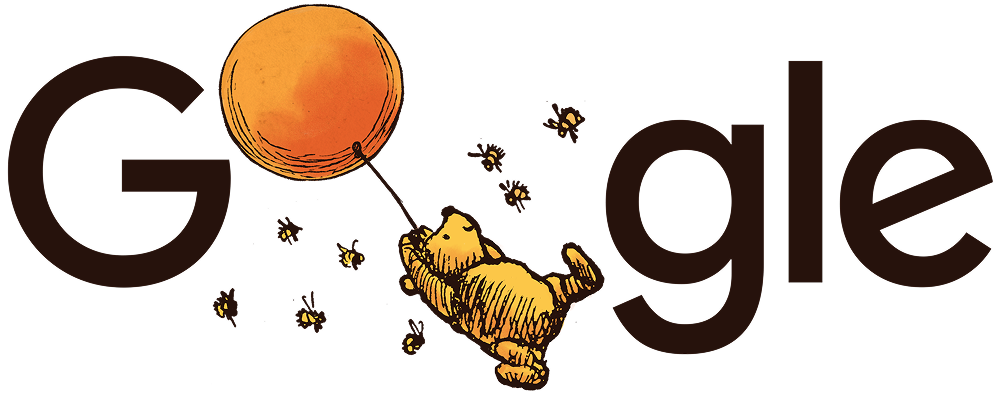
Image: Google Doodle, a colored rendition of E. H. Shepard's illustration. Original page.
Google's account explains that the artwork recalls the first-edition cover of A. A. Milne's Winnie-the-Pooh, using Shepard's bear swinging from a balloon. It marks one hundred years since the book's first publication. London Zoo's historical account gives that date as October 14, 1926.
A toy named after a real bear
Christopher Robin had a real counterpart: Milne's son. For his first birthday in 1921, he received a teddy bear from Harrods in London. The New York Public Library's timeline records the day as August 21. The toy's birthday and the book's anniversary belong to different calendars.
The name Winnie came from a female black bear at London Zoo. According to the zoo's own history, Canadian veterinarian Harry Colebourn bought the orphaned cub and named her after Winnipeg, where he lived. She accompanied his regiment to Britain in 1914. Before going to the battlefields of France, he placed her in the zoo's care. Milne and his son later visited Winnie, and Christopher Robin gave her name to his toy.
A real bear, a stuffed bear and a fictional bear meet in that name. Milne supplied the stories; Shepard's drawings gave their characters movements and expressions.
Pooh had already appeared before 1926. The library's timeline records "The Wrong Sort of Bees" in the London Evening News on Christmas Eve 1925. This centenary belongs to the book. The House at Pooh Corner followed in 1928.
The Hundred Acre Wood has roots in real ground
The Conservators of Ashdown Forest describe how Milne lived at the forest's edge and drew on explorations with his son. A bridge, a sandy patch or a woodland clearing could become a place for an adventure. The imaginary map carries traces of ordinary outdoor life.
To follow today's balloon into the book, open the library's 1926 edition and notice how Milne's words work alongside Shepard's black-and-white lines. If you visit the actual forest, consult its managers' route information and choose a walk that suits you. Bring a small notebook. Which tree or bridge near your own home might become the beginning of a story?