
Above a forest, an orange point glows beside a scattering of stars. Higher up, green and pink aurora hangs like a curtain. Their closeness in the photograph is the part most likely to mislead us.
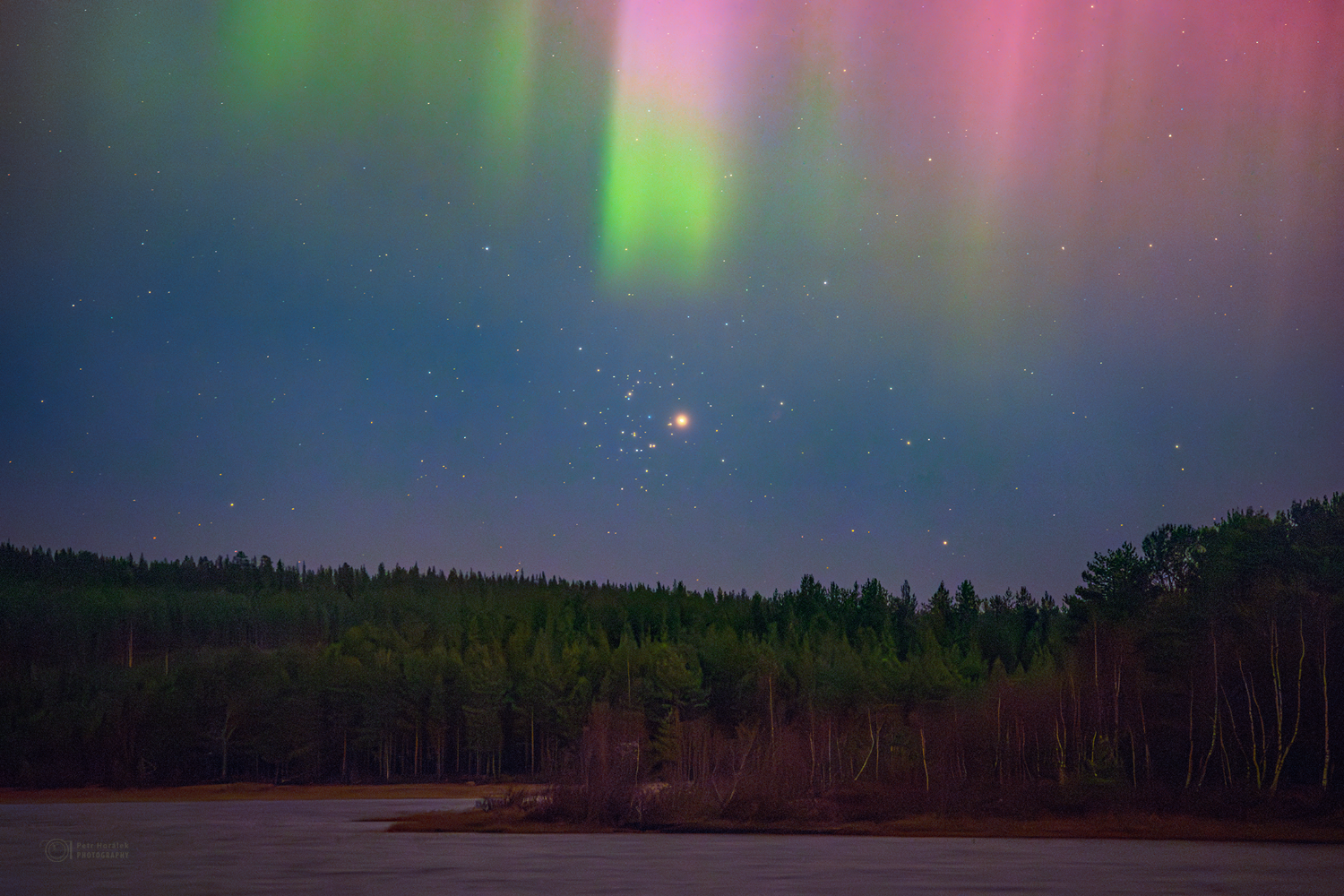
Image: NASA Astronomy Picture of the Day. Credit: Petr Horálek (Institute of Physics in Opava), Josef Kujal, Vojan Höfer. Original page.
NASA selected the picture on October 14. The photographer's account dates the scene to October 10, near Lansjärv, Sweden. A bright aurora appeared while Mars lay close to the center of M44, the Beehive Cluster, in the sky.
Close along our line of sight
Mars belongs to the Solar System. The Beehive is a distant group of stars. Their apparent meeting is an alignment as seen from Earth, like photographing a nearby streetlight against a faraway mountain. A flat picture compresses depth.
NASA's M44 observing guide places this open cluster in Cancer. It spans about 1.5 degrees, roughly three full-moon diameters. Unaided eyes may see a blur; binoculars can resolve around twenty stars. Conditions matter, so every observer should not expect the same count.
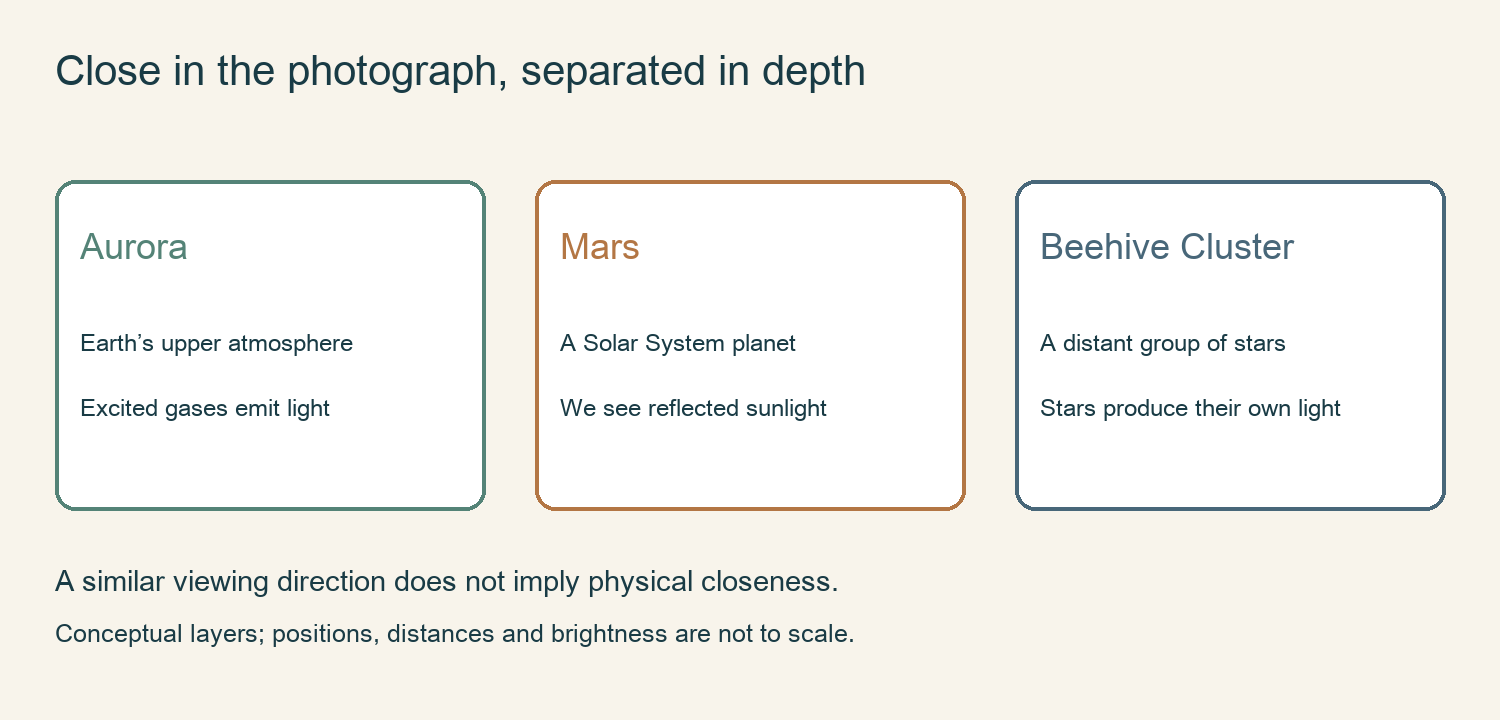
Diagram: The Daily Backstory. Earth's atmosphere, a Solar System planet and distant stars can share a line of sight. Not to scale.
The curtain glows in our own atmosphere
The aurora forms in Earth's upper atmosphere. NOAA's tutorial explains how energetic electrons following magnetic field lines collide with oxygen atoms and nitrogen molecules, transferring energy. As the excited particles return to lower energy states, they release light.
Oxygen produces green and red emissions; nitrogen contributes other colors. The gas, altitude and particle energy all matter. A colored patch in this photograph cannot by itself establish the exact height of a ray.
NOAA also notes that digital cameras can detect faint colors that eyes struggle to distinguish. A photograph's vividness does not necessarily match the unaided view. In this case, however, the photographer specifically reports an aurora bright enough to illuminate the landscape.
A cluster helps calibrate a stellar clock
The Beehive's stars formed at roughly the same time, giving astronomers a shared background against which to compare rotation. Sun-like stars can slow as magnetized stellar winds carry angular momentum away. Astronomers use this relationship to help estimate ages, but the clock needs calibration for a star's properties. It is not one rule that every star follows throughout its life.
A 2021 paper by Rayna Rampalli and colleagues combined three K2 observing campaigns to assemble rotation periods for 1,013 stars in the approximately 670-million-year-old cluster, including 220 new measurements. Among 331 likely single stars with at least two high-quality observations, more than 95% had periods agreeing within 10%. These are not 1,013 equally secure age readings. The study distinguishes measurement quality and flags confirmed or suspected binaries, whose companions may affect rotation or contaminate the signal.
Usually, a star is too far away for us to watch its surface turn. Researchers instead analyze repeating changes in brightness, rather as the rhythm of a revolving lamp reveals its period. Changing starspots complicate the signal, making repeat observations valuable.
Horálek used a Canon Ra with a lens at 200 mm, f/2.8 and ISO 10000, exposing for 1.6 seconds from a tripod. A short exposure helps capture a changing scene. Those settings should not be confused with his separate wide-angle aurora gallery, made with a 12 mm lens and two-second exposures.
To find the Beehive yourself, use NASA's chart to recognize Cancer, then try binoculars under a dark sky. Northern Hemisphere spring evenings offer a convenient opportunity. The Mars alignment in this October photograph has already happened; it does not promise the same arrangement tonight. For auroras, consult NOAA's current forecast, along with local cloud and darkness conditions.