
A golden glow behind the hills spreads upward into a fan, with a short rainbow stretched across it. At first glance, the camera seems to be facing a setting Sun. The real Sun is behind the photographer.
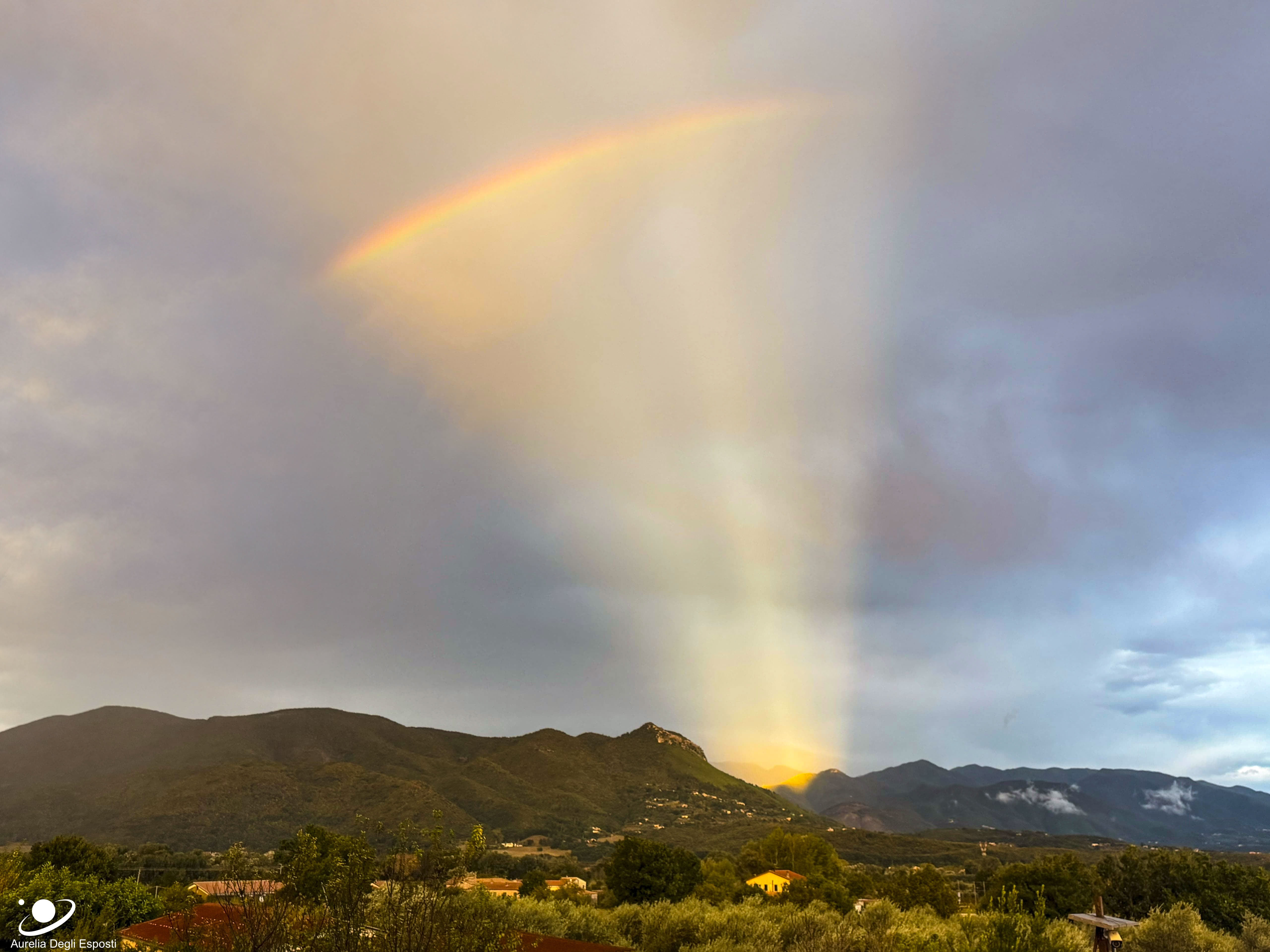
Image: NASA Astronomy Picture of the Day | Credit & Copyright: Aurelia Degli Esposti | Original page.
NASA's October 20 APOD explains that Aurelia Degli Esposti noticed the scene while hanging up laundry in Presenzano, Italy, at sunset the previous week. She photographed it with her phone. An ordinary chore had offered an unusually good lesson in perspective.
The Rainbow Gives Us a Clue
To see an ordinary primary rainbow, you need the Sun behind you and sunlit raindrops ahead. Light bends as it enters a drop, reflects inside, then bends again as it leaves. Different colors bend by slightly different amounts, separating white light into a spectrum. The U.S. National Weather Service traces that path.
Imagine a line running from the Sun through your head and onward in the direction of your head's shadow. Its opposite-to-the-Sun direction marks the antisolar point. A primary rainbow is centered there, with its red outer edge at an angular radius of about 42 degrees. That is an angle in your view, rather than a distance to the rainbow.
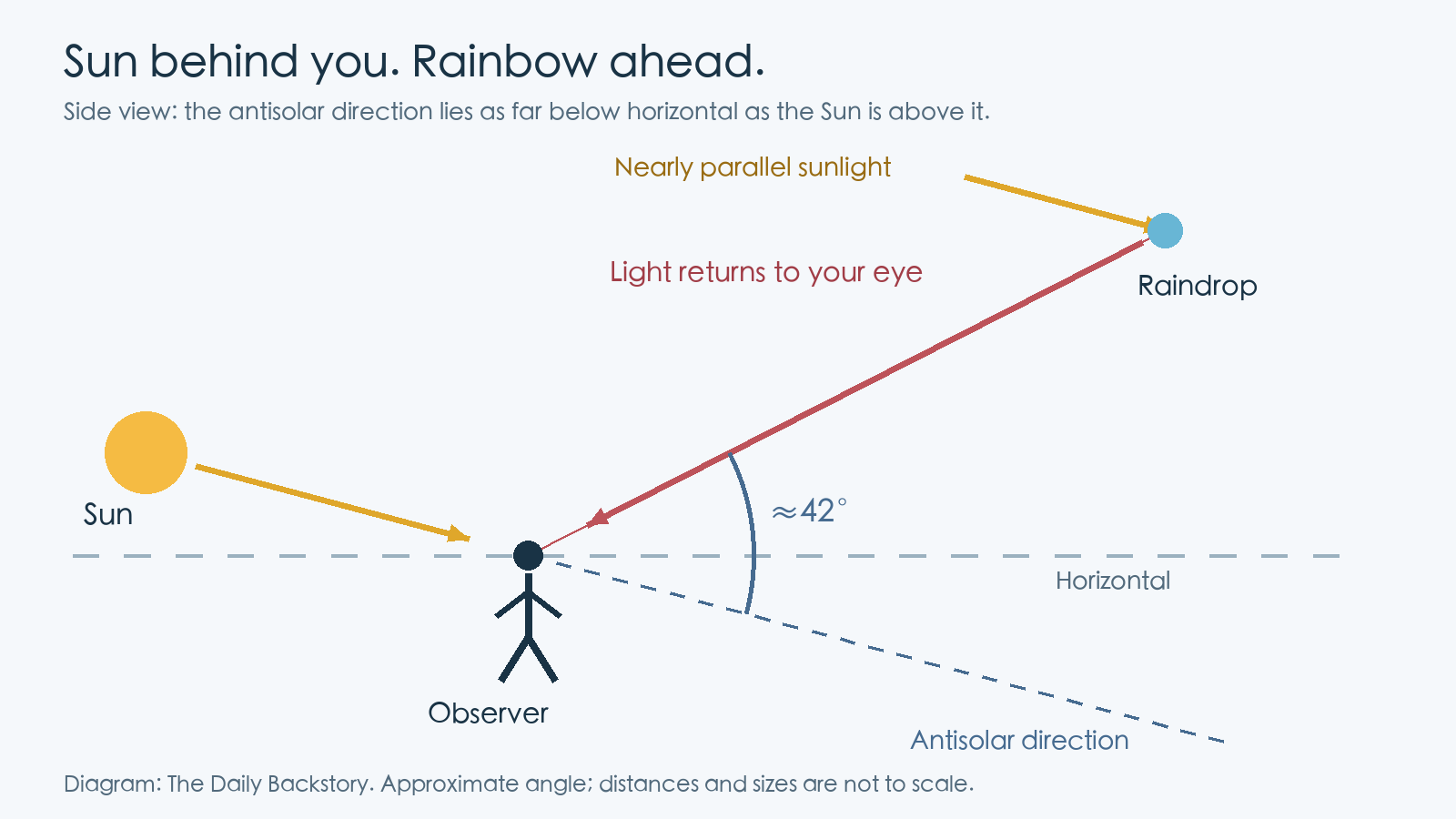
Diagram: The Daily Backstory, based on NASA and U.S. National Weather Service material. Approximate angle; distances and sizes are not to scale. When the Sun is above horizontal, the antisolar direction is below it.
However convincingly that glow resembles a Sun beyond the hills, the rainbow tells us the actual sunset is behind the camera.
Parallel Beams Can Seem to Meet
Clouds near the Sun block some light and leave gaps for other beams to pass through. Bands of light and cloud shadow stretch across the sky. On the opposite side, they appear to gather again in the distance: anticrepuscular rays.
The light paths are nearly parallel. Think of straight railway tracks receding toward the horizon. The distance between the rails stays the same, while perspective makes them seem to meet. Bright and dark bands across the sky can produce the same impression. A National Weather Service example shows rays on the horizon opposite the Sun; its guide to unusual weather explains scattering and the apparent narrowing of sunlight.
Here the two effects overlap. Raindrops separate sunlight into a rainbow, while light and shadow seem to converge toward the antisolar direction. Strong color appears in the illuminated part of the rain curtain, leaving what looks like a clipped section of the bow. The fan is neither another Sun nor light emitted by the rainbow.
Change Your Position, Change the View
People noticed this dependence on viewpoint long before they could describe the light paths. An essay by Jiang Boyi for National Taiwan University's CASE shows the arched, double-headed form of "rainbow" in oracle-bone writing, then turns to observations in Shen Kuo's Dream Pool Essays.
An evening rainbow could be seen looking east from the west, but disappeared when the observer moved to the other side and looked west. Shen also recorded Sun Yanxian's explanation linking a rainbow to sunlight falling on rain.
That change of view captures something essential. A rainbow is not a colored arch fixed between hills, waiting for someone to walk over. Sunlight, droplets, and the observer's position determine the view together. Move, and the paths bringing light to your eyes change too.
Next time low sunlight streams through cloud gaps, turn away from the Sun and search the opposite sky for faint bands. If rain is still falling ahead, look for a rainbow as well. Keeping track of the Sun, the rain, and your own position can be more revealing than learning a name. During a thunderstorm, observe from safely indoors.