
Two dark eyes peer through a mask of fur. Wrapped around a tree trunk, the brown-throated three-toed sloth in today's Bing wallpaper seems almost part of the branch beneath it. The photograph comes from Puerto Viejo de Talamanca, Costa Rica, where the surrounding foliage dissolves into green.
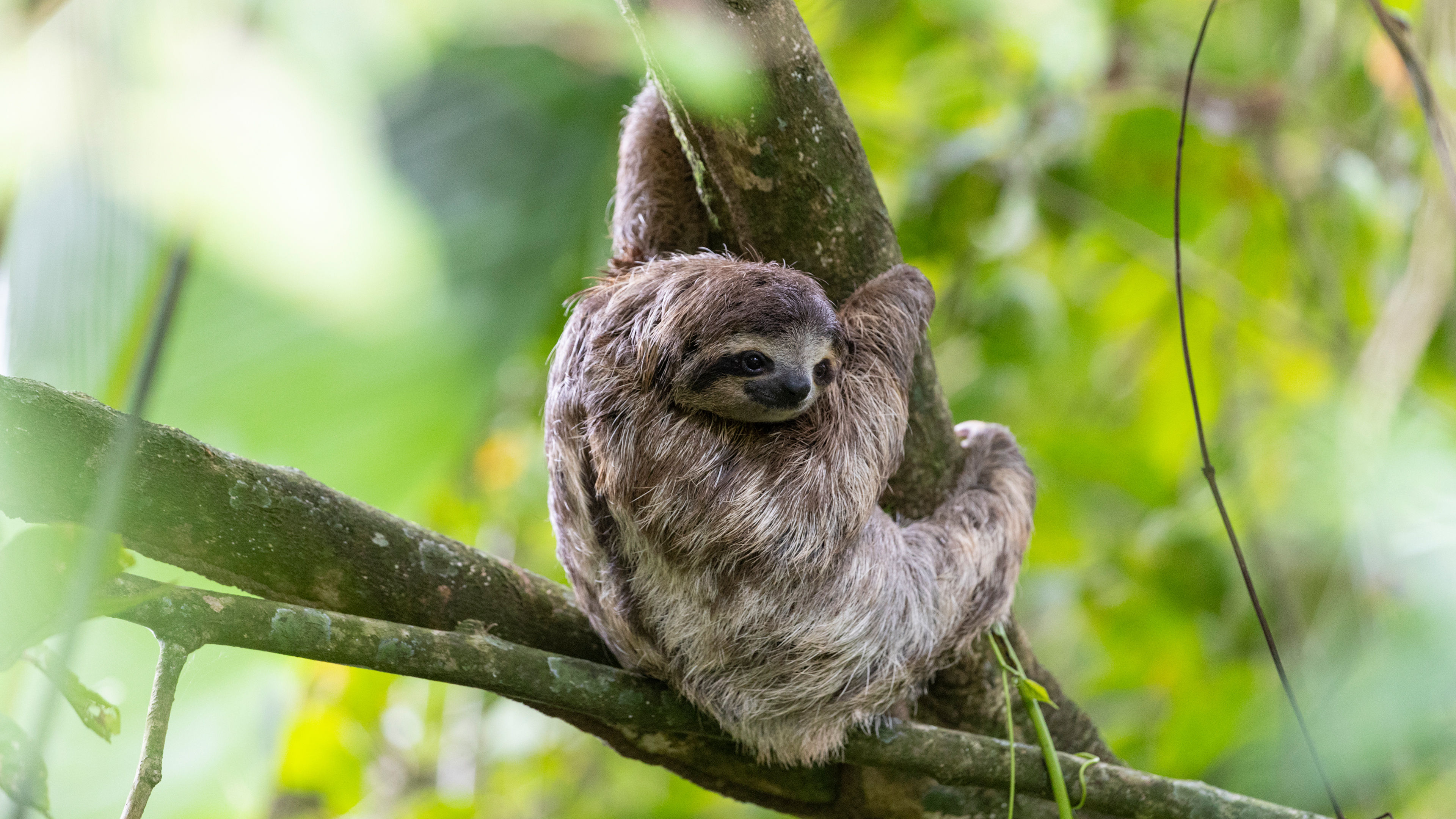
Image: Brown-throated three-toed sloth, Puerto Viejo de Talamanca, Costa Rica (© Suzi Eszterhas/Minden Pictures) | Original page.
October 20 is International Sloth Day. This animal is Bradypus variegatus. The familiar distinction between "two-toed" and "three-toed" sloths actually concerns their front limbs: both groups have three toes on their hind feet, while their hands have two or three fingers.
Leaves Take Work
A canopy full of leaves is not a cupboard full of ready fuel. Leaf cell walls are difficult to break down, and the food supplies relatively little energy. Microbes in a sloth's digestive tract slowly ferment it, making nutrients available to the animal.
With that diet, small savings matter. Fewer fast movements mean less energy spent on exercise; a low metabolic rate reduces the cost of keeping the body running. Movement, digestion, and energy use belong to the same story. The Sloth Conservation Foundation's guide to diet also makes clear that three-toed sloths eat more than one kind of tree. A connected, varied forest supplies a much more complete home than a single favorite food plant.
Their body temperature also varies more than ours. In a 2018 experiment, researchers measured the resting metabolism of eight adult brown-throated sloths. As the surroundings warmed, metabolic rate rose, remained relatively high at about 26-30 degrees Celsius, then fell above 30 degrees. The team suggested that this response could conserve energy while reducing the heat the body itself produces.
That result describes a particular species under experimental conditions. It does not mean hotter weather always suits sloths. Their digestion and other bodily processes still depend on suitable forest temperatures.
Stillness Is Not Sleep
Return to the same tree later and you might find the sloth in apparently the same place. It is tempting to imagine it has slept all day. But a motionless animal can be awake, and posture alone cannot tell us the difference.
A 2008 field study fitted three adult female brown-throated sloths in a Panamanian rainforest with equipment that recorded brain activity. They averaged about 9.6 hours of sleep a day. Three animals cannot set a timetable for every sloth, but the finding shows why claims that they all sleep twenty hours a day can mistake quiet wakefulness for sleep.
A Small Ecosystem, and an Expensive Trip
Brown-throated sloths also descend to the ground roughly weekly to defecate. A 2014 study by Jonathan Pauli and colleagues estimated that a trip costs energy equivalent to about 8 percent of a day's budget. Being near the ground also exposes them to predators. For such an economical animal, it is a puzzling expense.
The researchers sampled 19 three-toed sloths and 14 two-toed sloths, collecting averages of 15.2 and 4.5 moths per animal, respectively. Moth abundance, nitrogen in the fur, and algal biomass were related. The team proposed a possible exchange: sloths provide dung where moths can lay eggs; moths may supply nutrients to algae in the coat; and algae might supplement the sloth's diet.
Extrapolating from fur samples, the paper also estimated that sloths carried an average of about 125.5 grams of microbial biomass, mainly algae. That estimate depends on assumptions about the amount of fur and other factors. It was not obtained by scraping and weighing every animal's entire coat.
The crucial last link, eating the algae, remains unsettled. A 2021 paper examining the model noted the lack of reliable observations of sloths licking their own fur, and questioned whether algae in a few stomach samples necessarily came from their coats. A sloth really does carry a small ecosystem. A neat cycle has yet to explain conclusively why it makes that weekly descent.
A Branch Is Also a Road
Connected crowns lead to the next meal and the next resting place. Roads and buildings can break those routes, forcing journeys onto the ground or even along power lines. Protecting a tree with a sloth in it is only part of protecting the animal's home; the trees need connections.
The foundation's Slothopedia is a good place to explore their hands, food, and activity. If you encounter one in the wild, watch from a distance and leave it in the tree. Keep a brief record of what it actually does: turns its head, reaches, chews, or simply pauses. Once you slow down, those small movements become easier to notice.