
Beside a bright star, two red-and-white clouds seem to lean out of the darkness. Look farther right and blue filaments emerge alongside a broad sweep of red. Today's NASA Astronomy Picture of the Day places Cassiopeia's familiar "ghosts" in a wider scene with three newly revealed, faint structures.
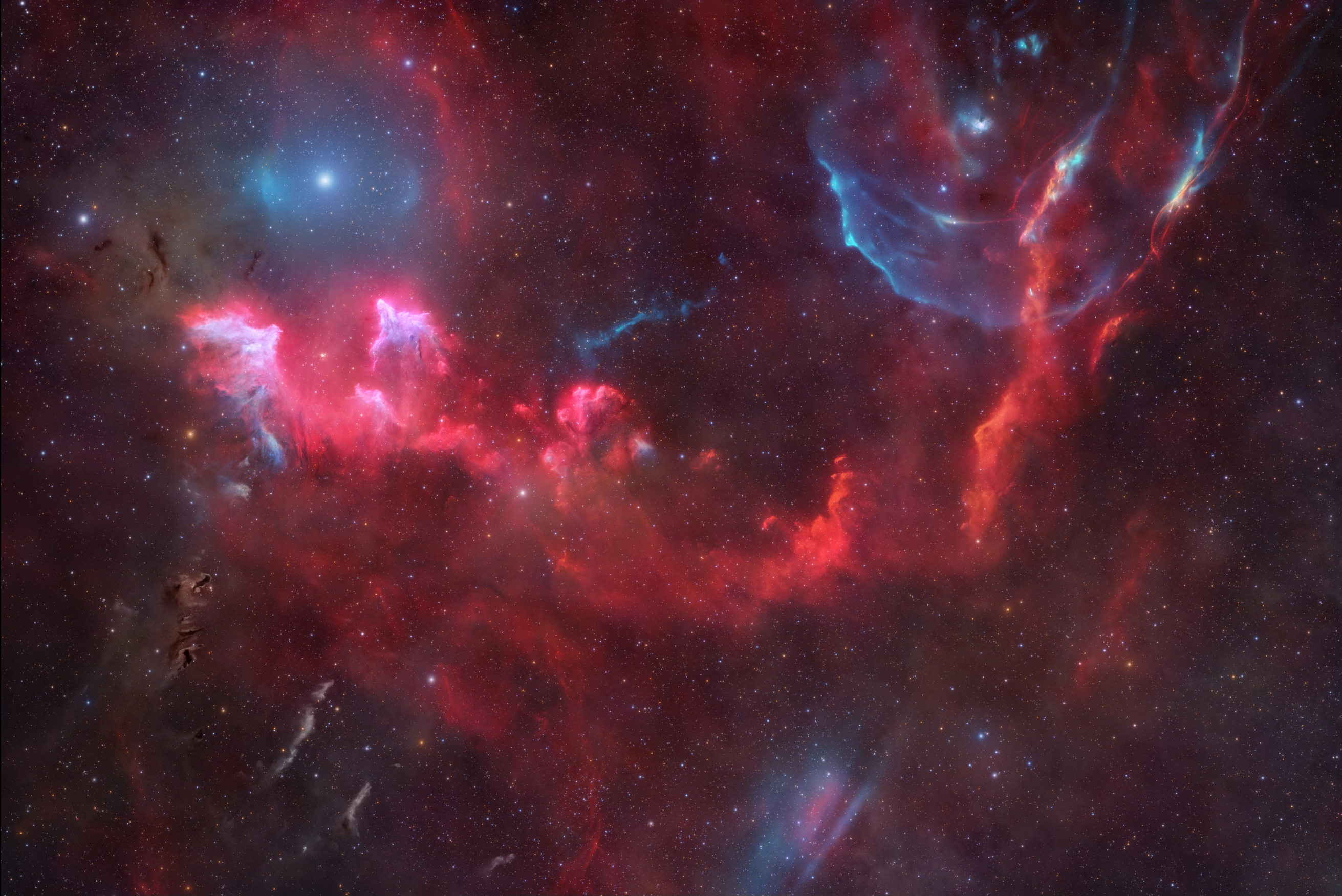
Image credit & copyright: Louis Leroux-Géré, Thibault Rouillée, Vincent Martin, Cédric de Decker (Starfront Observatories) | Original page.
IC 59 and IC 63 are the two long-known nebulae near the Gamma Cassiopeiae star system. Energetic starlight makes their hydrogen glow red, while dust scatters some blue-white starlight toward us. One cloud can both emit light and scatter light supplied from elsewhere.
Hubble's account of IC 63 describes these two processes. An emission nebula shines as its gas receives energy; a reflection nebula redirects starlight, a little like mist catching a distant lamp. Blue alone cannot identify which process produced a patch of light.
About 100 hours of observations, including a special oxygen filter, brought the three additional structures into view. A filter selects particular wavelengths and suppresses competing light. The newly revealed blue features indicate ionized oxygen. Their appearance also depends on the observations and image processing; this is not a promise of the view through an ordinary window onto space.
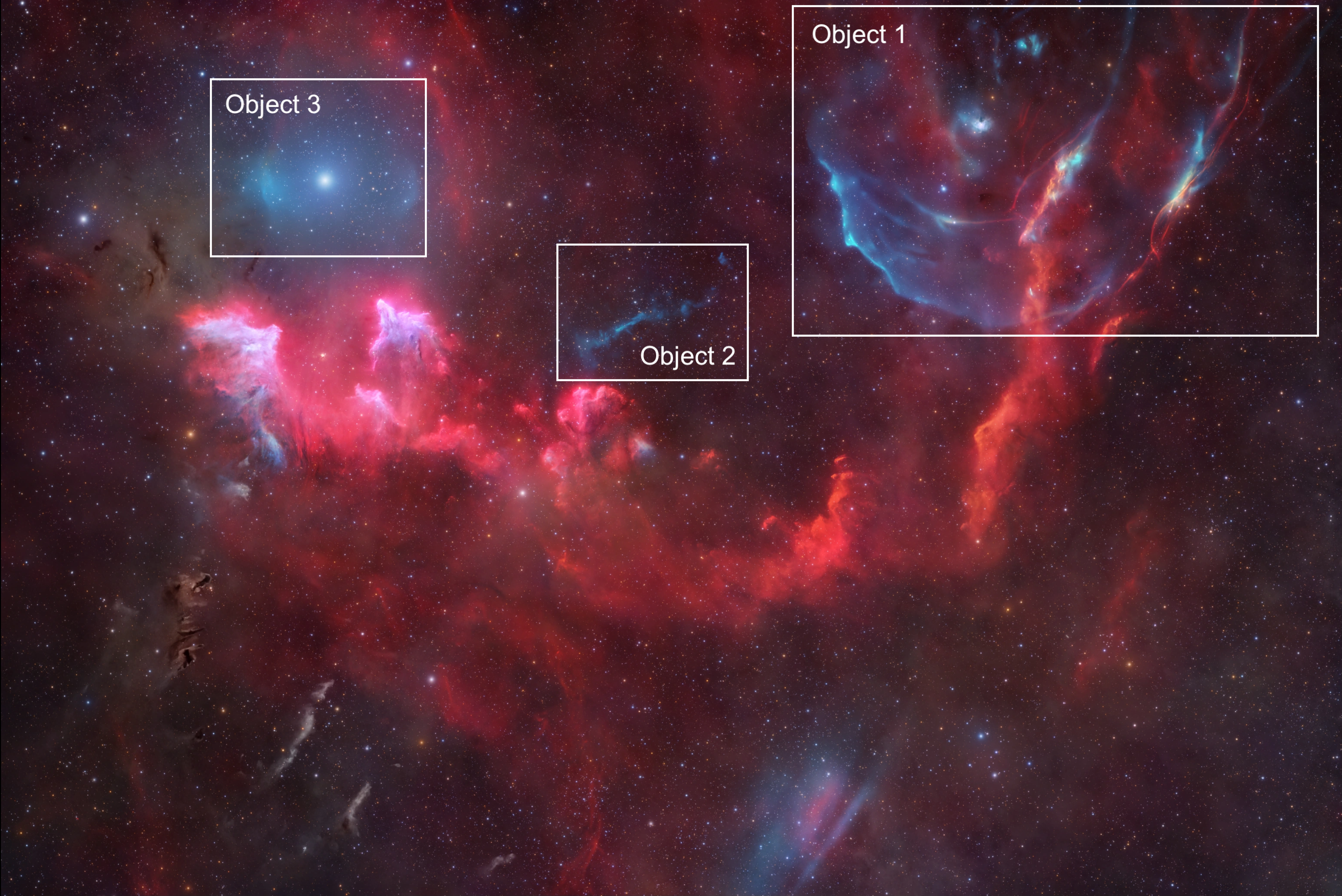
Annotated image credit & copyright: Louis Leroux-Géré, Thibault Rouillée, Vincent Martin, Cédric de Decker (Starfront Observatories), provided by APOD. The numbered boxes locate the new structures; blue elsewhere in the image can have a different origin.
What supplies the energy? APOD suggests that Gamma Cassiopeiae may pile up material as it moves through interstellar gas and dust, rather as a boat pushes water ahead of its bow. Object 3 might involve oxygen compressed and heated in such a bow shock. Object 1 could instead be a planetary nebula, gas expelled by an aging star, but that interpretation needs evidence of the corresponding central white dwarf. The three structures do not yet have settled identities.
A photograph can reveal a question before observations can answer it. APOD links to the observing team's image page for further information and ways additional observations might help.
Another Mystery, Inside the Star System
Gamma Cassiopeiae itself has recently yielded an important clue. It was the first star identified as a Be star: a rapidly rotating B-type star surrounded by a gas disk, with conspicuous emission lines in its spectrum. Its unusually strong, hard X-rays puzzled astronomers for decades. The emitting plasma has a temperature of roughly 150 million kelvin, and its X-ray luminosity is about 40 times the value typically expected for massive stars.
In research made public in March 2026, Yaël Nazé and colleagues used XRISM's Resolve instrument to track iron X-ray lines. Their Doppler shifts, changes in the lines' energy as emitting material moves toward or away from us, followed the orbital motion of the low-mass companion. The study links the anomalous hard X-rays to accretion onto that white dwarf: material falling toward it. This concerns processes inside the star system. It does not also establish the origins of the three newly revealed nebular structures.
On northern autumn evenings, begin with Cassiopeia's five bright stars arranged in a W. Gamma is the central one. The International Astronomical Union approved the name Tiansi on November 13, 2025, bringing a name from Chinese sky traditions into its international catalog.
The faint clouds call for deep imaging, so failing to see them does not mean you have found the wrong stars. Recognizing a star by eye, photographing nearby gas, and using different wavelengths to discover why that gas shines are three different stages of exploring the same sky.