
Rocky fragments sweep past a star glowing a pale yellow-green. In today's NASA Astronomy Picture of the Day, WD J1330+6435 could pass for a science-fiction sun. The word "Illustration" in the upper left supplies an essential clue: nobody flew close enough to take this photograph. It is an artist's impression.
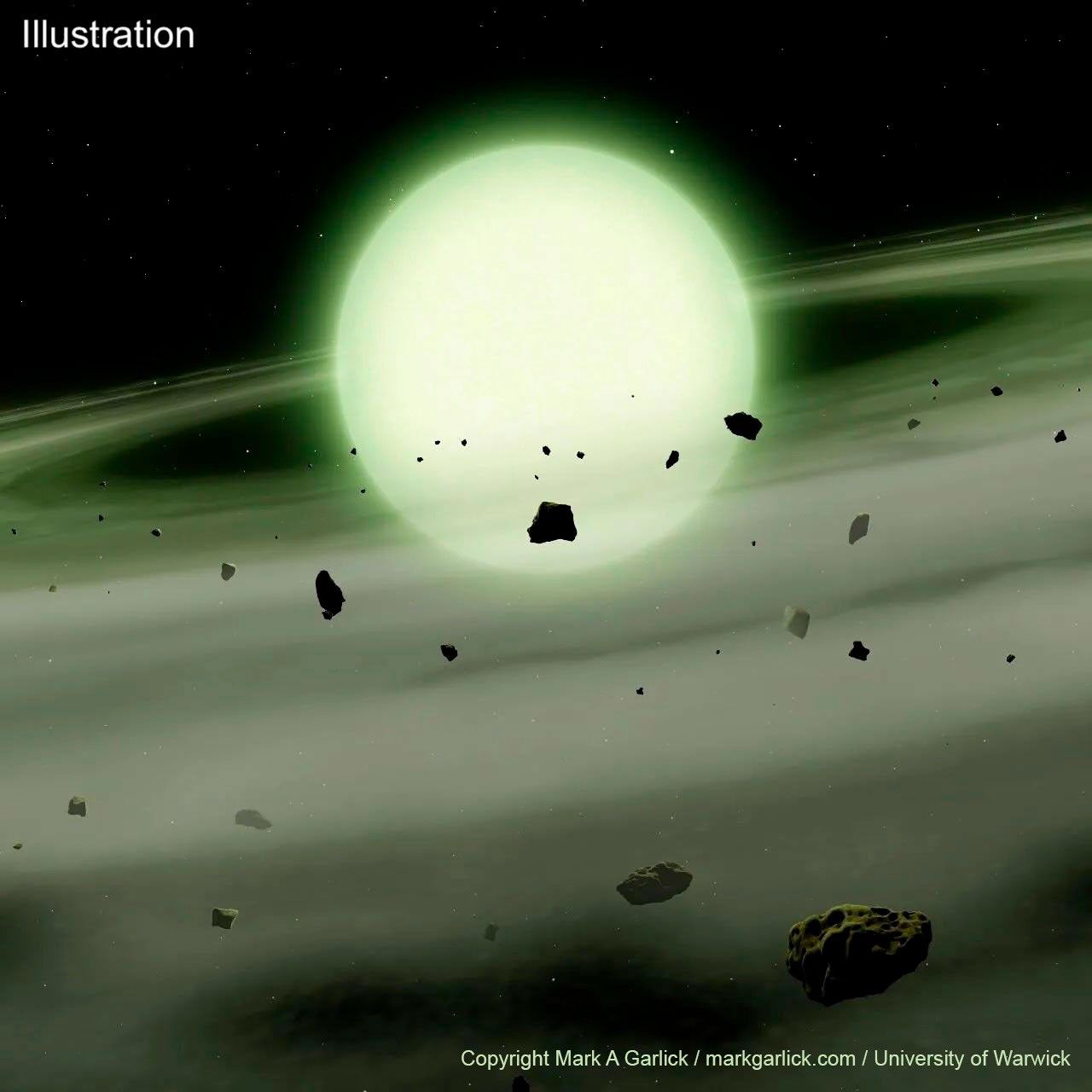
Credit & Copyright: Mark A. Garlick / University of Warwick. Artist's impression, not a photograph. Original page.
The green was not chosen at whim. In their original study, Mark Hollands and colleagues used stellar spectra and a model of human vision to calculate what color the light would appear if it were bright enough for our eyes to distinguish. For WD J1330+6435, the answer was yellow-green.
Change a color by taking light away
The familiar colors of stars often act as temperature clues: cooler stars look orange or red, hotter ones blue, with white in between. Each emits many wavelengths at once, and our eyes combine them. Even a star whose radiation peaks near green does not necessarily look green; the other wavelengths still enter the mixture.
White dwarfs add a twist. These compact remnants of stars like the Sun shed their outer layers and gradually cool as they release stored heat. In some very cool white dwarfs, atmospheric densities can reach about one gram per cubic centimeter, comparable to water. That is an extreme these atmospheres can reach, not a property of every white dwarf.
WD J1330+6435 has a helium-dominated atmosphere mixed with elements from rocky planetary material. In that crowded environment, the gaps where atoms absorb light become broad. In the study, sodium strongly absorbs orange wavelengths and calcium absorbs at the violet end, leaving a peak around 500 nanometers. Combining the full spectrum in the vision model produces yellow-green.
Think of several colored lamps shining together. Changing their mixed color does not always require adding a green lamp; covering some of the others can do it too. Here, the atmosphere selectively absorbs wavelengths. The star is neither wrapped in green glass nor producing a green sodium flame.
The paper's new fit gives an effective temperature of about 4,240 K, roughly 3,970 degrees Celsius. Although cooler than the Sun's surface, the star does not simply follow the familiar temperature-to-color sequence toward orange-red. Atmospheric chemistry and density change the light that escapes.
White dwarfs need not be white
NASA introduces this striking example as the "first green star." The paper offers a more varied picture: its analysis also produces two paler green white dwarfs, including WD J0851+1543, whose green has relatively strong spectroscopic support. WD J1330+6435 is a vivid example, not the only green star known in the universe.
Other unusual colors have other causes. Convection can bring internal carbon up into a white dwarf's outer layers, where molecular absorption shifts the combined light toward pink or purple. Some mixed hydrogen-helium atmospheres look cyan because of collision-induced absorption. Swallowing asteroids is not an explanation for every unusual color.
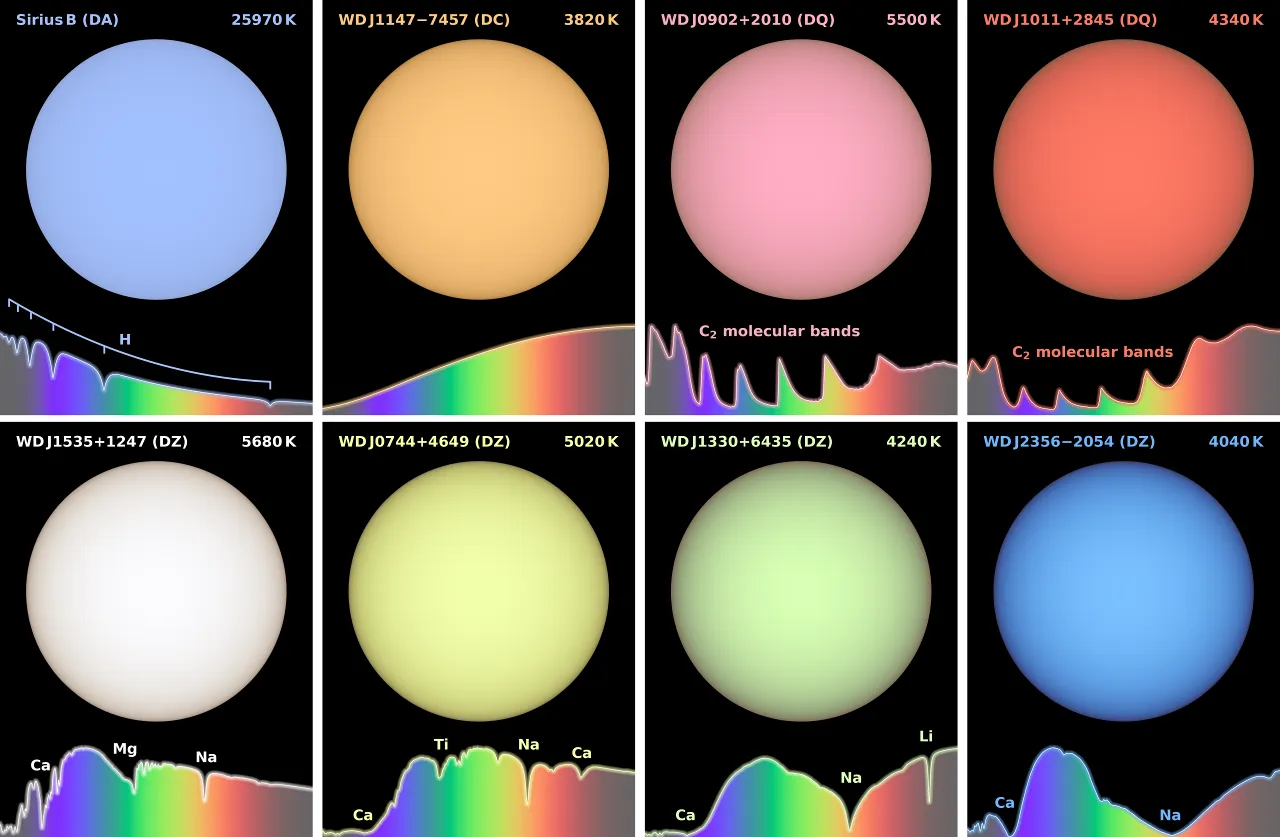
Color simulations: Mark Hollands / University of Warwick. Generated from spectral models, not telescope photographs; the display represents color rather than the stars' true brightness.
Still, the name "white dwarf" largely holds up. The researchers examined a sample within 20 parsecs, about 65 light-years, of the Sun. Their chosen color-deviation threshold flagged five objects as outliers: two yellowish and three pinkish. The remaining sample had a median correlated color temperature of about 6,800 K and was broadly white. Correlated color temperature matches a color to that of an ideal thermal radiator; it is not a new measurement of each star's atmospheric temperature. Nor is a nearby sample an exact census of the whole universe.
This is a reconstruction of appearance from data. The researchers note some noise in WD J1330+6435's observed spectrum, so its exact shade could differ, although different models still support a green color. The illustration's arrangement of rocks, close-up viewpoint, and glow are not a scene confirmed detail by detail by a camera.
Open the team's color display and explanation, temporarily turn off a warm night-display setting, and compare the white, pink, and green examples. The paper also recommends an sRGB display mode. These stars are too faint to expect a naked-eye view of the green tonight, but their spectra show what needs to be added to the old rules about stellar color.