
Two points of light draw together beside Jupiter. One briefly disappears behind the other, then emerges again. NASA's October 28 Astronomy Picture of the Day is a video of Ganymede passing in front of Io on October 20, 2026.
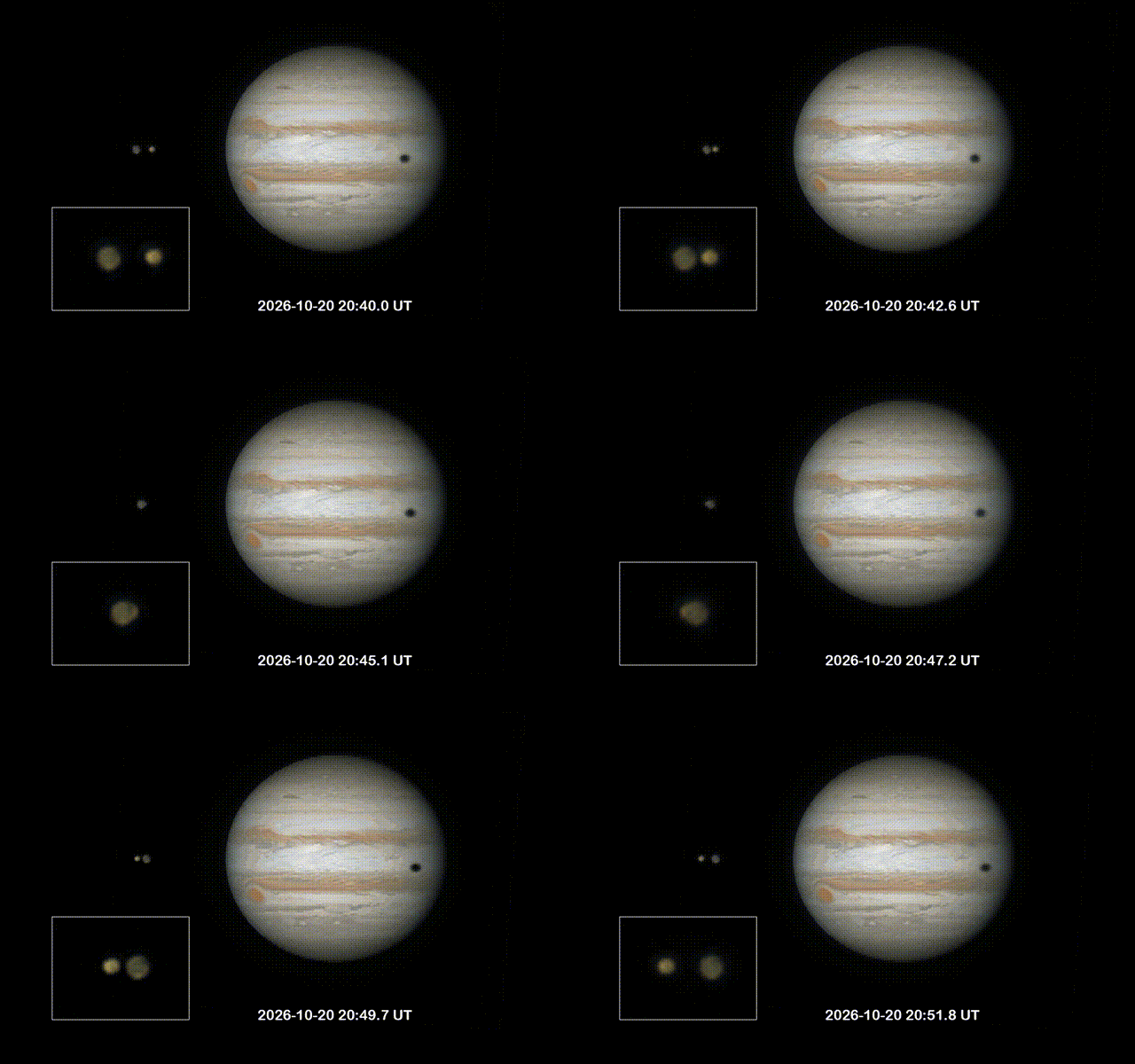
This looping GIF previews the original video. Its on-screen timestamps are in Universal Time; playback does not show the motion in real time. Watch the original video.
Video: Credit & Copyright: Michael Wong. Original page.
Astronomers call this a mutual occultation: from Earth, one moon blocks our view of another. The moons have not collided. Hold a finger in front of a distant lamp and the lamp still shines; you have interrupted the light's path to your eye.
An eclipse involves a shadow instead. One moon enters another's shadow and receives less sunlight. The British Astronomical Association's guide to this observing season distinguishes the two. Earth's viewing direction matters for an occultation; the direction of sunlight matters for an eclipse.
Jupiter's four Galilean moons orbit roughly in the plane of its equator. Near a Jovian equinox, the Sun and Earth pass close to that plane, giving us a view more nearly along its edge. Mutual-event seasons return about every six years. That means a season containing many opportunities, rather than one brief event every six years.
Ganymede also casts a shadow on Jupiter in the video. For an imaginary observer beneath that shadow, sunlight would be blocked in a solar eclipse. From Earth, we see a dark patch on Jupiter's clouds.
The association gives December 16, 2026, as the next Jovian equinox. Small telescopes can measure the drop in brightness during mutual events; resolving their details calls for an aperture of at least 12 inches, about 30 centimeters, in its guidance. Atmospheric steadiness and Jupiter's height above the horizon also affect the view.
Replay the video and follow the moon and its shadow separately. One is an orbiting world; the other is a region where sunlight has been intercepted. To try observing, consult the association's seasonal guide and choose an event visible from your location. The October 20 encounter shown here has already happened.