
The Moon moves one Moon-width per hour - too slowly to notice as you watch, yet fast enough to swallow a planet over dinner.
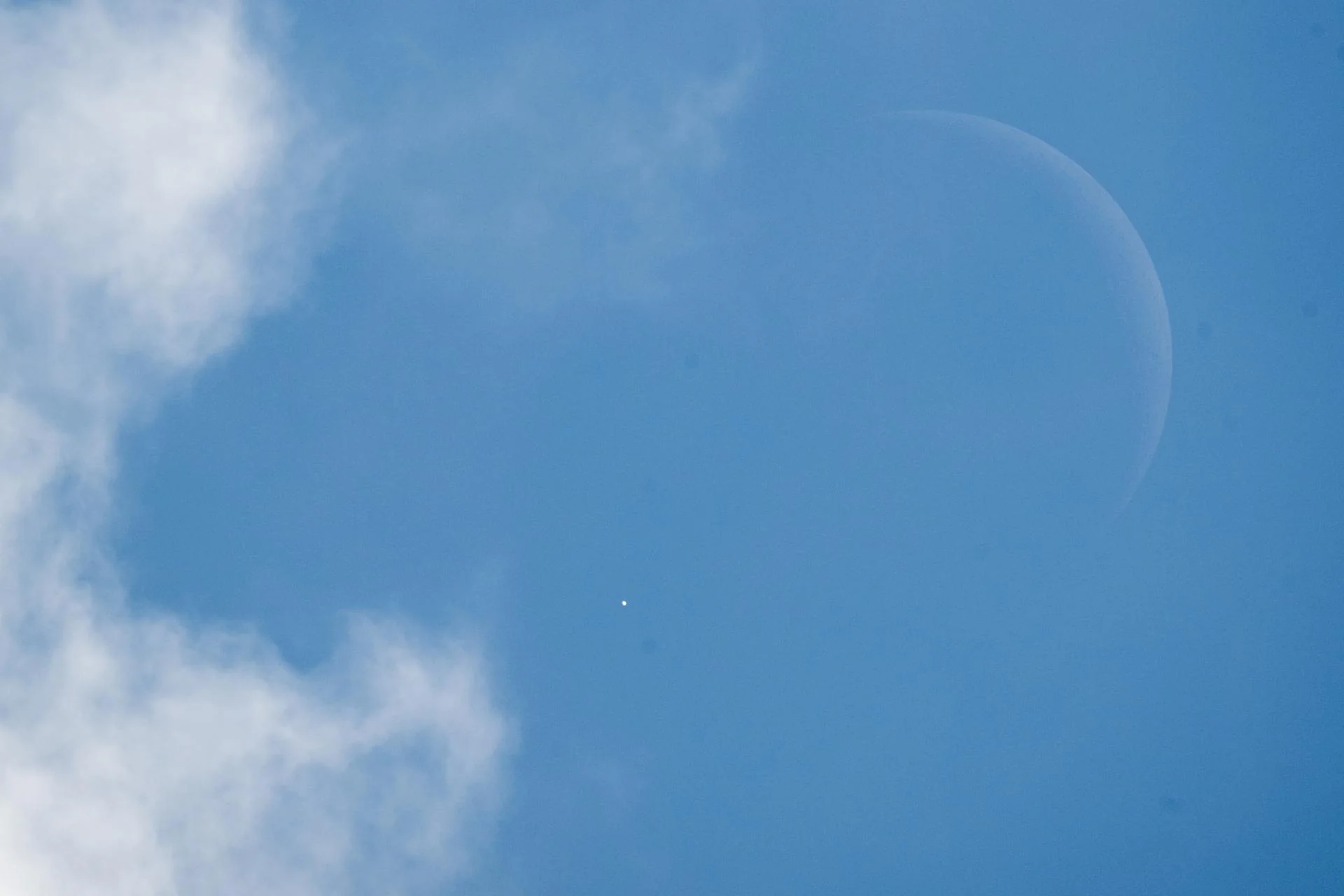
Image: NASA Image of the Day | Image credit: NASA/Joel Kowsky | Image page
A slender crescent Moon, a bright point beside it, and then nothing.
Begin with the strangest thing about this photograph: it was taken in the afternoon. The date was June 17, 2026, and the place was NASA Headquarters in Washington - the Mary W. Jackson building. Along the East Coast, the occultation began at 3:49 p.m. EDT. The Sun was still high in the sky.
In broad daylight, the Moon swallowed a planet.
It Vanished Behind an Edge You Could Not See
Look again at where the bright point sits.
A crescent Moon is lit from the side: one edge shines while the other remains dark. The Moon travels eastward across the sky, and the edge that reaches an object first is precisely the one sunlight does not illuminate.
Venus was not slowly consumed by a bright arc. It touched an invisible black edge and suddenly went out.
Liu Zhongli, an astronomy educator at the Tianjin Science and Technology Museum, explained the rule clearly in a Xinhua report: because the Moon orbits eastward, an occulted object always disappears at the Moon's eastern limb and reappears at its western limb.
That is the best part of the word occultation. The planet is not merely covered. It is taken in, then given back.
The Moon Moves One Moon-Width per Hour
How can the Moon hide a planet for a substantial stretch of time instead of merely brushing past it?
The arithmetic makes it clear.
One sidereal month lasts 27.32 days, during which the Moon completes a 360-degree circuit relative to the background stars. In one hour it therefore moves 360 / (27.32 x 24), or about 0.549 degree - roughly 33 arcminutes.
The Moon's own apparent diameter averages about 31 arcminutes.
Those two figures are nearly identical. In other words, every hour, the Moon moves across the stars by roughly its own width.
Once you remember that, several things fall into place:
- How long can an occultation last at most? The longest chord across the lunar disk is 31 arcminutes. Divide that by 33 arcminutes per hour and the answer is about 57 minutes. An occultation is always an event on the scale of less than an hour.
- How long does the lunar limb take to sweep across the small disk of Venus? Venus was about 20 arcseconds wide. At 0.55 arcminute per minute, the passage takes a little more than half a minute.
The Moon moves too slowly for you to notice while staring at it, yet fast enough to consume an entire planet over the course of a meal. Both statements describe the same speed.
(These figures were recalculated here from the sidereal month; they are not quotations. They do have an independent check: reporting on the September occultation says the Moon will take "just over a minute" to cover the disk of Venus, which is entirely consistent in scale.)
Because the Moon has no atmosphere, its edge can also be treated as an ideally sharp boundary. Astronomers have used that boundary to do something exquisite: measure the angular diameters of stars. As the lunar limb cuts off starlight, it produces Fresnel diffraction fringes. The entire pattern passes in less than one second, yet its light curve can yield angular resolution approaching one milliarcsecond. An occultation combines extremely slow celestial motion with an extremely fast optical event.
Why Venus Is Visible in Daylight
There is a common misunderstanding worth untangling.
The problem is not that Venus is insufficiently bright. It is the third-brightest object in the sky after the Sun and Moon, and it provides enough contrast to be seen by day.
The problem is that you cannot find it.
The daytime sky is a uniform field of blue with no reference points. Your gaze has nowhere to settle; even the focusing system of your eyes may not know where to focus. Venus is there, shining plainly, but your eyes can sweep across it ten times without registering it.
That was the real beauty of June 17: the Moon served as a signpost. The sky contained something you could reliably find, and the planet you sought was right beside it.
Astronomy coverage called the crescent a "perfect celestial signpost."
Why Venus Is a Crescent When It Is Brightest
Venus, like the Moon, has phases. Sometimes it is a disk, sometimes a half-circle, and sometimes a fine crescent.
You might assume Venus must be brightest when it is full. The opposite is true.
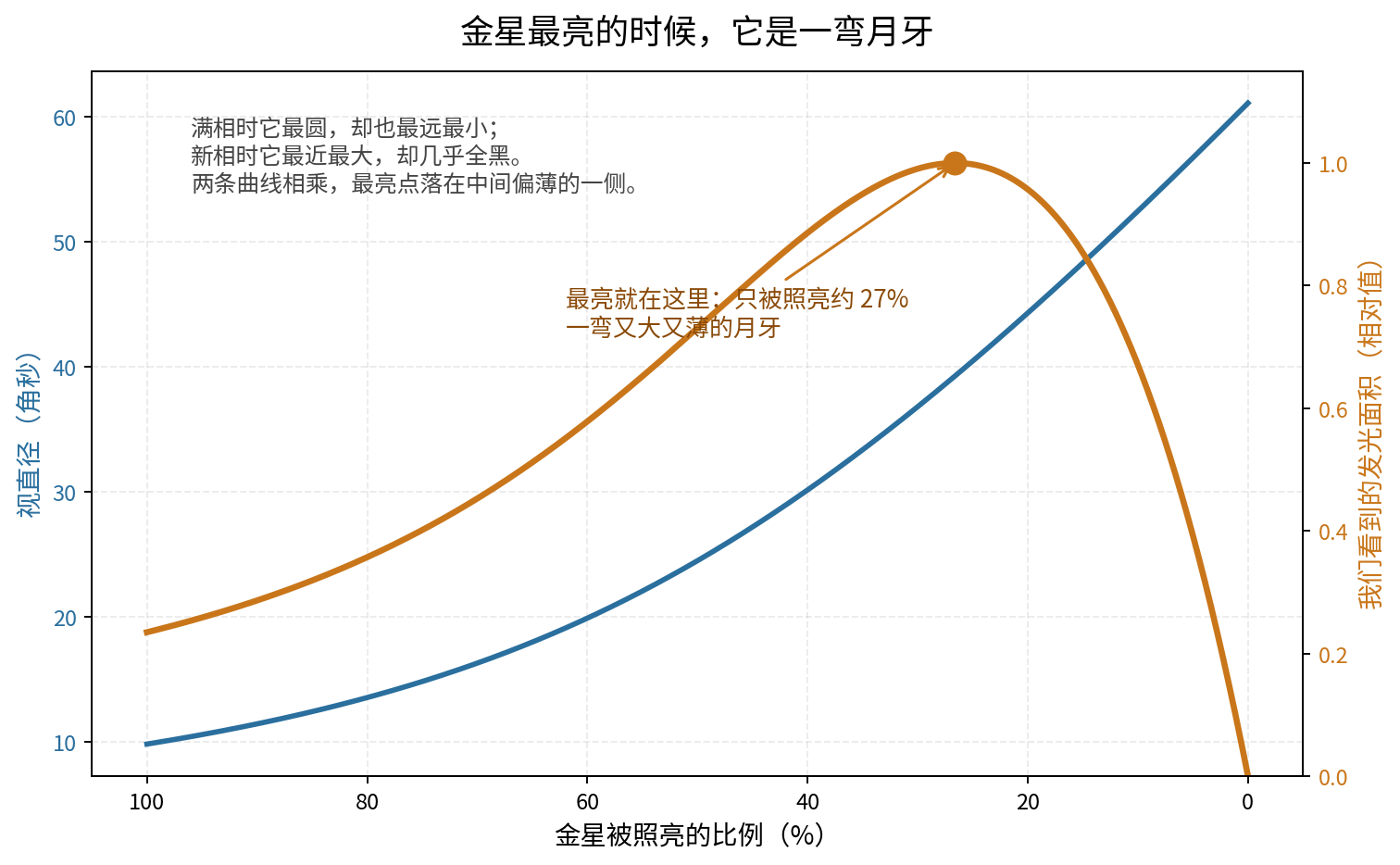
Two curves are working against each other. When Venus is full, it lies on the far side of the Sun and is farthest from us, with an apparent diameter of only 9.9 arcseconds. When it swings between Earth and the Sun and grows to 68 arcseconds across - nearly seven times larger - its illuminated face points almost entirely away from us.
The brightness we see depends on the illuminated fraction multiplied by the area of the disk. One rises as the other falls, and their product peaks between the two extremes, when a little more than a quarter of Venus is illuminated.
At its brightest, Venus is a large, slender crescent.
For scale, the full Moon is about 1,800 arcseconds across. Even at its largest, Venus is only about one twenty-sixth as wide.
In 1610, That Crescent Condemned the Geocentric Universe
Galileo first observed the phases of Venus late in 1610.
He did something wonderfully peculiar. First he published an anagram, a jumble of letters that secured his claim to the discovery without revealing it. Once he was certain, he disclosed the solution. The original puzzle read, "Haec immatura a me iam frustra leguntur," roughly, "These things are not yet ripe, and I read them in vain."
Rearranged, it became: "The mother of love imitates the shapes of Cynthia." Venus, the mother of love, was imitating the phases of the Moon goddess.
Behind the wordplay was a devastating blow. In the Ptolemaic geocentric model, Venus always moved between Earth and the Sun. It could never pass behind the Sun, so we should never see it approach a full phase.
Galileo did.
A small disk in a telescope sent a 1,400-year-old model of the universe to the scaffold.
The World That Was Swallowed
NASA's planetary fact sheet offers three facts worth remembering about the planet in the photograph.
Its surface temperature is about 467 degrees Celsius. Its surface pressure is about 93 times that at sea level on Earth. Its clouds are made of sulfuric acid.
A day there lasts longer than a year: Venus takes 243 Earth days to rotate once but only 225 Earth days to orbit the Sun.
It also rotates backward. In NASA's words, on Venus the Sun would rise in the west and set in the east.
That quiet point of light in the photograph is a 467-degree world with sulfuric acid rain and sunrises in the west.
Ancient China Had a Name for Venus by Day
Daytime Venus was familiar enough in ancient China to require a term of its own.
In a 2018 paper in Acta Astronomica Sinica, Liu Ciyuan and Ma Liping of the National Time Service Center, Chinese Academy of Sciences, give the definition: Venus and Jupiter are bright enough that, when air quality is exceptionally good, they may be seen for a time after sunrise or before sunset. The phenomena were called Taibai zhoujian, Venus seen by day, and Suixing zhoujian, Jupiter seen by day.
The numbers make the point. The Veritable Records of the Ming alone contains 261 records of Venus seen by day, including four instances of Taibai jing tian, Venus crossing the sky. By comparison, histories from the 24 official dynastic histories before the Ming contain 15,292 astronomical records in total.
That figure of 261 means daytime Venus was not so rare that no one saw it. It was common enough to need a name.
Those records are still useful. In a Royal Society paper, Stephenson and colleagues explicitly describe their systematic use of observations from Babylon, China and Greece, spanning 720 BCE to 2015, to reconstruct the long-term slowing of Earth's rotation. They found that the length of the day increases by about 1.78 milliseconds per century, compared with the 2.3 milliseconds predicted by tidal friction alone. The difference emerges only because ancient observers wrote down what they saw, one record at a time.
(An honest boundary is necessary: the Chinese material used in that work consists mainly of solar-eclipse records. Timing occultations at the dark lunar limb to study Earth's rotation belongs to the telescopic era. The two should not be conflated.)
China's most recent nationwide occultation spectacle came on the evening of March 2, 2026, when the Moon occulted Regulus and the full event was visible across northern and northeastern China. Liu Zhongli explained why it was unusual: from December 2025 through the end of 2026, the Moon would pass in front of Regulus almost every month, but most occultations would occur either while the Moon was below the horizon or during daylight. Only the March 2 event was well placed for observers in China.
Occultations themselves are not rare. What is rare is one happening above you, at night, under a clear sky.
Nine Days From Now, It Is Our Turn
Why did NASA choose on September 4 a photograph taken almost three months earlier, in June?
Because it shows the first of three lunar occultations of Venus this year. NASA's image page identifies the other two:
- September 14, visible from parts of Asia, Africa, Europe and western Russia;
- November 7, visible from southern South America.
September 14 is next Monday.
Xinhua, citing Yang Jing of the Chinese Astronomical Society and the Tianjin Astronomical Society, reports that people in parts of Yunnan, Guizhou and Guangxi may be able to see Venus occulted on the horizon.
Both qualifications matter: parts of those provinces, and on the horizon. This is not an event the whole country can see simply by looking up. It will occur extremely low in the southwestern sky and requires a very open horizon. The Moon that day will be a crescent about 12% illuminated; Venus will shine around magnitude -4.7 and sit about 41 degrees from the Sun.
No specific disappearance or reappearance times for locations in China were found. Chinese official reporting names the provinces but gives no times. Near the date, the official notices from Purple Mountain Observatory or the Beijing Planetarium should be treated as authoritative.
Then, on Saturday, September 19, Venus will reach its brightest appearance of the year as the evening star, at magnitude -4.8. EarthSky gives the moment as 23:00 UTC on September 18, which is 7:00 a.m. on September 19 in Beijing. Both refer to the same instant.
Two celestial markers, six days apart.
Finally
Joel Kowsky, who took the photograph, is a NASA Headquarters photographer with a particular talent for alignments. During the total solar eclipse on August 12 this year, he photographed the International Space Station from Hodgdon, Maine, as it crossed the eclipsed Sun at about five miles per second. In a 12-frame sequence, the station took roughly six minutes to travel from the right side of the solar disk to the left.
Photographs like these look lucky, but they are calculated: calculate the time, calculate where to stand, then wait.
This one demanded less. At a little after three on a June afternoon in Washington, someone looked up at the daytime Moon, saw a planet beside it and pressed the shutter.
Next Monday evening, if you happen to be in Yunnan, Guizhou or Guangxi, if the southwestern horizon is clear of buildings, and if the weather cooperates, the same thing will happen again.
You do not need a good camera. First, you need to find the Moon.
Sources: NASA Image of the Day, Lunar Occultation of Venus, and images-api metadata; NASA's Venus fact sheet at science.nasa.gov; Xinhua astronomy reports of February 28 and August 30, 2026, quoting Liu Zhongli and Yang Jing; Liu Ciyuan and Ma Liping, "A Statistical Analysis of Astronomical Records in the Veritable Records of the Ming," Acta Astronomica Sinica 59, no. 3 (2018); Stephenson, Morrison and Hohenkerk on Earth's rotation; Richichi and Glindemann's 2012 occultation light-curve analysis in Astronomy & Astrophysics; EarthSky on Venus at greatest brilliancy; and observing guides from Universe Today and Space.com.