
A thin silver arc rises against blue, its tips fading away at either end. It looks familiar enough to be the Moon. This time it is Venus, and those extended tips are the feature to watch.
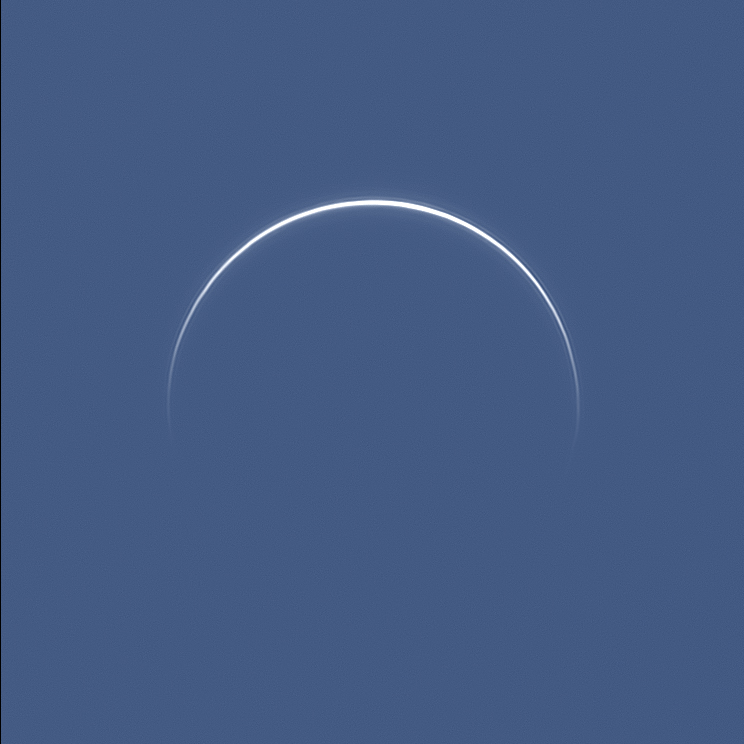
Image: Credit & Copyright: Thierry Legault · Original page
One planet, changing shapes
Venus orbits closer to the Sun than Earth does. Sunlight illuminates half the planet, but the fraction of that daylight hemisphere turned toward us changes as both planets move. Venus consequently has phases.
Near its passage between Earth and the Sun, we mostly face its night side, with only a narrow edge of the illuminated hemisphere visible. APOD describes the recurrence of this approximate alignment as about a year and a half. That is a cycle of relative positions seen from Earth, rather than Venus's orbital year.
An atmosphere changes the edge
The atmosphere adds another effect. Sunlight passing through its edge changes direction through refraction; scattering also redirects light. APOD invokes both processes to explain an arc extending beyond 180 degrees. Its projecting tips give Venus its "horns."
A straw partly submerged in water appears displaced because light changes direction as it passes between different materials. Refraction at Venus also bends light, although a spherical atmosphere whose density changes with altitude is more complicated than a glass of water.
This photograph records faint light around a planet's edge. It does not represent the shape you would ordinarily see with unaided eyes. Detailed imaging parameters could not be obtained from the photographer's original page, and a filename alone does not establish an exposure time.
To explore the phase geometry, illuminate a ball with a lamp and look at its bright side from several positions. For actual skywatching, use a reliable chart's morning or evening window. Do not sweep binoculars or a telescope near the Sun to search for Venus.