
A cat sits with its back toward us, turning its head to reveal a bright eye. Gas and dust have arranged this accidental likeness in a small part of the Carina Nebula nicknamed the Cat's Head Nebula. NASA's October 30 Image of the Day shows it in mid-infrared light.
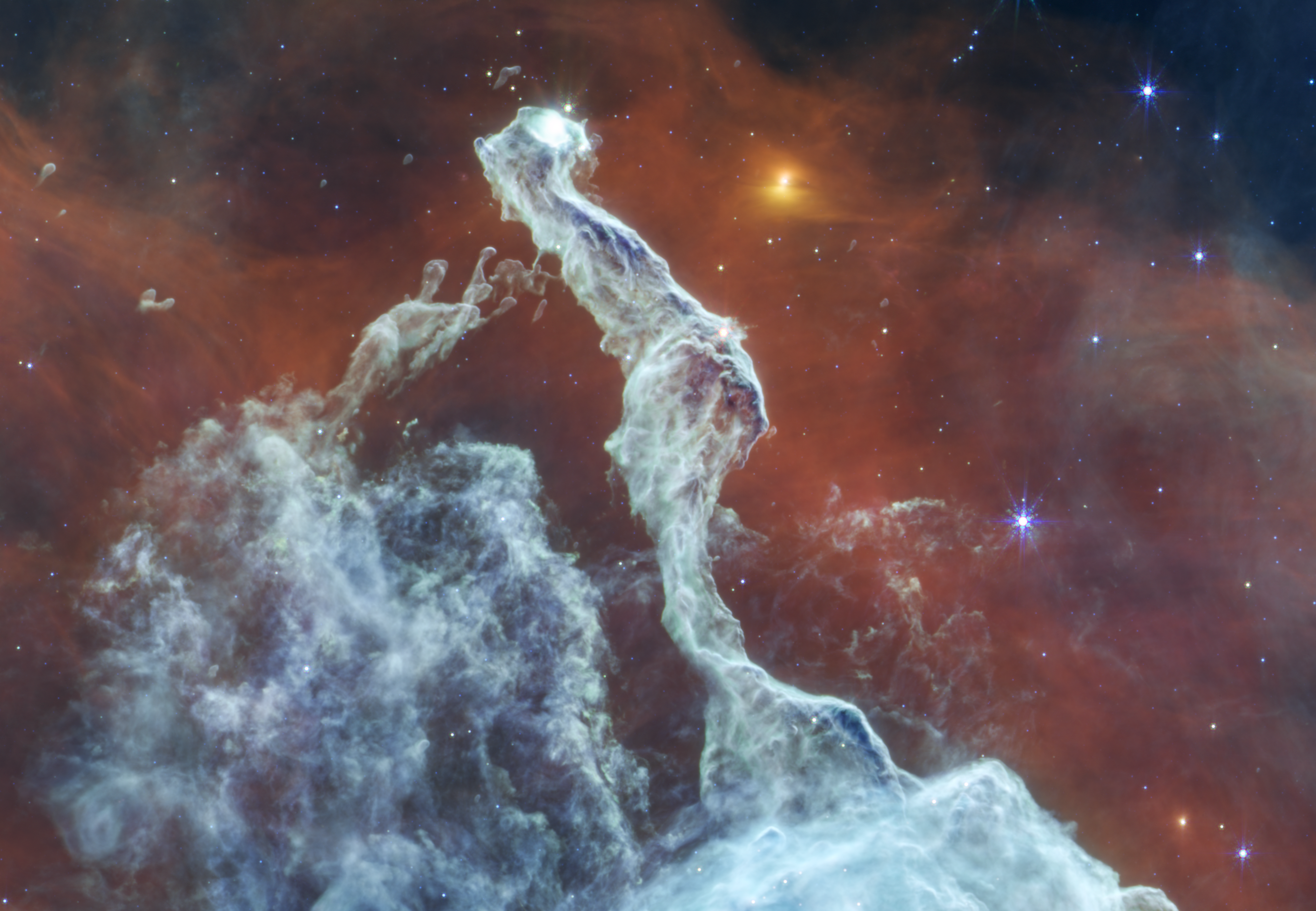
Image credit: NASA, ESA, CSA, STScI; Image Processing: Joseph DePasquale (STScI) · Original page
The Hubble and Webb teams place this region about 7,500 light-years away. Its light takes roughly 7,500 years to reach us. Within the vast Carina Nebula, the cat occupies just a small patch.
Its outline was likely sculpted by ultraviolet radiation and winds from nearby massive stars. As those forces erode surrounding gas and dust, denser material in the pillar holds out, at least for now. A resistant column left behind by erosion on Earth offers a useful visual analogy, though stellar radiation and winds do the work here.
Different kinds of light reveal different clues. Hubble's visible-light image shows an opaque dusty pillar. Webb's near-infrared view reveals more stars through some of the dust. This mid-infrared image emphasizes emission from warm dust and carbon-based molecules excited by starlight. Its colors display infrared information that human eyes cannot see directly.
One family of emitters is called polycyclic aromatic hydrocarbons, or PAHs: molecules built around connected carbon rings. After absorbing starlight, they can release energy through vibrations that emit particular infrared wavelengths. The NASA Ames spectral database helps researchers interpret interstellar infrared emission by comparing molecular spectra. Identifying material means reading those fingerprints of light; a patch of green alone is insufficient.
The cat's eye may be a young star still embedded in dust. That uncertainty matters: brightness does not establish an object's identity. The team also notes a thin filament apparently crossing another bright source, while cautioning that the image alone cannot show whether they are physically connected.
Open the team's release and find the same cat in all three wavelength views. Start with the tail, then the head and eye. Which stars emerge? Which dusty structures become clearer? Comparing what changes is a step toward reading an astronomical image as evidence.