
A blue barred spiral spreads its arms across this Hubble view. The actual target of the observation lies toward the lower-right corner: a reddish galaxy accompanied by blue arcs.
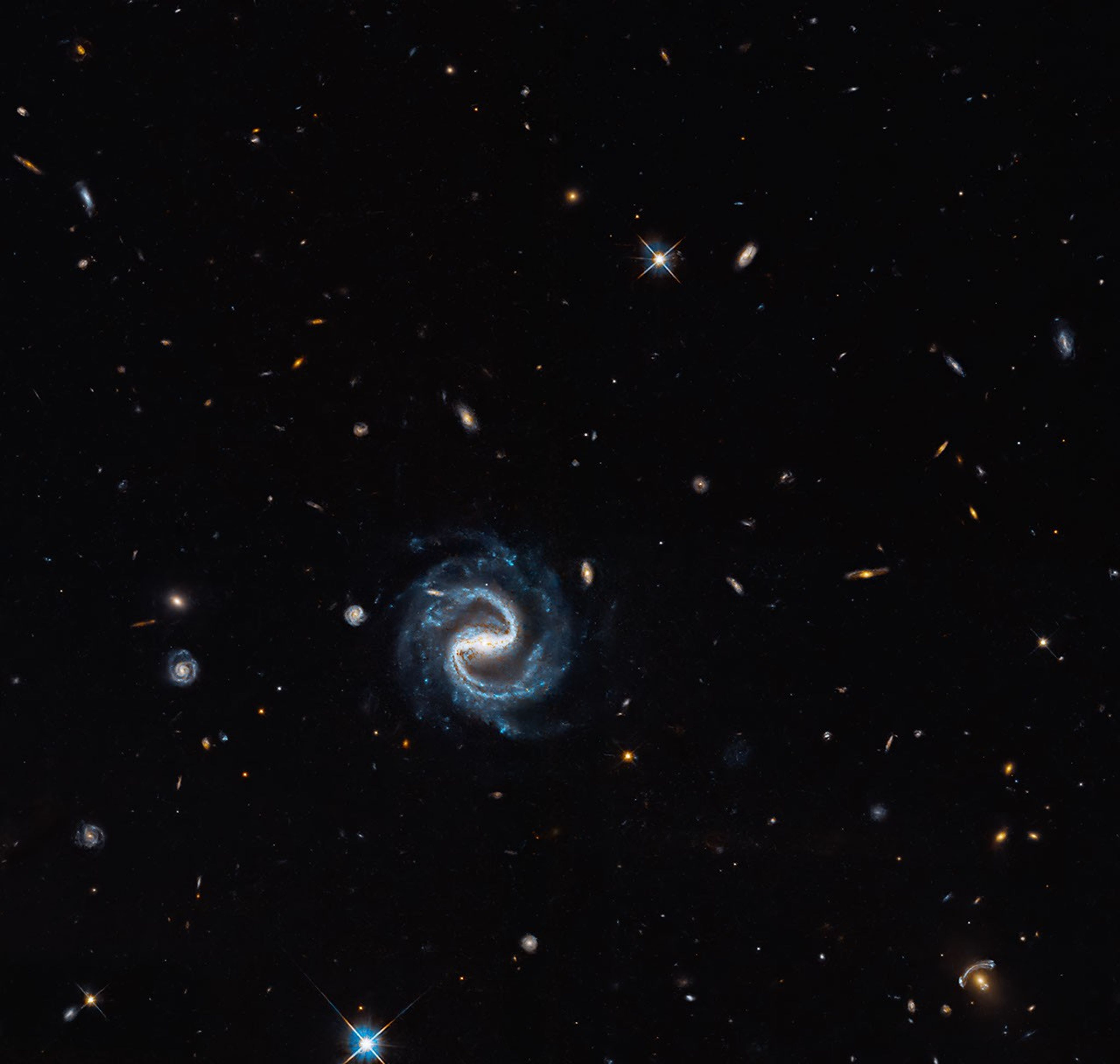
Image: Image Credit: NASA, ESA, and X. Huang (University of San Francisco); Processing: Gladys Kober (NASA/Catholic University of America) · Original page
NASA's detailed explanation identifies an arc-counterarc pair. These are two images of the same background galaxy, a larger arc and a smaller, flipped counterpart on opposite sides of a foreground elliptical galaxy.
Seeing one galaxy twice
Mass curves spacetime. Light from a distant galaxy follows bent paths as it passes a foreground object. With a suitable chance alignment, the background image can be magnified, stretched or multiplied. This gravitational lens has no glass: mass does the work.
The two arcs therefore should not be counted as two separate galaxies. Nor should the conspicuous central spiral be assumed to produce the lens at the lower right. That system has its own foreground and background galaxies.
Weighing what bends the light
The distortion depends on how foreground mass is distributed. Researchers model the arcs to constrain the galaxy's total mass and compare it with visible matter, investigating the contribution of dark matter. Dark matter has not been painted a particular color in this photograph; its gravity provides the evidence.
Hubble is gathering such observations in preparation for the Nancy Grace Roman Space Telescope. Hubble can examine individual targets in detail, while Roman's broader field will suit larger samples. Researchers use Hubble's sharp images to develop analysis tools, and plan follow-up of interesting lenses Roman finds. These are preparations and plans, rather than observations Roman has already completed.
Return to the photograph, temporarily set aside the prominent spiral, and enlarge the lower-right corner. Find the larger blue arc and its smaller companion. Sometimes reading an astronomical image begins by looking past the object that seems to be its star.