
💬 Deep Dive
The book Fish Don’t Exist became popular thanks to Meng Yan’s podcast No One Knows. This particular episode has been streamed over one million times on Xiao Yuzhou.
It also appeared in WeChat Reading’s 2024 annual report. So, in January this year, I opened the book with some expectations. After finishing the first two chapters, I felt bored — it was too far removed from my own life.
But with over 8,000 reviews on Douban and a rating of 8.4, I couldn’t help wondering what exactly made it so good.
Last month, I picked up Fish Don’t Exist again, this time reading the third chapter.
And that third chapter struck me. The author describes her confusion and unease growing up, as well as her doubts about the meaning of life, which made me deeply curious.
After reading it once, I wasn’t satisfied. I read it again.
I now think this book deserves an 8.8. It’s clearly not an ordinary biography, but a book about questioning the meaning of life — or perhaps, about finding a reason to go on living.
In one sense, it resembles existentialism, exposing the inherent meaninglessness of life. Yet ultimately it offers hope: every person, every tree, every gust of wind is like a dandelion — seemingly insignificant, yet profoundly important — because nature has no hierarchy, and diversity born from variation is the most beautiful thing.
1
The story begins with David Starr Jordan, the first president of Stanford University.
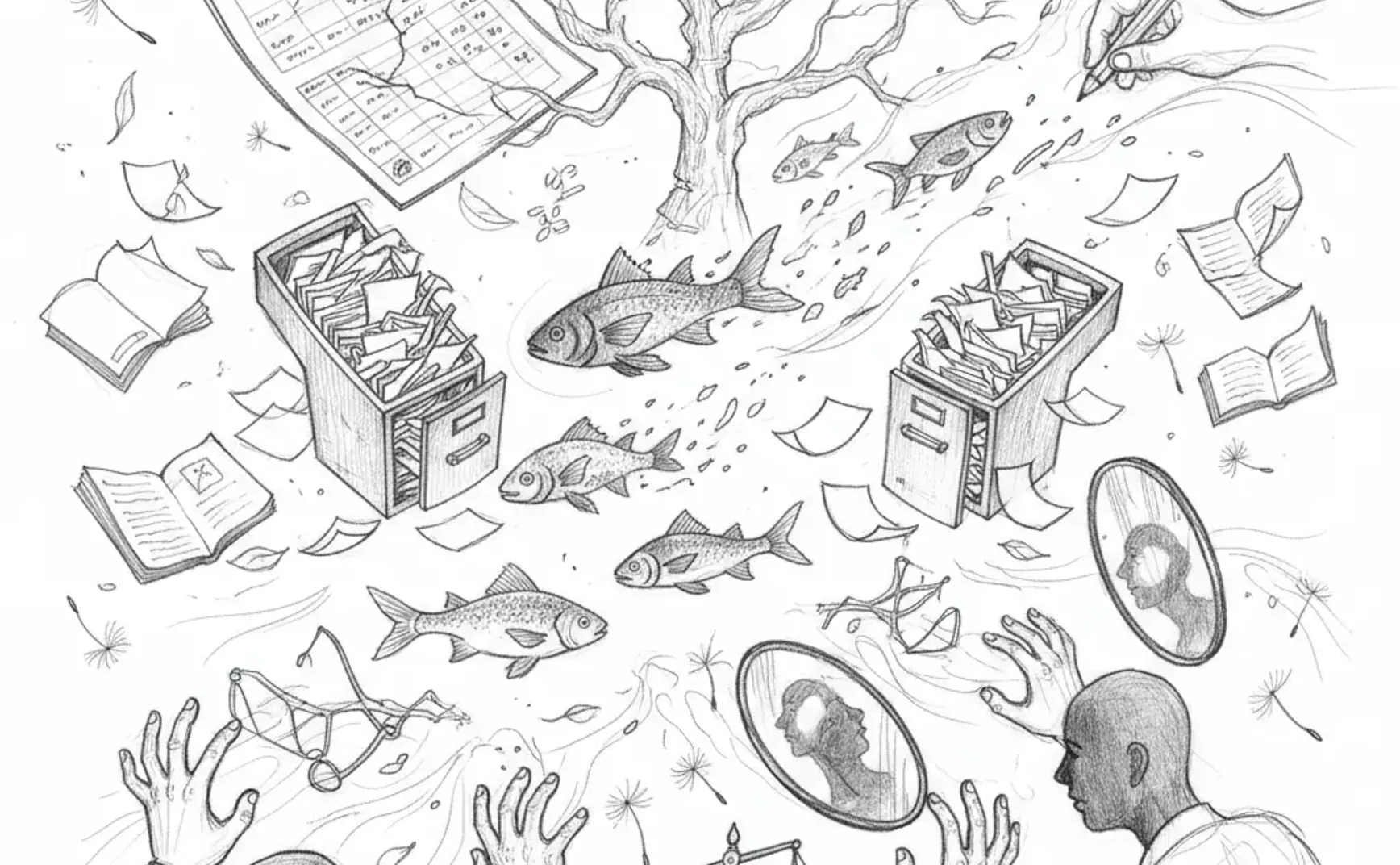
David was a taxonomist who dedicated his life to classifying fish, naming one-fifth of all known species — an extraordinary feat, and as you might expect, one that did not come easily.
In July 1883, while still teaching at Indiana University, a fire destroyed all his specimens and the secret documents he had painstakingly put together.
Two years later, his wife died of pneumonia.
Then, in April 1906, a magnitude 7.9 earthquake struck San Francisco, once again destroying nearly all of his fish specimens, classification records, and research notes.
Yet despite blow after blow, David was never broken. This is what fascinated the author: what force kept him going through fire, bereavement, and earthquake, continuing his fish research with resilience and refusing to be swallowed by despair?
Her answer: “self-deception” — or, more precisely, “positive illusions.”
David believed that human will determines destiny — ironically, a notion he had once claimed to oppose. But it was this untrue belief that allowed him to keep fighting through setback after setback, driven by sheer willpower.
By working tirelessly, he pushed back against the void, finding order and a sense of control in taxonomy.
In psychology, this self-deception is called “positive illusion.” Studies show that mentally healthy people often have such illusions — they believe themselves to be smarter, more attractive, and more in control than they actually are. Those who see themselves and the world with complete clarity, by contrast, are often more prone to depression.
Such optimistic misperceptions can fuel continuous action in the face of setbacks and uncertainty — even when everything has been lost, they allow a person to keep moving forward.
2
But positive illusions have a dark side.
When one convinces oneself that “willpower determines destiny,” such overconfidence can lead to arrogance.
David followed this dangerous path, becoming a passionate advocate of eugenics. He arrogantly believed humanity could control nature through reason and will, and that nature has a hierarchy: humans at the top, and within humanity itself, a ranking system of the “fit” and “unfit.”
In his eyes, the poor, alcoholics, the intellectually disabled, and the morally corrupt were “unfit” — burdens to society who should be controlled through isolation or sterilization to prevent the “decline” of human quality.
He pushed the government to implement mass sterilization, making California one of the first U.S. states to practice what was called “better breeding.”
As a result, tens of thousands of American women were forced to undergo hysterectomies under the banner of eugenics.
Moreover, eugenics theory and U.S. practices of the time later became a key inspiration for Nazi racial cleansing ideology.
Moderate self-deception can help us persevere through hardship, but excessive self-deception makes us rigid, stripping away objectivity, doubt, and humility.
I find it hard to define exactly where “moderate” ends and “excessive” begins. The safest path might be to maintain constant doubt and humility.
3
Ironically, when scientists later reexamined David’s research using DNA technology, they discovered something astonishing: fish don’t actually exist. Fish have no common ancestor — the classification itself was wrong. A certain “fish” might be more closely related to humans than to another “fish.”
Call it cosmic justice or mere coincidence: David’s life’s work simply did not exist.
This is another expression of human arrogance. We love to classify and label, to assign rankings, hoping it will give us more control.
But nature’s beauty lies in the diversity born from variation. There’s no fixed “better” or “worse,” only adaptation to ever-changing environments.
This is like the author’s “dandelion principle”: to a gardener, a dandelion is a weed; to a herbalist, it’s medicine; to a child, it’s a wish. Its value isn’t fixed — it depends on the relationship one has with it.
From the vast perspective of the universe or eugenics, an individual life may seem tiny and irrelevant; but for a family or a network of relationships, an “ordinary” person can be the most important of all.
So let go of imagined hierarchies and rigid classifications, and find your worth and meaning in genuine relationships.
Final
Humans are no smarter than other creatures.
Each human being, like all living things, is both small and significant, unimportant yet irreplaceable.
🧵 One More Thing
This issue of the newsletter skips the Curated Gems section — I’ve moved it to my daily blog.
You can follow me on WeChat, Xiaohongshu, or via Quaily and RSS to read it.
I’m currently creating three types of content:
- Videos: Updated irregularly, posted on YouTube, Bilibili and Xiaohongshu, mainly sharing apps, useful items, and self-growth topics. Each video runs 5–15 minutes.
- Blog: Updated irregularly, aiming for three posts per week, published on Quaily, WeChat, and Xiaohongshu. I share my fragmented thoughts and reading notes, 200–500 words each.
- Newsletter: Updated every four weeks, published on Quaily and WeChat, featuring my reading notes and systematic thinking, 2,000–3,000 words each.
I’m not great at self-promotion — so if you like my work, please share it widely 😄
I’m also wondering whether I should keep writing the newsletter. Maybe I’m trying to do too much. Writing it is great mental exercise, but compared to videos and blogs, does it put too much reading pressure on my audience? I’m still thinking about it.
One reason for this hesitation is that this happens to be the 50th issue — a natural decision point 😄
If I stop, I’ll notify everyone. Even so, it would be more of a “pause” than a “full stop.”