
A transformation can have many decisive moments. A national holiday chooses one.

Image: Google Doodle, "German Unity Day 2026" | Original page
Google uses the German flag's black, red and gold to mark Unity Day. The holiday does not commemorate November 9, 1989, when the Berlin Wall opened. It marks October 3 the following year, when the German Democratic Republic's accession to the Federal Republic took effect.
November 9 carries another history that cannot be set aside: the antisemitic pogroms of 1938. They were not the beginning of Nazi persecution, but their anniversary made that date unsuitable for an uncomplicated celebration.
From a Decision to Its Effective Date
The Bundestag's historical account distinguishes two easily confused dates. East Germany's Volkskammer began a special meeting on August 22, 1990. The formal decision came early on August 23: accession to the Federal Republic, effective October 3.
Beginning a meeting on one day does not place every vote on that same date. A nation's chosen anniversary carries political meaning and a precise legal chronology.
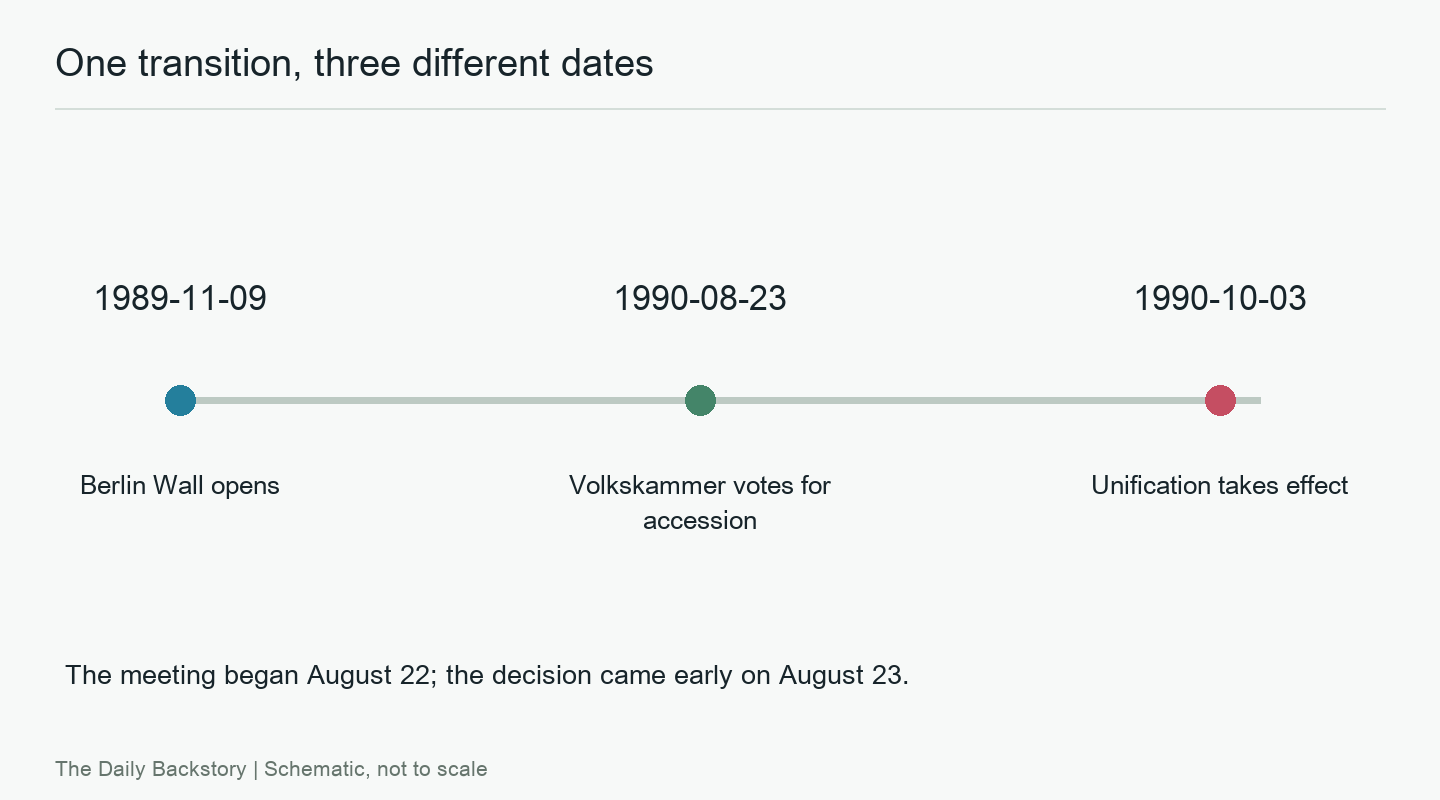
Diagram: The Daily Backstory; event order, with intervals not to scale.
Bremen hosts the central celebrations in 2026, 36 years after unification. Local officials publish the program; the anniversary itself remains October 3 every year.
What Can Remain after a Wall Comes Down
The striking color contrast in historical nighttime views of Berlin reflected different lighting systems on its eastern and western sides. A political boundary can change overnight. Replacing lamps, roads and infrastructure takes much longer.
That does not mean a sharp light boundary remains visible along every part of the former wall today. Night photographs have dates, and LED conversions continue to change their colors. The contrast is a record of infrastructure at a particular time, not a permanent luminous wall.
A Line Nobody Built
China's Hu Huanyong Line is a different kind of division. In 1935, Hu described a population-geography boundary from Aihui, now Heihe, to Tengchong. Under the historical area and population definitions he used, the southeastern side occupied about 36% of the territory and held about 96% of the population. Those proportions should not be transferred unchanged to today's territorial calculations.
An article hosted by China's education ministry notes that six censuses from 1953 through 2010 continued to show the broad pattern of a densely populated southeast and a sparsely populated northwest. Geography, water and precipitation help explain it. They are not a command preventing change; migration and urbanization alter the details.
Berlin's lighting contrast came from infrastructure and history. Hu's line summarizes a long relationship between population and geography. Understanding where a division came from is the first step toward understanding how it might change.
Sources
Google Doodles: Original page; Bundestag: the August 23, 1990 decision; Bremen government: Unity Day 2026; DarkSky: city lights from space; China's education ministry: the Hu Huanyong Line.