
Today is the second day of France's Heritage Days. Organizers made "the heritage of photography" the first of this year's themes, marking the bicentenary of photography's invention. And the image Bing has given its Chinese readers today is, fittingly, a photograph.
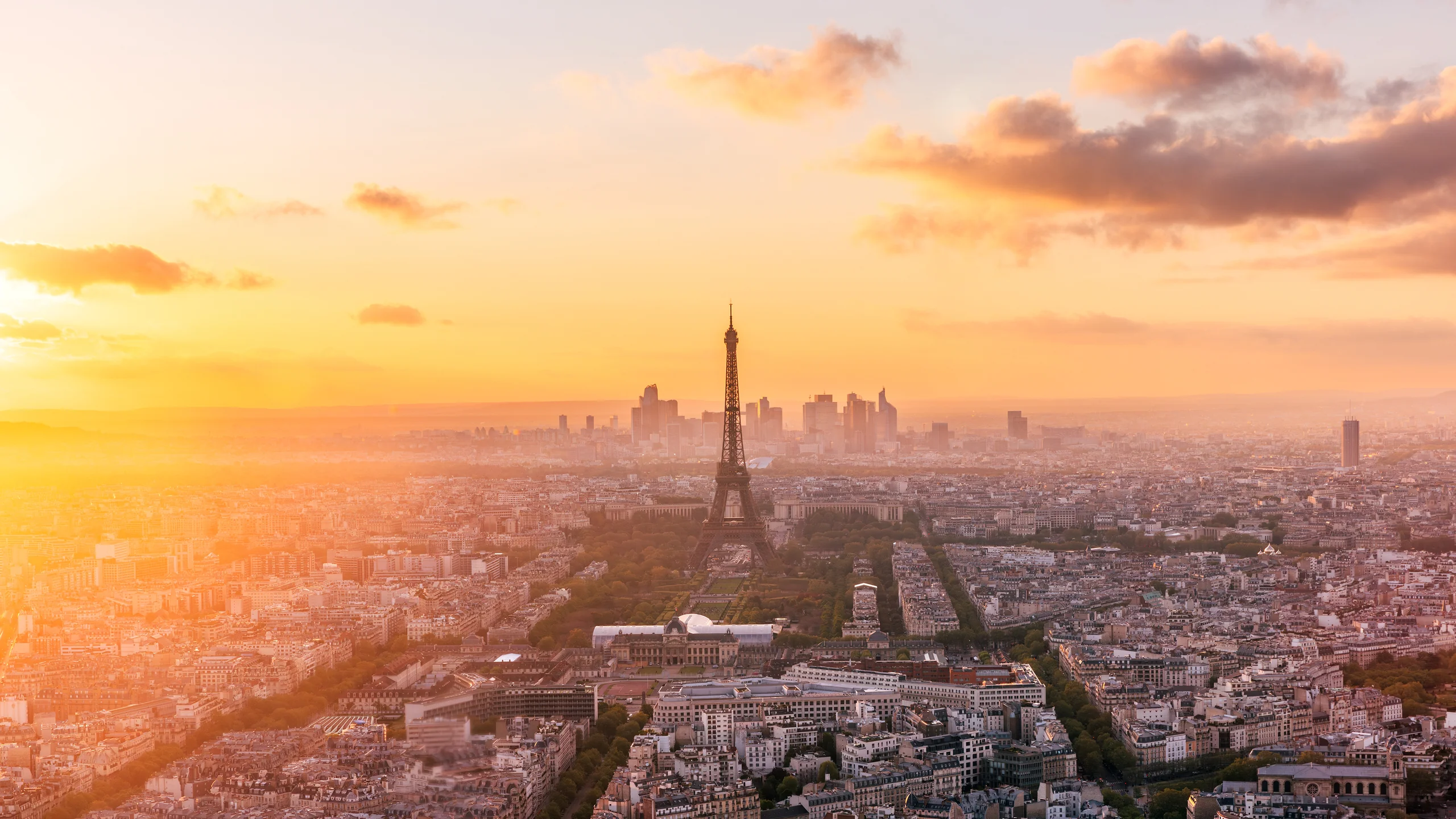
Image: Bing Daily Wallpaper | The Eiffel Tower at sunset in Paris, France (© Alexander Spatari/Getty Images) | Bing homepage
Bing's Chinese title for this photograph is "The Tower That Finally Won Paris Over."
That word "finally" is the most interesting part. The tower was certainly not loved at first.
Some 40 People Signed a Letter to Stop It
On February 14, 1887, the Paris newspaper Le Temps published an open letter. Its signatories were some 40 of France's most famous writers, painters, sculptors and architects.
They called the unbuilt tower a "Tower of Babel" and a "dizzily ridiculous tower," like "a gigantic black factory chimney" crushing Paris beneath it. Its shadow, they said, would fall across the city "like a blot of ink."
The names included the composer Charles Gounod, Guy de Maupassant, author of "The Necklace," and Alexandre Dumas fils. The group was led by Charles Garnier, architect of the Paris Opera. Émile Zola is often included in accounts of the protest, but neither of the two independent lists I checked contains his name.
One story about Maupassant has circulated endlessly: that he ate lunch at the tower's restaurant every day because it was the only place in Paris from which he could not see the tower. No primary source for the anecdote has been found. The earliest known version attaching it to Maupassant dates from 1975, though he died in 1893. A 1914 version of the same joke concerned the Englishman William Morris, and later versions moved it to Warsaw and London.
The anecdote is unnecessary. Maupassant's own words were harsher. In 1890, he wrote in A Wandering Life that one reason he was leaving Paris and France was that he was "sick to death of the Eiffel Tower," which he described as an inescapable nightmare.
A Date Hidden in the Protest
The letter contains another often overlooked line. Its authors complained that the colossus would cast its shadow over Paris "for 20 years, the duration of the concession."
The signatories knew perfectly well that the tower was meant to be temporary.
Gustave Eiffel held a 20-year permit to use the land. On January 1, 1910, the tower would be handed over to the City of Paris. No one had guaranteed that it would remain standing afterward.
The real question was never whether Parisians would gradually learn to love it. It was this: could the pile of iron prove that it needed to exist before those 20 years ran out?
He Changed the Terms of the Argument
In response to the protest, Eiffel did something revealing. He had 72 names inscribed around the first level of the tower.
They belonged to French scientists, engineers and mathematicians, all active after 1789. Their names formed a ring of gold around the structure. Accounts of Eiffel's motive are direct: he did it because the protests against the tower mattered to him.
In other words, he had no intention of arguing with artists over who understood beauty. He moved the argument to different ground.
The gold lettering was painted over in the early 20th century, rediscovered in 1986-87, and restored to its original color during another renovation in 2010-11.
From the year the tower opened, its structure housed a measurement laboratory with barometers, anemometers and lightning conductors. Eiffel kept an office on the third level for astronomical and physiological observations. He called the tower "a laboratory such as science has never had at its disposal."
What Really Saved It Was an Antenna
The turning point first appeared on November 5, 1898. That day, Eugène Ducretet completed the first wireless radio link between the Eiffel Tower and the Panthéon, four kilometers away, using Morse code.
In 1903, the French army captain Gustave Ferrié approached Eiffel with a proposal for a military wireless network based on the tower. Eiffel paid for the antenna installation himself. The following year, the tower became an official military radiotelegraph station. By 1908, it could communicate over 6,000 kilometers. In 1909, a permanent station was built beneath the Champ de Mars, with six cables, each 425 meters long, running down from the summit.
Then came May 23, 1910.
On that day, the tower transmitted its first official time signals. Every day thereafter, at noon and midnight, it broadcast the exact time in Paris. Where did that time come from? An underground cable ran directly from the Paris Observatory to the foot of the tower. The observatory supplied the precise time; the tower announced it to the world. Ships at sea could receive the signal and calculate their longitude.
A temporary iron structure had become a mast for telling time.
When the concession expired on January 1, 1910, Eiffel secured an extension. Not for a few more years, but for 70.
The French Ministry of the Armed Forces is unequivocal in its archives: the strategic value of successful radio communication was the decisive factor in preserving the monument.
So Bing's sequence is backward. People did not first learn to like the tower and then decide they could not bear to demolish it. The tower first became useful, and that is why it survived. Its aesthetic rehabilitation was the result, not the cause.
That Curve Was Calculated
Now consider why it looks the way it does.
You may have heard that the tower follows an exponential curve. In a 2004 paper, the mathematicians Weidman and Pinelis were direct: a model often attributed to Eiffel's own writing produces the wrong curvature. The real tower can be approximated by two exponential curves with different growth rates across 29 panels. The lower section narrows more sharply because an extra safety factor was applied there.
More interesting than the formula, however, is the condition Eiffel himself specified. He said the tower's outer profile reproduces, at a fixed scale, the curve of the moment created by the wind.
Put in terms that can be drawn: at any height on the tower, extend the tangent lines from its two sides upward. They must meet exactly at the point where the resultant of all the wind forces above that height acts.
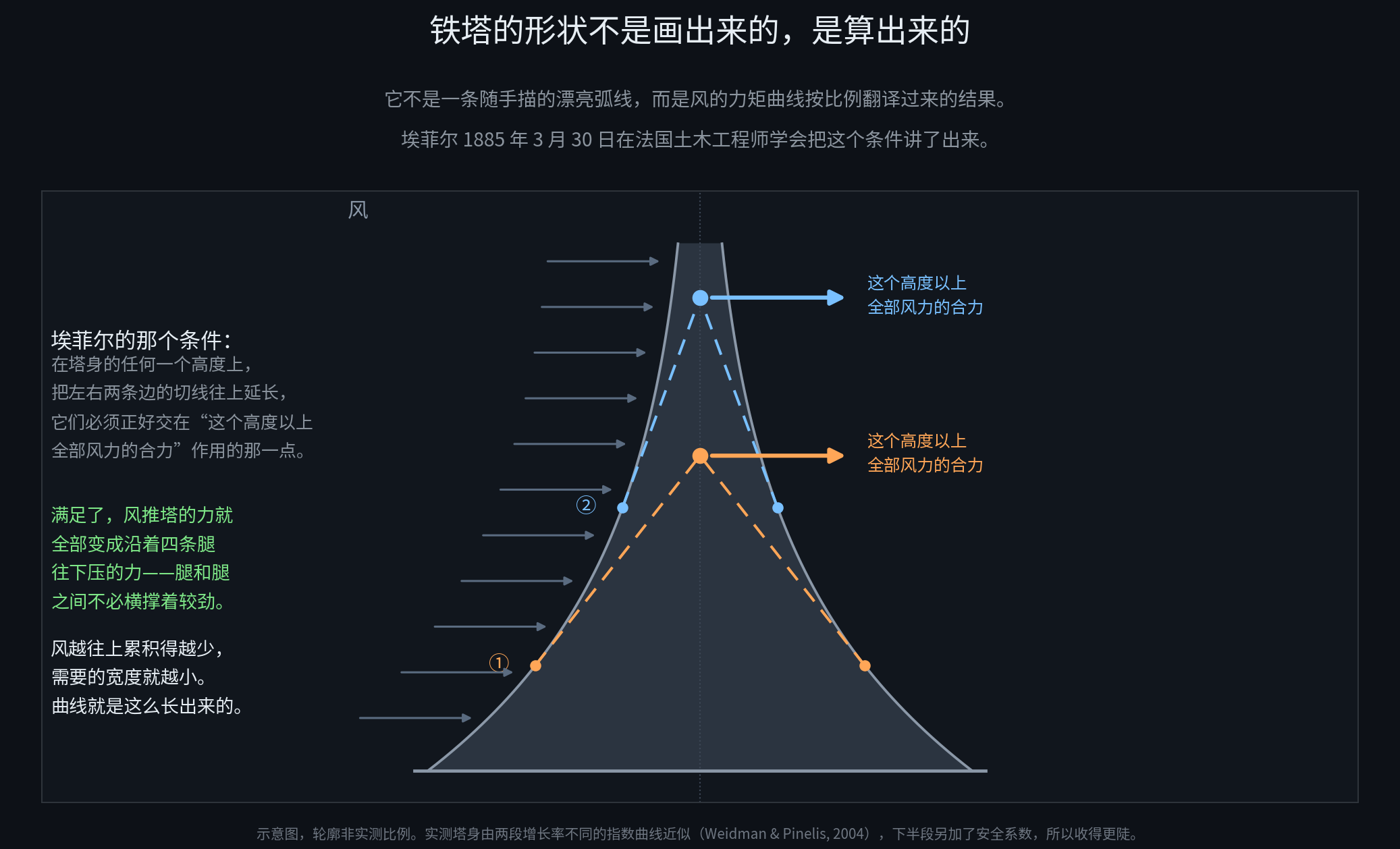
When that condition is met, the force of the wind becomes axial compression down the tower's four legs. The legs do not need cross-bracing to fight one another. Eliminating those diagonal supports saves weight and reduces the surface exposed to the wind. Higher up, with less accumulated wind force overhead, the tower needs less width.
The curve was not drawn for effect. It grew out of the forces.
Eiffel described this condition to the French Society of Civil Engineers on March 30, 1885. Weidman, a University of Colorado professor who studied the tower, put it neatly: throughout his building career, Eiffel was preoccupied with wind. He called the tower "a structure shaped by the wind."
The Summit Draws a Circle in the Sky Every Day
One claim is especially common on the Chinese internet: that the Eiffel Tower grows 15 centimeters taller in summer.
It conflates two different things.
The tower's official website says that thermal expansion makes the structure a few millimeters taller. In winter, the metal contracts by a few millimeters again. Millimeters, not 15 centimeters.
The 15 centimeters describe something else, and it is far more beautiful.
On a sunny day, the Sun heats each of the tower's four faces in succession. The sunlit side expands more than the shaded side, pushing the summit toward the shade. As the Sun moves around the tower, the top moves with it. According to the official site, the summit traces a circle about 15 centimeters in diameter over the course of a day.
Every day, the summit draws a 15-centimeter circle in the sky. The Sun holds the pen.
One related note: I checked both the official "key figures" page and its dedicated account of how the tower changes size. Neither gives a number for how far the tower moves in high winds; both merely say that strong winds can cause it to sway or vibrate. The figures of 12 or 13 centimeters often repeated in Chinese have no official source that I could find, so no number is given here.
His Tower Turned Him into an Aerodynamicist
After the tower was finished, Eiffel did not move on to another construction project. He turned the tower into an experimental instrument.
In 1903, he suspended a steel cable from the second level to create a drop-testing machine. Over three years, he sent about 40 differently shaped objects down the cable, repeatedly measuring the drag on them.
In 1909, he built a wind tunnel at the tower's foot, powered by the tower's own generator. Repeating the tests there confirmed something that now seems obvious but then needed to be demonstrated: air flowing around a stationary object produces the same drag as the object moving through stationary air. From August 1909 through December 1911, the tunnel completed 5,000 tests.
In 1912, Eiffel moved the laboratory to Auteuil in Paris's 16th arrondissement. Its two wind tunnels shared a test section, with bell-shaped entrances and exits. Wind tunnels around the world later copied the design. In 1920, at the age of 88, Eiffel donated the entire laboratory to the French government. It still operates today and is the world's oldest surviving aeronautical laboratory with its original wind tunnel intact.
Testing a sphere, Eiffel encountered something strange. As wind speed rose, drag should have continued rising with it. Instead, at a certain point, the drag suddenly dropped. Stranger still, the transition occurred at the same point whenever the product of wind speed and the sphere's diameter was the same.
What determines how air flows around a sphere is neither its size nor the wind speed alone, but their product.
That is the physical core of the Reynolds number. The phenomenon is still called the "Eiffel paradox." Eiffel and another French researcher, Morin, discovered it independently. Prandtl's laboratory in Göttingen initially doubted the result, then explained it through boundary-layer theory.
A man who calculated the wind because he feared it might topple his tower was carried by that wind into aerodynamics.
Today, That Wind Tunnel Is Open
This year's European Heritage Days fall on September 19 and 20. Their two themes are "the heritage of photography" and "endangered heritage: rekindle, resist, reimagine."
The Auteuil wind tunnel that Eiffel built in 1912 is open to the public for Heritage Days:
- Address: 67 rue Boileau, Paris 16th arrondissement
- Sunday, September 20, 9:00 a.m.-12:00 p.m. and 2:00-4:30 p.m., local CEST, six hours behind Beijing
- Pay what you wish; no reservation required
The tower itself is not part of this arrangement. It is operated by a company that sells tickets year-round. What opens today is the century-old aerodynamics laboratory that still runs. The tower's form was calculated from the body of knowledge whose beginnings can be found in that room.
Shanghai, More Than 120 Years Later
The same problem is tackled differently in China today.
The State Key Laboratory of Disaster Reduction in Civil Engineering at Tongji University has four wind tunnels. One of them, TJ-3, has a test section 15 meters wide, large enough for models of supertall buildings and long-span bridges.
The facade of Shanghai Tower twists through 120 degrees from bottom to top. On its project page, structural engineer Thornton Tomasetti writes in the first person that the team optimized the tower's form and reduced wind loads by 24%, allowing a lighter structure and lower material costs. A double-pendulum tuned mass damper at the top restrains wind-induced movement. Chinese media report that it weighs about 1,000 metric tons and has a name: the "Shanghai Eye."
Eiffel used a curve against the wind; Shanghai Tower uses a twist. More than 120 years separate them, but the reasoning is the same: rather than asking steel to resist the entire force, let shape dissipate it first. More neatly still, both explanations give the same blunt reason: it saves material.
The Protected Work Is Not the Tower, but Its Light
This point is practical, and widely misunderstood.
The official website is clear: daytime images of the Eiffel Tower are in the public domain. They may be used freely without prior authorization.
The tower's lighting, however, is protected. That includes the golden illumination, the sparkling lights, the summit searchlights and special-event displays. Any professional use of an image showing the illuminated tower requires advance permission and may incur royalties. Private use requires no permission.
So a daytime photograph may be freely shared. Posting a nighttime picture for friends is also fine. But anyone planning to sell that night view, print it on merchandise or use it in advertising must negotiate first.
The protected work is not the 1889 tower. Its designer died in 1923, and its copyright has long expired. What is protected is the golden lighting scheme created by Pierre Bideau in 1985, using 336 high-pressure sodium lamps, along with the sparkling lights he also designed. That display first appeared at midnight on December 31, 1999: 20,000 six-watt bulbs spread across the tower's four faces.
The lights run from nightfall until midnight or 1:00 a.m., sparkling for five minutes on the hour. The final display is special: the golden lighting and searchlights go dark, leaving only those 20,000 bulbs glittering against the night.
The Seventy-Third Name
Return to the 72 names.
Sophie Germain is not among them.
Germain was an early 19th-century French mathematician. Her work on elasticity - how a thin plate bends and vibrates under force - helped establish the mechanics on which the tower depended. As early as 1913, one writer pointed out that she had been excluded because she was a woman.
On January 26, 2026, the City of Paris announced a list of 72 women scientists whose names are to be inscribed on the tower's first level. They will appear directly above the existing band, in the same typeface and the same gold. An association led the eight-month selection process, co-chaired by an astrophysicist and the chair of the tower's operating company. The list must next be submitted to the academies of sciences, technologies and medicine for review.
Sophie Germain is on it.
From 1889 to 2026: 137 years.
Sources: the Eiffel Tower's official website, toureiffel.paris, including its pages on history, key figures, science, lighting, image use and why the tower changes size; the French Ministry of Culture's official Heritage Days portal, journeesdupatrimoine.culture.gouv.fr; the French Ministry of the Armed Forces archive, "The Man Who Saved the Eiffel Tower: Gustave Ferrié"; the French Astronomical Society, "The Eiffel Tower and Time"; the City of Paris press release of January 26, 2026; Weidman and Pinelis, Comptes Rendus Mécanique (2004); Chanetz, "A Century of Wind Tunnels Since Eiffel," Comptes Rendus Mécanique (2017); a University of Colorado Boulder news release; the ASME engineering landmark record, "Eiffel's Drop Test Machine and Wind Tunnel"; Quote Investigator; the Thornton Tomasetti and RWDI project pages for Shanghai Tower; Tongji University's State Key Laboratory of Disaster Reduction in Civil Engineering wind-tunnel documentation; and Chapter 15 of the Structural Engineering Handbook.