
Broad trunks rise from the water like long-necked bottles. Rust-red and golden branches reappear in their reflections, giving the forest a second, upside-down canopy. Bing's October 27 wallpaper shows pondcypress trees in Georgia, in the southeastern United States.
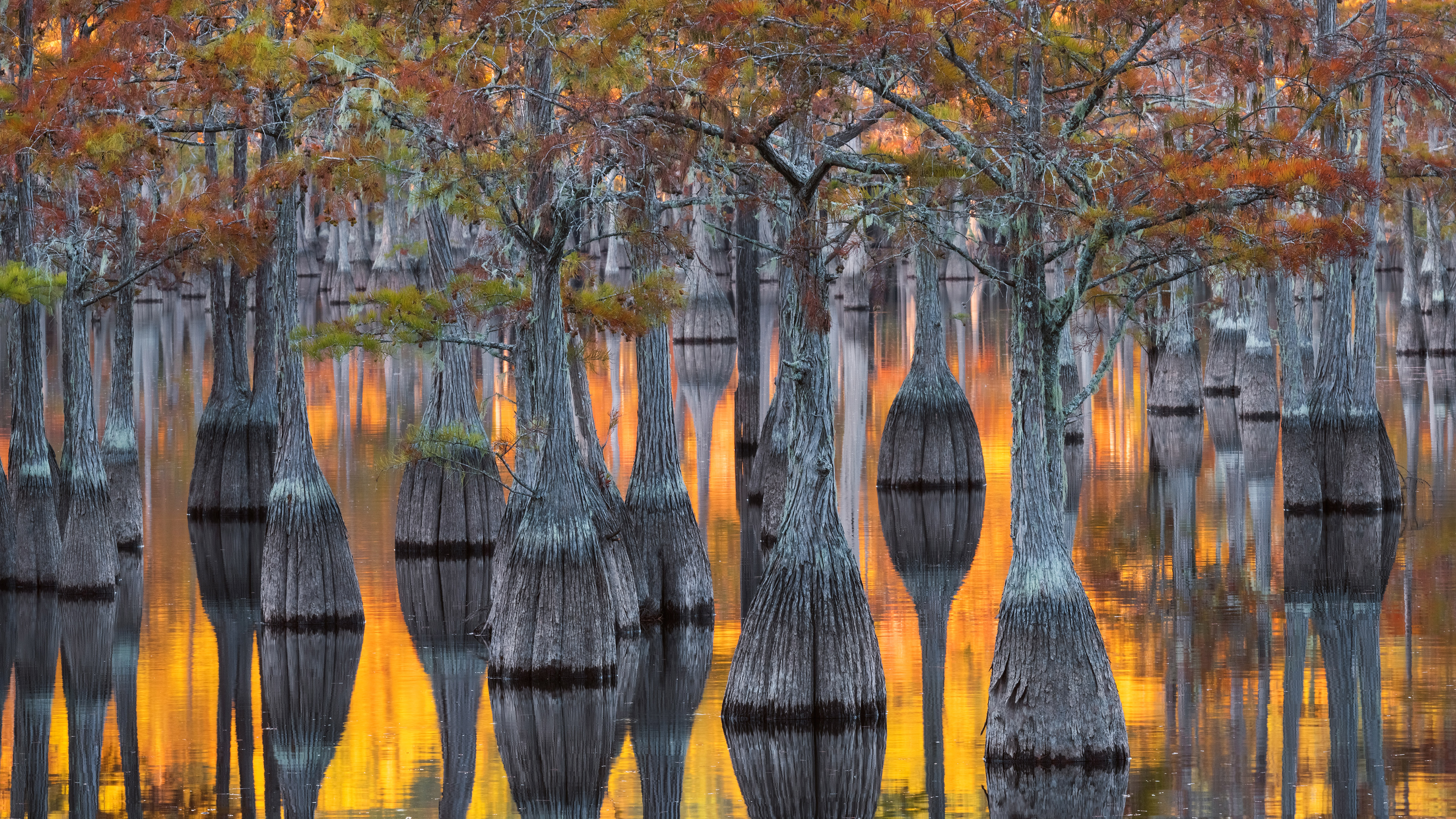
Image: Pondcypress forest in autumn, Georgia, United States (© Chris Moore/Getty Images). Original page.
Look first at the flared bases, then up at the changing foliage. Conifers do not all keep their leaves through winter. Pondcypress is deciduous. It is closely related to baldcypress, and some classifications treat it as a variety of that species.
Water Changes Meaning as a Tree Grows
The US Forest Service's account of baldcypress describes a demanding start to life. In swamps, seeds generally germinate on wet muck or sphagnum moss. They do not germinate underwater, but a dry surface can prevent germination too.
A period of falling water can therefore open a window for new trees. Once seedlings emerge, they need to keep at least part of their crowns above floodwater. Prolonged complete submergence can kill them. These observations concern baldcypress regeneration; they cannot reconstruct the childhood of each pondcypress in this photograph. They do reveal why a forest of water-tolerant adults should not make us assume every stage of life is equally flood-tolerant.
What a Knee Can Do
Some cypress wetlands have woody projections rising beside the trees. These "knees" belong to roots, rather than being new saplings. Pondcypress can produce them, although the Forest Service describes its knees as less common, shorter, and rounder than those of typical baldcypress.
Research on their functions continues. A 2015 experiment with baldcypress compared submerged roots with their attached knees either exposed to air or submerged too. Oxygen concentrations in air inside the roots were much higher when the knees remained above water. That supports a role in supplying submerged roots with oxygen. Weak results from older experiments do not justify dismissing aeration altogether.
A long-term study published in 2026 followed 30 knees in a Florida wetland, measuring them monthly over 14 years. Growth depended on both water conditions and the trees' seasonal dormancy: water alone did not make knees grow at any time of year. The study leaves broader questions open while making growth and aeration more tangible subjects for measurement. It does not mean every pondcypress in the Georgia photograph has been tested. Nor should the prominent swollen trunk bases be mistaken for knees.
There are pondcypress landscapes farther afield too. A 2021 report from Shanghai's municipal culture and tourism authority described the flooded forest at Qingxi Country Park, with peak color then expected from late November to early December. That was a forecast for that particular year. Check current park notices before planning a visit.
From a wetland boardwalk, look for old water marks, exposed wet mud, and the different positions of seedlings and mature trees. Stay on the trail and leave roots undisturbed. A small change in water level can mean very different things to a seed and a fully grown tree.