
Four people wave beneath a blue sky, with a NASA water tower behind them. They have not flown home from Mars. Yet for more than a year, they have not been able to stand outside like this.
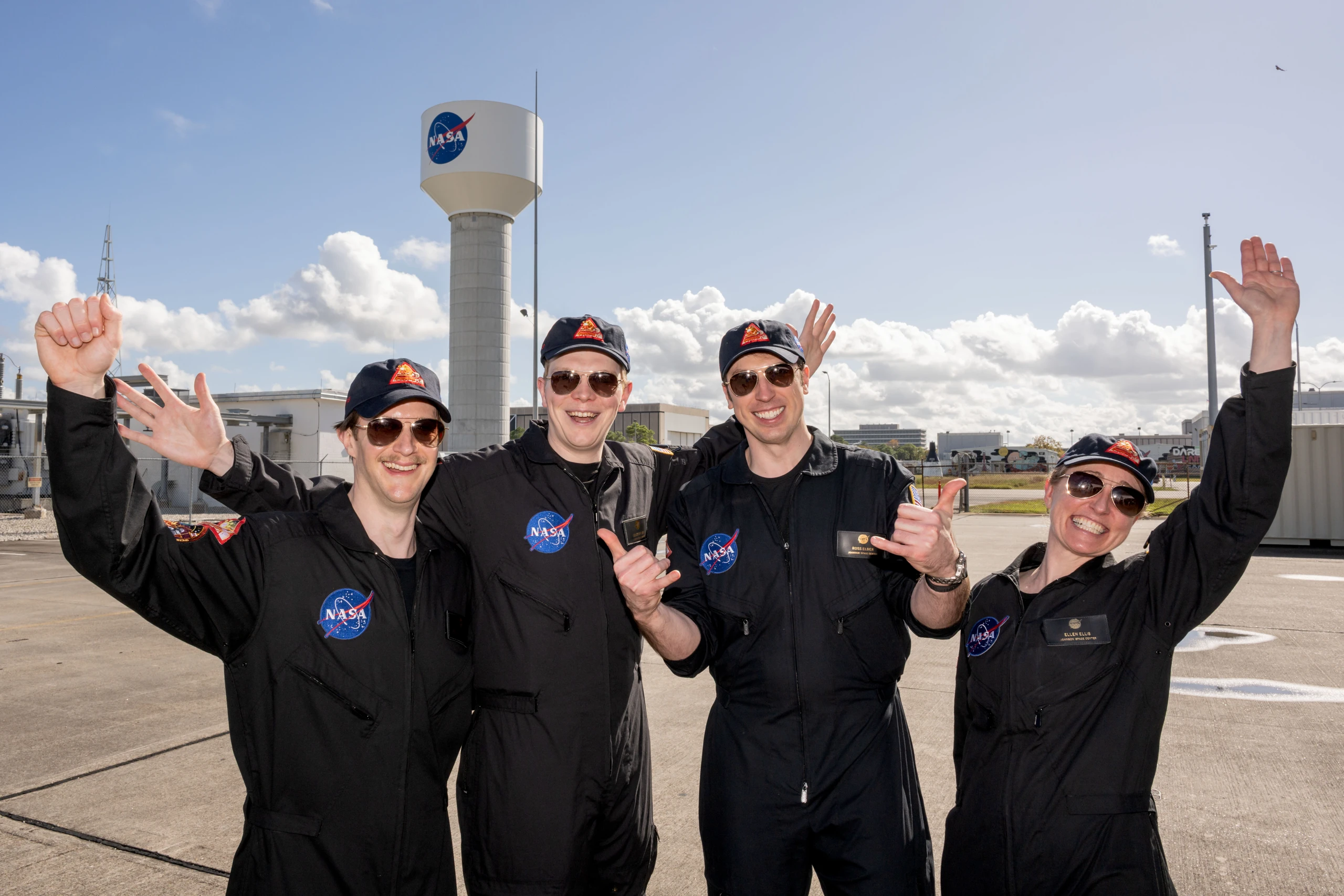
Image: NASA Image of the Day · Credit: NASA/James Blair · Original page
NASA's November 2 image shows the second CHAPEA crew after leaving their simulated habitat on October 31. From left are Matthew Montgomery, James Spicer, Ross Elder and Ellen Ellis. They spent 378 days living and working in the facility at Johnson Space Center in Houston.
Making delayed replies part of the experiment
CHAPEA stands for Crew Health and Performance Exploration Analog. Rather than leaving Earth, the volunteers lived with constraints that a long mission would impose: limited resources, equipment maintenance, crops to tend and delayed communication with the ground.
The second mission also included a simulated two-week loss of contact. NASA's 200-day progress report explains that this represented the communication difficulty when Mars passes behind the Sun. The crew had to follow prepared procedures and work with available resources instead of expecting an immediate answer whenever a problem arose.
The simulation has limits. Houston has Earth's gravity, and the habitat does not reproduce deep-space radiation. It is especially useful for studying adaptation to prolonged isolation, a fixed team and restricted resources. NASA will use the health and performance data to reduce risks for future missions; one simulation cannot establish that a crewed trip to Mars is ready.
Listen to the crew's CHAPEA audio logs for accounts of tools, food and daily life. Large exploration plans eventually become small jobs that somebody has to do each day.