
These moons look like a box of colorful buttons. For NASA's November 1 Astronomy Picture of the Day, Marcella Giulia Pace brings together full moons photographed from different places across Italy over ten years.
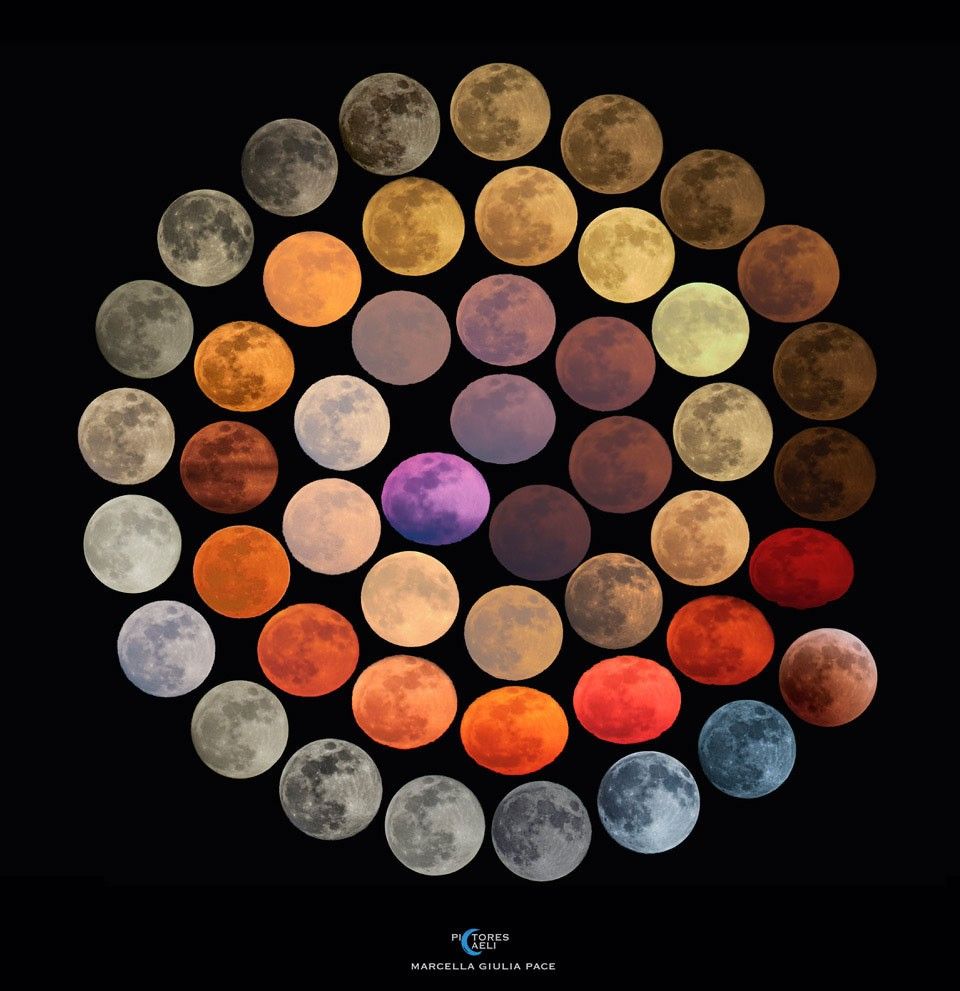
Image: NASA Astronomy Picture of the Day | Credit & Copyright: Marcella Giulia Pace | Original page
The Moon shines by reflected sunlight. From the ground, we see that light through a changing atmosphere. These colors do not mean the lunar surface has suddenly changed its material, and the collection does not show moons appearing together in one sky.
Near the horizon, moonlight takes a longer path through the air. Some blue light scatters away before reaching our eyes, making the Moon more likely to look yellow or red. Dust can affect the result, too. That qualification matters: a redder Moon cannot simply be read as a lower Moon on a calibrated scale.
When the Moon Really Looks Blue
NASA's explanation of blue moons describes smoke or dust particles of suitable sizes, around the micrometer scale, scattering red light strongly enough to leave transmitted moonlight looking bluish. Particle sizes and their distribution matter; any cloud of smoke will not do.
This is separate from the calendar term Blue Moon, commonly used for the second full moon in a month or the third in a season containing four full moons. The name promises no particular color. A visibly blue Moon remains a question about the air on that occasion.
The purple Moon is especially tempting to explain. APOD explicitly leaves its cause uncertain, suggesting several effects may combine. Curiosity does not require every question mark to be filled in.
The work also includes the Moon during the total lunar eclipse of July 2018. During a lunar eclipse, the Moon enters Earth's shadow, but some sunlight travels through the atmosphere around Earth and is refracted into it. Much blue light scatters away along the way; the remaining light makes the Moon appear dark red. That geometry does not apply to every red Moon in the collection.
Make a Color Record of Your Own
The next full moon occurs on Tuesday, November 24, 2026, at 14:53 Universal Time: 10:53 p.m. in Beijing and 9:53 a.m. Eastern Standard Time. This is the global instant of full phase; local moonrise must be checked separately. The US Naval Observatory's phase table provides the dates and times.
You do not need to watch at that exact minute. From a safe place with an open horizon, compare the Moon low in the sky with its appearance later, noting whether the air is clear. If you use a camera, record white balance and exposure settings as well. Otherwise the comparison may include the camera's choices alongside changes in the sky. Weather, altitude, and equipment all affect the result; no evening has to produce a complete collection.