
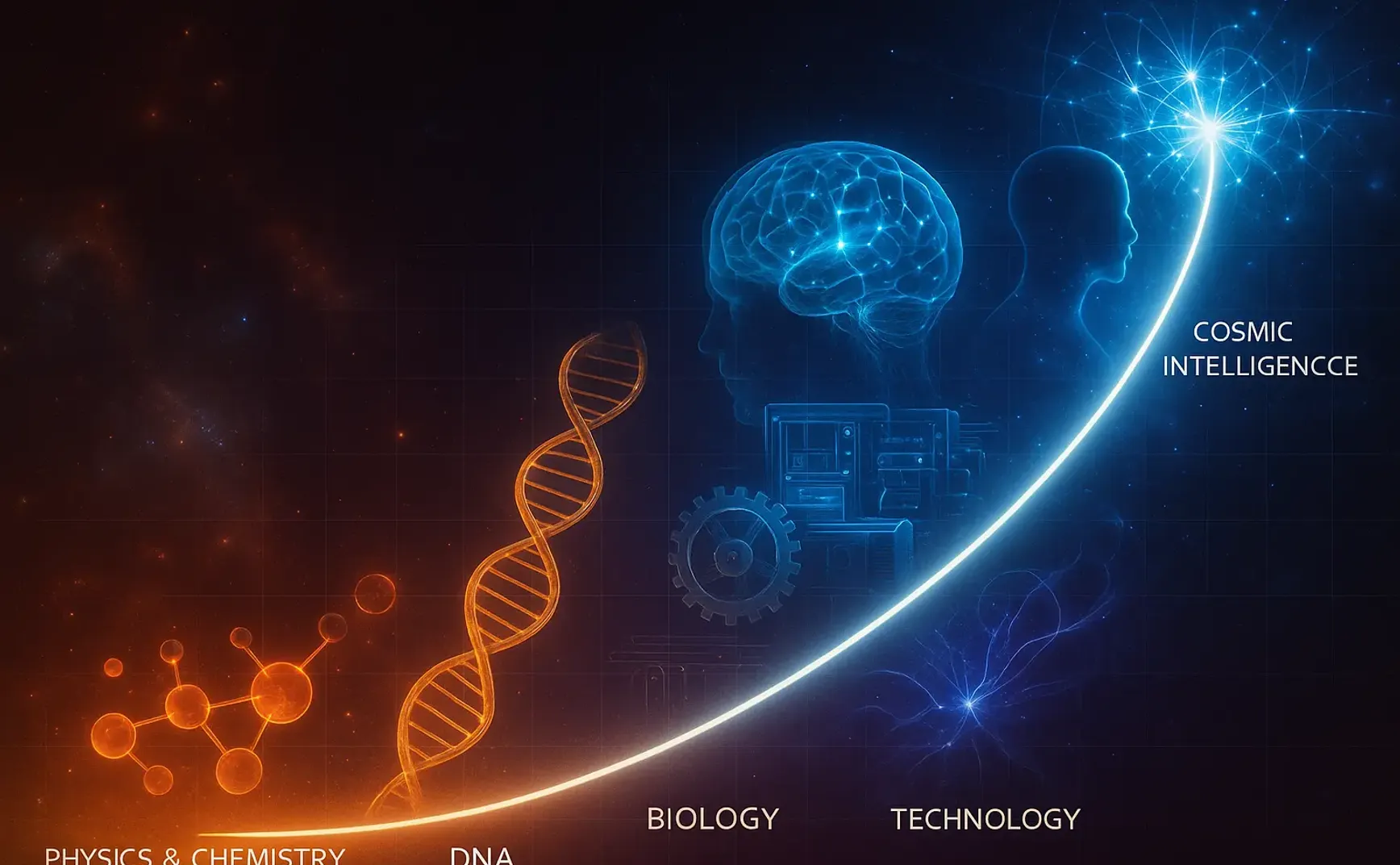
1. The Concept of Technological Singularity and the Framework of Six Epochs
Technological singularity refers to a future point at which technological progress accelerates exponentially until a “singularity” is reached, transforming the world beyond prediction due to an explosion of intelligence.
Kurzweil borrows the metaphor of a black hole singularity from physics to describe this moment when intelligence grows beyond the predictive power of current models—in his words, “human cognitive abilities will expand by millions of times.” He predicts that this singularity will occur around 2045.
He proposed a framework of six epochs in human and technological evolution (Six Epochs) to help understand the path to the singularity:
Epoch One: Physics and Chemistry – From the Big Bang to the formation of basic physical laws and chemical elements.
The information carrier in this epoch is the atomic structure; the laws governing the material world laid the foundation for the emergence of life. For example, the strong nuclear force allowed atomic nuclei to remain stable, enabling elements to combine into molecules and opening up the possibilities for complex chemistry. Over hundreds of millions of years, atoms gradually evolved into molecules capable of carrying rich information, setting the stage for life.
Epoch Two: Biology (DNA) – Life emerges, and genetic information is stored and transmitted in the form of DNA and RNA.
The information within DNA molecules guides the growth and reproduction of living organisms. About several billion years ago, primitive molecules evolved the ability to self-replicate, leading to the appearance of the earliest single-celled organisms and opening the door to biological evolution.
Epoch Three: The Brain (Biological Intelligence) – The development of complex animal brains.
Over the course of evolution, organisms developed neural networks for processing and storing information. Encoded by DNA, living beings gradually evolved centralized nervous systems and brains, equipping them with advanced perceptual and behavioral capabilities. Over millions of years, larger brains offered survival advantages, paving the way for the emergence of intelligent species such as humans.
Epoch Four: Technology – With high intelligence and dexterous hands, humans begin creating technological carriers to store and process information.
From the earliest markings and papyrus to mechanical printing and electronic computers, humans externalized memory and calculation processes. Technological progress became a new accelerating force, developing much faster than biological evolution—for instance, while human brain volume increases by about one cubic inch every 100,000 years, the cost-performance of digital computing nearly doubles every year. The technological era witnessed the shift of information processing from biological brains to silicon chips, putting human civilization on an exponential growth trajectory.
Epoch Five: Human-Machine Integration – The direct merging of biological and artificial intelligence results in enhanced human intellect.
Through means such as brain-machine interfaces, the human brain is connected to high-speed computers, integrating the neocortex with virtual neural layers in the cloud. Because neurons fire only several hundred times per second while computers can process tens of billions of operations per second, this “merger” could grant humans cognitive abilities far beyond natural biological limits. Non-biological intelligence offers an infinite new level for the brain; the neocortex could continuously layer additional virtual neurons, unleashing unimaginable abstract intelligence. Kurzweil sees this epoch as marked by massive human intelligence enhancement, whereby humans will evolve into a new species integrated with powerful AI.
Epoch Six: Cosmic Awakening – Intelligence breaks free from the confines of individuals and planets, expanding throughout the universe.
Ordinary matter is transformed into the densest computational material (“computable elements”), and intelligence proliferates exponentially across the cosmos. In this envisioned ultimate epoch, the intelligence of humans and AI will organize matter and energy, endowing every particle in the universe with intelligence, truly achieving “everything is alive.” Kurzweil vividly describes this as a “cosmic awakening,” where the universe comes to life through intelligent activity.
The developmental law governing these six epochs is the “law of accelerating returns,” because each new paradigm in information processing evolves faster and more efficiently than the last, resulting in an exponential increase in the rate of evolution. For example, biological evolution represents a huge acceleration compared to chemical evolution, and human technological progress is an even greater acceleration relative to biological evolution. Information technology benefits from a self-reinforcing cycle—technological advances boost research and development efficiency, in turn spurring even faster progress.
Information technology is like a rising tide that lifts all aspects of human life.
The “Six Epochs” framework views human evolution as a relay and acceleration of information-processing paradigms, from material substance to human-machine integration, ultimately culminating in a universe filled with intelligence.
2. The Current State of AI Development and the Path Toward Turing Test Achievement by 2029
Kurzweil boldly predicted that AI will pass the “Turing Test” before 2029.
The Turing Test involves an AI engaging in conversation with a human, and if a human evaluator cannot distinguish whether they are interacting with a machine or a person, the AI is considered to have reached human-level intelligence.
In his early book, The Age of Spiritual Machines, he mentioned that for AI to pass a rigorous Turing Test it must master human language, common-sense reasoning, and other capabilities.
Since 2011, when a cognitive question-answering system defeated a human champion, AI has gone on to beat the world champion in Go. Later, with the emergence of general textual intelligence, large language models gradually became accessible to the public. AI chatbots such as ChatGPT have taken the world by storm, demonstrating unprecedented utility in daily conversation and writing assistance.
According to a preprint paper titled "Large Language Models Pass the Turing Test" published on arXiv on March 31, 2025, researchers at the University of California, San Diego conducted a rigorous three-party Turing Test. In the test, participants engaged in a five-minute text conversation with both a human and an AI (including GPT-4.5, LLaMa-3.1-405B, GPT-4o, and an early chatbot named ELIZA) and then determined which was human. The results showed that when GPT-4.5 was prompted to adopt a “humanized personality,” 73% of participants believed it was human—far exceeding the 50% expected by random guessing and even outperforming actual humans (i.e. GPT-4.5 was more frequently identified as human than the real human interlocutor).
This is considered the first instance of an AI system passing the standard three-party Turing Test.
Yet, some have raised concerns about the testing system…
The current Turing Test is conducted under specific conditions (five-minute conversations with particular personality prompts). Kurzweil’s envisioned “rigorous Turing Test” might require an AI to perform excellently over longer durations, on a wider range of topics, and under more stringent conditions—perhaps even needing to deceive computer science experts.
Some researchers argue that the test assesses an AI’s ability to mimic humans rather than genuine intelligence. AI may “trick” humans by imitating human language style and emotions (for example, by using slang or exhibiting social awkwardness), without necessarily possessing deep understanding or consciousness.
Furthermore, the Turing Test does not directly measure consciousness, self-reflection, or emotional experience, which are vital components of human intelligence. Although GPT-4.5 is remarkably convincing, researchers emphasize that it does not possess consciousness or self-awareness.
Thus, GPT-4.5’s success partially validates Kurzweil’s prediction: advancements in language and common-sense reasoning are enabling AI to mimic humans in specific contexts. Consequently, some argue that we need to modify the Turing Test.
The Turing Test was originally intended as a thought experiment rather than a definitive measure of intelligence. Even if an AI passes the test, it does not prove that it has human-like understanding or awareness. Critics also claim that the Turing Test is more akin to a game of deception. This has led to the development of the ARC (Abstraction and Reasoning Corpus) test as an alternative. Humans can score about 80% on ARC, but AI currently only achieves around 30%, indicating that AI still lags behind humans in abstract reasoning. Companies like DeepMind and OpenAI are developing assessments for general intelligence to simulate complex real-world tasks.
Kurzweil’s prediction for 2029 likely refers to AI demonstrating capabilities approaching artificial general intelligence (AGI) in a wide range of domains, rather than merely passing the Turing Test. GPT-4.5’s achievement may be an important step, but there is still a way to go before reaching AGI.
So, what do experts think about the arrival of AGI? Due to the rapid evolution of AI, many leaders in the field have significantly advanced their timelines for AGI. DeepMind CEO Demis Hassabis predicted at the end of 2023 that within 5–10 years the industry might develop an AGI system with human-level intelligence. OpenAI CEO Sam Altman is even more optimistic, suggesting AGI could emerge by the mid-2020s. Meanwhile, the CEO of Anthropic has claimed that AGI might appear as early as 2026.
While definitions of AGI vary, there is a general consensus that breakthroughs in human-level intelligence are occurring faster than anticipated a decade ago. In this context, Kurzweil’s prediction regarding the Turing Test by 2029 does not seem overly optimistic but rather aligns with mainstream views—perhaps even slightly conservative.
Some remain cautious, noting that although current AI excels in tasks like recognition and text generation, it still falls short in truly autonomous understanding, causal reasoning, and emotional intelligence. However, with each technological leap, these gaps continue to narrow.
For example, AI was once thought to lack creativity, but generative models can now compose music and generate art. Similarly, while AI was criticized for its lack of common sense, the latest models supplemented by fine-tuning and tool usage have overcome many shortcomings in common-sense reasoning. Thus, it is optimistic to anticipate that in the next few years we may witness AI with more comprehensive intelligence—even to the point where many might believe it possesses self-awareness.
3. Human Intelligence Enhancement Technologies Integrated with AI
As we enter Kurzweil’s envisioned Epoch Five, the boundaries between humans and AI will gradually blur.
To avoid being left behind by rapidly evolving AI, our brains will need to connect directly to the cloud, harnessing machine intelligence to extend our cognitive capabilities.
Kurzweil predicts, “A key breakthrough in the 2030s will be the direct connection of the upper part of the human neocortex to the cloud,” so that AI is no longer our competitor but an extension of ourselves. By then, the non-biological cognitive capacity within our brains could be thousands of times greater than our biological capabilities.
While this vision sounds like science fiction, recent technological trends suggest its basic form is emerging—for example, Elon Musk’s brain-machine interface company Neuralink.
Brain-Computer Interfaces (BCI) serve as one of the bridges to human-machine integration.
BCIs enable direct signal transmission between the brain and computers, breaking down the barrier between biological organisms and electronic devices. Depending on the degree of invasiveness, brain-machine interfaces can be classified as non-invasive (e.g., EEG caps that read brain waves), semi-invasive (placing electrode arrays beneath the skull or within blood vessels), or invasive (implanting microelectrodes directly into brain tissue).
Currently, non-invasive techniques are safe but offer limited bandwidth and can only capture coarse signals; invasive interfaces can obtain high-resolution neural data but require surgical implantation and carry higher risks. In recent years, BCIs have achieved several breakthroughs, laying the foundation for future large-scale brain enhancement.
In the field of medical rehabilitation, invasive brain-machine interfaces have already helped paralyzed patients regain some abilities. In 2018, an American quadriplegic patient used a BCI with an implanted electrode array to control a robotic arm with his thoughts, successfully performing actions such as grasping objects and shaking hands. These “neuroprosthetics” demonstrate that signals from the brain’s motor cortex can be decoded in real time for machine use.
In 2022, an Australian patient with amyotrophic lateral sclerosis had Synchron’s intravascular BCI device, Stentrode, implanted. By merely imagining typing, he could send text messages via an iPad to communicate with the outside world. Synchron’s system, which avoids open-brain surgery by delivering electrodes through veins to the vicinity of the motor cortex, is regarded as a safer solution. This marked the world’s first instance of a human patient using an implanted BCI for daily communication.
In 2023, the U.S. FDA granted Neuralink approval to begin human trials for its invasive brain-machine interface, marking the entry of the field into the clinical trial stage.
In animal experiments, Neuralink, founded by Elon Musk, released a striking video in 2021 showing a monkey with a Neuralink implant controlling a computer cursor using only its thoughts while playing a Pong-like game (known as the “MindPong” experiment). In the video, the monkey learned to move the cursor with its brain and exhibited fluid control. This demonstrates that Neuralink’s wireless BCI can decode multichannel neural signals in real time to support agile motor control. Neuralink’s device also features “in-brain Bluetooth” that wirelessly transmits neural data, hinting at the future possibility of fully implanted intelligent chips that allow seamless interaction with computing devices.
Regarding non-invasive enhancement, although current methods of acquiring signals from the scalp yield limited results, advances in AI algorithms have also delivered unexpected breakthroughs. In 2022, a research team used functional magnetic resonance imaging (fMRI) coupled with generative AI models to reconstruct images seen by subjects based solely on brain activity recordings from the visual cortex. Using diffusion models akin to Stable Diffusion to translate neural signals into images, they astonishingly recreated visuals similar to what the subjects originally viewed. This indicates that even without implanted electrodes, the efficacy of brain decoding is rapidly improving.
With enhancements in imaging resolution and AI decoding algorithms, we may one day non-invasively “peer into” our dreams or imaginations. Such progress holds potential applications in cognitive enhancement and human-machine communication—possibly allowing one’s thoughts to be directly transformed into text or images for mind-to-mind exchange.
Kurzweil’s ultimate vision is a “cloud cortex” or “virtual neocortex”: by connecting countless mini brain-machine interfaces to a cloud-based supercomputing network, the human cortex could access limitless computational power and knowledge as effortlessly as calling up one’s own memory. It is akin to equipping the brain with an ever-upgradable cognitive add-on—a remote server continuously enhancing your computer’s capacity.
In his description, Kurzweil envisions adding a layer of virtual cortex upon which countless additional layers can be stacked. Just as you can connect multiple servers to a computer to expand storage, so too can cognitive ability be infinitely enhanced. Of course, cognition involves more than mere storage—it includes logical reasoning and other mental processes. In the future, part of your thinking might occur in the cloud, enabling your brain to pose questions and retrieve answers online without relying solely on sensory input. Your memory would no longer be confined to the hippocampus but could store and retrieve enormous amounts of data like a computer. Your reasoning capabilities could rival those of a supercomputer, completing complex computations instantaneously.
We must also consider whether such advancements could further exacerbate class divisions or inequality. The wealthiest and most powerful individuals would be best positioned to use these technologies to augment themselves, potentially triggering a flywheel effect where the powerful grow ever more dominant while those at the bottom fall further behind.
Currently, smartphones and wearable devices function as rudimentary forms of a “cloud brain”: we search online for immediate answers, use AI navigation when driving, and consult our contacts or photos when we cannot recall someone’s face—outsourcing an increasing share of our cognitive tasks to cloud-based tools. In this sense, we already partially rely on artificial intelligence on a psychological level. The progress in brain-machine interfaces merely shifts this reliance from behavioral actions directly to the neural level, making it more efficient and seamless.
Of course, achieving a true “cloud-to-brain” connection poses many technical challenges, including: secure and high-speed wireless transmission of brain signals, the biocompatibility of invasive devices (ensuring long-term implants do not damage brain tissue), and large-scale decoding and stimulation of neural signals (enabling computers not only to read but also to write information into the brain).
Current experiments on non-human primates and some volunteers are only small-scale validations. Yet, like all information technologies, brain-machine interfaces are following a path of rapid iteration. On the hardware side, electrode materials are becoming softer and smaller (e.g., MIT-developed thread-like electrodes and “neural lace”), with channel counts increasing from a few hundred to several thousand. On the algorithmic side, deep learning has been applied to extract features from neural signals, significantly enhancing decoding accuracy. Industrially, beyond Neuralink, several other Silicon Valley BCI startups (such as Synchron, Paradromics, and Precision Neuroscience) are competing in this space, which will drive the technology to mature faster and reduce costs.
Bryan Johnson, founder of Kernel, has even predicted that by 2030 the cost of a non-invasive BCI headset could fall to that of a smartphone, thus democratizing access to brain signal measurement and stimulation services.
Kurzweil believes that, as these advances accumulate, by the 2030s humans will be able to add an “intelligent cloud assistant” atop the cortex. At that point, each person would effectively have an invisible AI second brain, and together they would constitute an upgraded human being.
The direction of technological evolution appears to be moving toward human-machine integration—as Kurzweil put it, “by then, AI will no longer be our competitor, but an inseparable extension of every individual.” This implies that humans will not be replaced by AI; rather, by merging with AI, we can achieve a collective breakthrough.
4. Biotechnology, Nanomedicine, and Longevity Roadmaps (The “Four Bridges” Model)
Kurzweil is known for advocating radical life extension, comparing the journey to achieving “immortality” to crossing four progressively advanced bridges. Each bridge represents a technological approach that can slow, reverse, or even overcome aging, buying time to cross to the next stage.
The first bridge is about managing current health using accessible methods. This includes planning a balanced diet, exercising moderately, quitting smoking and drinking, maintaining mental health, and utilizing existing medical practices for routine checkups and prevention of chronic diseases. Kurzweil refers to these lifestyle and health measures collectively as the first bridge toward significantly extending lifespan. Of course, these methods only delay inevitable death and cannot fundamentally overcome the roughly 120-year biological limit. The significance of the first bridge is that a healthy lifestyle allows us to live longer and better while we wait for more powerful longevity technologies to emerge.
We are now stepping onto the second bridge by leveraging breakthroughs in biotechnology—such as gene therapy, regenerative medicine, and immunoengineering—combined with AI and big data to tackle age-related degenerative diseases. Kurzweil notes that fortunately, during the 2020s we began crossing the second bridge; researchers are not solely relying on manual integration of drugs and clinical data but are employing AI to discover new drugs and design gene-editing strategies. He therefore predicts that by around 2030, digital bionics will largely replace slow, inefficient manual experiments, and medicine will truly become an information technology.
Already, some applications of AI in drug development have emerged. For instance, in 2022, Hong Kong’s Insilico Medicine announced a new drug entirely designed by AI for treating idiopathic pulmonary fibrosis (a fatal lung disease), which has already entered clinical trials. This drug is hailed as the world’s first designed from scratch and advanced to human trials by AI. While traditional drug discovery—from target identification to candidate selection—can take years, Insilico used its AI platform to compress the process to under 18 months. In June 2023, the drug advanced to phase two clinical trials, marking an important milestone in AI-enabled drug development.
Recently, DeepMind researchers won the Nobel Prize in Chemistry for developing AlphaFold2, which in 2021 predicted the structures of over 200 million proteins. Within just one year, scientists used these predictions to discover a new antimalarial vaccine, develop breakthrough antibiotics, and even make strides in understanding aging mechanisms. In short, AI is accelerating medical knowledge accumulation and therapeutic innovation at an unprecedented pace.
Besides AI and big data, the other pillar of the second bridge is the biotechnology revolution, including gene editing. Since its inception in 2012, the CRISPR gene-editing tool has undergone continuous refinement and has been successfully used to treat genetic diseases; breakthroughs in the fields of stem cells and regenerative medicine, including growing tissues and organs in the lab and 3D bioprinting, are also laying the groundwork for “curing aging.”
Kurzweil mentions that we are learning to master the “software” of human biology—that is, understanding how genes and cellular programs lead to aging and designing interventions to modify them. Optimistic scientists even believe we will soon enter the phase of longevity escape velocity: each year, the average remaining lifespan increases by over one year, meaning that life extension outpaces aging.
Kurzweil predicted in 2018 that this inflection point for humans would be reached around 2028–2030; in 2024 he revised his forecast to the early 2030s and emphasized that AI would play a key role by simulating biological processes to find anti-aging strategies. Many longevity experts share similar views—in particular, biologist Aubrey de Grey estimates there is a 50% chance of achieving longevity escape velocity by the mid-2030s.
Recently, renowned geneticist George Church stated that gene therapies and other age-reversal technologies might mature “within one or two rounds of clinical trials”—that is, within 10–20 years achieving longevity escape velocity. Even more strikingly, Kurzweil publicly declared in 2024 that “people in good condition and with sufficient resources will have access to technologies by the end of 2030 that enable longevity escape velocity.”
This essentially predicts that around 2030, the wealthiest individuals will be the first to cross the threshold into “non-aging.” Although this sounds radical, given the rapid pace of technological iteration on the second bridge, witnessing the initial human victory over age-related diseases and extending healthy lifespan beyond 100 in the 2030s is not pure fantasy.
If the second bridge allows us to initially control aging-related diseases, then the third bridge aims to completely overturn aging itself. Kurzweil envisions that by the 2030s we will have crossed the third bridge—nanomedicine and comprehensive repair. We could employ nanorobots at the molecular level to intelligently patrol within the body, repairing cellular damage on demand, clearing harmful metabolic byproducts, eliminating mutated cells, and carrying out precision maintenance of our bodies.
Our bodies already contain biological molecules, such as T cells in the immune system, which function as natural nanorobots by performing tasks at the molecular level. However, artificially engineered nanorobots have two distinct advantages: first, they can be centrally controlled by AI and programmed for specific tasks; second, they are not constrained by the forms or metabolism of organic life, allowing them to use more robust and efficient materials and energy sources.
Thus, nanorobots hold the promise of achieving therapeutic effects beyond the reach of our natural immune system. For example, they could routinely repair DNA mutations to preempt cancer cell formation, clear arterial plaques to prevent cardiovascular disease, repair damage caused by protein misfolding in Alzheimer’s, or even actively reverse cellular aging, rejuvenating aged cells.
Kurzweil offers a vivid analogy: with nanorobots, our control over our bodies would be akin to a mechanic’s control over a car—provided there are no catastrophic accidents, parts could be replaced and maintained indefinitely, keeping the system functioning.
Provided there are no fatal mishaps, humanity might achieve indefinitely extended healthy lifespans through regular nanoscopic maintenance. This means that aging would no longer be an unyielding fate but a manageable and treatable biological process.
Although nanomedicine is still in its early stages, there have been promising developments. For example, some research teams have developed DNA-based nanostructures capable of delivering drugs through the bloodstream to target cancer cells without harming healthy ones. There are even tiny “nano-fish” that can swim within cells to deliver medication directly to specific locations—each a step toward the “in-body doctor” concept.
The third bridge will endow us with unprecedented capabilities to intervene in and manage our own biology. Once we cross this bridge, those who diligently follow cutting-edge medical advances will achieve longevity escape velocity—meaning that each passing year adds an additional year of life, and lifespan stops diminishing and instead begins to extend.
The first three bridges deal with tangible, biological processes, while the fourth bridge transcends the limits of the flesh.
Kurzweil describes the fourth longevity bridge as one that can digitally back up and perpetuate our minds by uploading consciousness onto a medium that can be backed up and expanded upon. This refers essentially to whole-brain emulation and mind uploading technologies—methods that scan the brain with extremely high resolution to capture all information, such as neuronal connections and electrical activity patterns, and then convert it into a computer-readable mind model, thereby recreating a person’s thoughts and personality on a digital platform.
Once this technology is realized, even if the original biological brain is destroyed, a person’s identity and consciousness need not perish. With secure backups of the digitized mind, it can be reactivated on any platform, rendering lifespan nearly infinite.
Kurzweil emphasizes that the core of one’s “self” is not in the physical body or biochemical processes but in the unique arrangement and processing of information within the brain.
The brain is merely the carrier for operating the “mind software.” If we can precisely copy this software onto another platform, the continuation of consciousness becomes feasible. The fourth bridge corresponds to the post-singularity vision: at that point, humanity could choose to abandon the fragile carbon-based body and exist as information on more robust and powerful substrates. Digitized consciousness can be quickly backed up, duplicated, edited, and transferred—free from the constraints of aging, sickness, and death.
This represents the ultimate form of immortality and symbolizes humanity’s total “transcendence of biology,” leading into the state of “ubiquitous intelligence” described in the sixth epoch.
We are already witnessing progress in related fields. For instance, advances in neuroimaging are approaching single-cell and single-synapse resolution, while supercomputers and cloud computing pave the way for simulating large-scale neural networks. Meanwhile, simplified digital personas have begun to appear—in some form, chatbots trained on data from deceased individuals hint at the early stages of digital duplicates, even if they are far from being truly conscious.
The Four Bridges Model outlines a longevity roadmap from the present until the technological singularity. In simple terms, the first bridge (current medicine) allows us to live long enough for the technology of the second bridge to mature; the second bridge (biotech revolution) will significantly extend life and delay aging so we can reach the third bridge; the third bridge (nanomedicine) will enable us to indefinitely maintain the body; and the fourth bridge (mind uploading) offers true immortality by perpetuating life at a digital and cosmic scale.
These bridges are interlinked rather than isolated. We are presently at the junction between the first and second bridges: most easily attainable health advances have been achieved, and the primary barrier to further lifespan extension lies in internal bodily aging. AI and biotechnology are the breakthroughs of today that are beginning to address these internal issues. With time, these tools will naturally evolve into the “in-body repair systems” required for the third bridge, eventually paving the way for the fourth bridge’s “informational immortality.”
From a practical standpoint, much of the technology of the second bridge has already demonstrated its power in the 2020s and has begun to be applied, prompting many experts to be increasingly optimistic about the timelines for the third and fourth bridges. Global investments are rapidly flowing into the longevity field—companies like Calico under Google and Silicon Valley startup Altos Labs are investing tens of millions of dollars in anti-aging research, hoping to crack the code to biological immortality. Governments around the world are also recognizing the challenges of “super-aging” demographics and encouraging the development of anti-aging drugs.
We may witness the first truly effective medical intervention against aging (for example, treatments that restore a 60- or 70-year-old’s physiology to that of a 40- or 50-year-old) in the 2030s. The 2040s might then see a momentous ethical breakthrough with the birth of the first human who has achieved mind uploading and “resurrection” in a virtual environment. Should that day arrive, humanity would have taken a decisive step toward becoming an “information species.” Of course, this would be accompanied by substantial ethical and philosophical debates—questions such as whether an uploaded consciousness is still the “real me” will be discussed in detail later.
5. Changes in Social Structure: Employment, Wealth Redistribution, and the Transformation of Education Systems
Historical experience shows that every technological revolution triggers fundamental shifts in employment patterns, wealth distribution, and educational models. As the singularity approaches, society will face challenges such as: large numbers of jobs being replaced by AI and automation; how new wealth can benefit the broader population; and how education can cultivate talent for the future.
-
Transformations in Employment and Work
Since the Industrial Revolution, fears about “machines replacing human labor” have been constant. Although technological progress eliminates old jobs, it also continually spawns new roles and industries, ultimately creating more jobs than it destroys.
Yet when people ask, “What new jobs will actually emerge?” the answer remains uncertain—because those roles have not yet been invented or established within current industries. This uncertainty is the root of anxiety brought about by technological transformation.
Recent studies estimate that 63% of work content in advanced economies can be automated with existing technology. A 2023 McKinsey report predicts that under a rapid adoption scenario, about half of all jobs could be automated by 2030; even under median assumptions, this level could be reached by 2045. And this assumes that future AI does not achieve breakthrough levels, despite AI’s exponential progress.
In other words, a massive reshuffling of the employment structure is inevitable and may be swifter than ever before. Many repetitive, highly programmed jobs are at risk of disappearing—such as drivers, cashiers, assembly line workers, call center operators, and basic copywriters.
For example, in the United States alone, over 4.6 million jobs involve driving various vehicles, accounting for more than 2.7% of the workforce. Once autonomous driving technology matures, these jobs are highly vulnerable. In recent years, robots in industries like courier services, warehousing, and dining have begun to replace human labor. Logistics centers now employ automated sorting systems, and large restaurant chains are piloting delivery robots.
These trends validate the notion that nearly every job based on rules and physical labor will eventually be performed more efficiently by machines.
But it isn’t only blue-collar jobs—white-collar professions are now experiencing widespread threat from AI. Generative AI models (such as GPT-4, Midjourney, etc.) can already draft marketing copy, prepare preliminary legal contracts, generate software code, create charts and reports, and even perform data analysis. Consequently, some companies have cut positions in copywriting, administrative support, and junior programming, delegating tasks to AI. The 2023 surge of ChatGPT has underscored that even professions requiring creativity and linguistic finesse—such as teachers, journalists, customer service representatives, and designers—are now facing AI competitors.
This situation is unprecedented in past technological revolutions—machines used to primarily impact manual laborers, but now even knowledge workers are not immune.
Some fear that this may lead to a significant loss of middle-class jobs, creating a “dumbbell-shaped” labor market: a small elite of high-skilled AI developers and managers at one end, a low-paid segment of service workers who cannot be replaced by machines at the other, with most middle-skilled jobs disappearing, resulting in structural unemployment and inequality.
As Kurzweil has noted, although certain occupations may vanish, new ones will constantly emerge, leading to overall job growth. In the 1990s, it was hard to imagine today’s roles such as website operators, digital analysts, app developers, or esports players. Looking to the future, entirely new types of jobs—such as human-AI collaboration trainers to help AI work better with people; digital legacy managers to help clients manage online identities and digital assets; virtual world architects to design metaverse spaces; and genetic consultants to advise on gene editing and enhancement—will undoubtedly appear to meet new societal demands.
If machines significantly boost productivity, humans might eventually see the standard workweek shrink to 30 hours or even less, freeing up time for creativity, research, and leisure. This is not mere fantasy: in 2023, several countries experimented with a four-day workweek, with many companies reporting maintained or even increased productivity alongside improved employee happiness.
Of course, such transformations will undoubtedly spark social conflicts, much like the Luddites in early 19th-century England who destroyed machinery that threatened their livelihoods. Today, older generations—such as truck drivers or factory workers—may not easily transition into roles like AI engineers or robot maintenance specialists. In the short term, friction between unemployment and reemployment can cause hardship and social instability.
AI and automation will not leave humans idle, but rather the nature and distribution of work will be fundamentally altered. Repetitive physical and cognitive tasks will become scarce, with creative, socially interactive, and high-level cognitive work taking precedence. At the same time, the traditional model of “one lifelong career” might end, requiring individuals to engage in lifelong learning and continuously adapt to emerging jobs. Fortunately, technology also offers solutions: enhanced educational and training opportunities, richer entrepreneurial prospects, and more freelance remote work options, enabling new generations to choose careers flexibly.
-
Wealth Distribution and Economic Fairness
Historical trends show that information technology generally makes humanity wealthier and healthier overall, but during transitions new technologies often widen wealth disparities. Giant companies that monopolize cutting-edge AI and data resources may reap extraordinary profits, further concentrating wealth and market power. Without policy intervention, a winner-takes-all digital economy could see top-tier AI companies’ market value and earnings soar while traditional industries and labor see diminished shares, exacerbating income inequality.
We have already discussed how only the rich would be able to achieve immortality, leaving the poor behind. Kurzweil believes that such inequality is temporary because market forces and technological advancements can rapidly drive down costs. Just as early mobile phones were prohibitively expensive but subsequently became mass-market devices, and as gene sequencing dropped from $100 million in 2001 to less than $600 today with prices continuing to fall exponentially, cutting-edge medical treatments will likewise become accessible to the masses in just a few years.
Currently, roughly 3 billion people around the world lack internet access—nearly 40% of the global population. Without access to modern digital services, these individuals would miss out on the educational, healthcare, and other benefits of the AI era, potentially falling even further behind economically. In response, international organizations and tech companies are promoting “global connectivity” initiatives (such as low-Earth orbit satellite internet) to cover remote and impoverished areas.
UNESCO’s 2021 AI Ethics Recommendations specifically emphasize that countries should take measures to narrow the digital divide, ensuring that developing nations can access AI resources and participate in rule-making. As humanity enters an era of enhanced cognitive abilities and extended lifespans, it is even more critical to avoid a scenario where an elite of advanced nations forms a “superhuman” group while impoverished masses remain in a natural state. If not addressed, this gap could lead to geopolitical tensions or even conflict.
Thus, global governance must emphasize inclusivity—including knowledge sharing, technological aid, and benefit-sharing mechanisms—so that technological progress becomes an opportunity for all, rather than a source of division.
-
The Transformation of the Educational System
Traditional education primarily focused on rote memorization and obedience. In today’s world, where AI can readily provide information and execute instructions, this model is clearly in need of change. In the future, education should place greater emphasis on developing creativity, critical thinking, emotional intelligence, and adaptability to cultivate talent that cannot be replaced in the AI era.
Some schools have already incorporated AI teaching assistants for personalized student guidance, transforming AI into both a tool and a participant in education. For example, Khan Academy launched an AI tutor project called “Khan Miguo” in 2023, based on the GPT-4 model, offering personalized tutoring available 24/7 for each student. Designed in a Socratic style to guide rather than directly provide answers (to avoid fostering dependency or academic dishonesty), it adjusts its pace according to each student’s progress, achieving personalized instruction. Such AI tutors have the potential to address educational inequality by giving every child access to a one-on-one mentor, regardless of their local resources.
While the aforementioned examples pertain to the form of education, the content too must be adjusted to match the skills required in a future society. Today, since information is readily accessible, rote memorization is losing its importance; instead, learning how to learn becomes paramount.
Future curricula should emphasize interdisciplinary thinking, innovation, and quantitative literacy. Skills such as programming and data literacy could become as fundamental as reading and mathematics, integrated into primary and secondary education. Not everyone needs to become a programmer; rather, children should understand the logic behind algorithms and data to become competent citizens in the AI era.
Humanities will remain essential, as moral judgment, critical thinking, and artistic aesthetics are areas where AI struggles to replace human abilities; creativity will remain a core goal of education.
Moreover, lifelong learning is imperative. With technology advancing so rapidly that college knowledge may become outdated soon after graduation, education must extend beyond the classroom. The rise of online learning platforms lays the foundation for lifelong education, where individuals may maintain a continual learning portfolio tailored to their career development. In this sense, education will be omnipresent throughout life.
The future educational system will likely adopt a human-machine collaborative model for talent cultivation. On one hand, everyone must learn to use AI as an intellectual augmentation tool—AI literacy becoming as indispensable as basic reading and writing skills. On the other hand, education must focus on developing uniquely human capabilities that machines cannot replicate, enabling students to complement rather than be replaced by AI.
6. Constructing the Digital World and Issues of Virtual Identity
As human activities become increasingly digitized, we are moving toward an era in which the physical and virtual worlds are deeply integrated. In Kurzweil’s singularity scenario—especially in the fifth and sixth epochs—virtual reality will become so remarkably lifelike that the boundaries will blur, and people may spend a substantial part of their lives in virtual environments.
This raises new questions about virtual identity: when our social interactions, work, entertainment, and even self-identification can take place in a digital realm, how will the definition of self and social structure evolve?
First, when discussing the digital world, one must mention the concept of the “Metaverse.” The Metaverse refers to an immersive, always-on digital universe where people can socialize, create, and transact under digital identities—essentially replicating many experiences from the real world.
Although the concept of the metaverse originated in science fiction, it became a hot topic only after Facebook rebranded as Meta in 2021 and began focusing on it. Kurzweil also noted that as VR/AR technologies mature and converge in the late 2020s, a captivating new layer of reality will emerge.
In this digital world, many goods and experiences need not exist in physical form, as highly realistic virtual versions suffice. For example, people can attend meetings with VR headsets and feel as if they are in the same room as colleagues; they can participate in virtual concerts that provide an experience akin to being in a concert hall; entire families could enjoy a vacation on a virtual beach—with the sound of waves, breathtaking views, and even the scent of the sea. These technologies are already nascent: most current VR systems stimulate primarily vision and hearing, and some have begun to incorporate smell and touch, although not yet in a fully convenient manner.
Kurzweil believes that advances in brain-machine interfaces over the coming decades will eventually enable truly fully immersive, multisensory VR. Data simulating an environment could be directly fed into the brain, creating an experience of being physically present without bulky external equipment.
In such a future, daily life may occur to a considerable extent in virtual spaces: working in virtual offices, strolling in virtual plazas with friends, participating in virtual classrooms, and adventuring in virtual games. The concepts of space and distance will be redefined—social interactions will no longer be limited by geography, and economic activities will expand into the realm of digital assets and virtual services.
This transformation poses new challenges to identity and self-conception. In real life, a person may have a fixed name, nationality, and occupation, but in the virtual world one can adopt multiple identities—with different avatars, nicknames, and even distinct personality traits and behaviors. In the metaverse, you can shape-shift into any persona — regardless of gender, age, or ethnicity, customizable to your preference.
While this malleability of identity brings freedom and creative potential, it may also lead to confusion over personality and ethical dilemmas. For instance, if a person becomes overly immersed in their idealized virtual self, might they eventually feel that their real self is inferior? Will teenagers who assume various roles in virtual spaces struggle to form a coherent self-identity in the real world? Moreover, when multiple parallel identities exist, how should legal responsibility and rights be defined? If someone commits fraud or violent acts (such as cyberbullying or virtual property theft) in the virtual space, how should their real-world identity be held accountable? These are issues that will demand attention in the future.
Currently, virtual items in games and digital artworks (NFTs) already carry real-world value and can be traded for profit. As the metaverse further develops, large numbers of people may earn a living based on virtual identities and assets. How can we guarantee their ownership rights over digital identities and properties? Blockchain technology may offer partial solutions through decentralized identity verification and asset registration, ensuring that users truly control their digital assets rather than being entirely subject to platform rules imposed by a single company.
Moreover, privacy and security are critical in the virtual world. If brain-machine interfaces can directly stimulate the senses, could malicious actors cause traumatic experiences or gain control over you in VR? Identity impersonation will also become easier—deepfake technologies already convincingly simulate a person’s appearance and voice, making it challenging to discern who you are really interacting with online. In a future filled with immersive virtual experiences, identity verification will be a major challenge. It may be necessary to develop enhanced digital identity authentication systems—integrating multifactor verification, biometric traits, and behavioral pattern analysis—to ensure that actions in virtual environments can indeed be attributed to the correct individual.
On the other hand, the digital realm also offers opportunities to reshape social interactions and communities. The internet has long made the world feel smaller, connecting like-minded individuals through forums and social media. The metaverse will build on and intensify this trend, enabling communities to form based on interests rather than geography. Virtual identities could help those marginalized or restricted in real life to find a sense of belonging—for instance, individuals with disabilities might navigate virtual environments more easily, and shy individuals could express themselves freely under anonymous identities. This could foster a culture of greater inclusivity and diversity.
However, it is also important to note that the virtual society might become detached from the real world. Excessive escapism into virtual realms could neglect close personal relationships and real-world responsibilities. Balancing virtual and real life will become a critical skill for individuals and society alike.
As the digital world comes to rival or even complement the real world in importance, we must redefine what it means to “exist” and what constitutes identity. In the future, the famous dictum “I think, therefore I am” may expand to “I think both offline and online, therefore I am.” Human identity will no longer be limited to a physical body but can extend into virtual forms.
Kurzweil’s discussions on mind uploading already touch upon this topic: it is the pattern and processing of information that defines a person’s identity, rather than the specific substrate. In that sense, whether we inhabit biological bodies or digital vessels, as long as the core informational pattern remains unchanged, our identity can be considered continuous. This perspective challenges traditional notions of self and will undoubtedly spark long-term philosophical and ethical debates.
The construction of a digital world will offer humanity an expansive “second life,” full of innovative opportunities yet fraught with complex identity and ethical issues. Society in the singularity era might come to live simultaneously in two worlds: a physical realm that meets our basic survival and physiological needs, and a virtual realm that caters to our social, creative, and self-fulfillment needs.
How we achieve harmony and balance between these realms will determine the overall health of future society. Regarding digital identity, we must balance bold innovation with cautious validation to ensure that technology serves human well-being rather than causing new forms of alienation.
Conclusion
The technological singularity is like two sides of the same coin: one side shines with unprecedented prosperity and progress, while the other hides subtle risks and challenges. In The Singularity Is Near, Ray Kurzweil paints an optimistic and exhilarating blueprint for the future—where AI attains human-like and even superhuman intelligence, vastly expanding our cognitive horizons; brain-machine interfaces and biotechnology liberate individuals from evolutionary constraints, enabling long, healthy lives and even digital immortality; and the fusion of matter and information accelerates society toward a higher state of civilization.
Yet, he also soberly points out that these will be “the most exciting and important years in human history,” and we need to ensure safe and successful pathways. Looking ahead to the next ten or twenty years, we must adhere to the following principles: forward planning, cautious innovation, global cooperation, and shared benefits. The singularity will not arrive as a miraculous, sudden event—it will be the culmination of countless choices made today.
If we can make wise decisions regarding AI, safety, biotechnology, and ethical issues, the singularity is more likely to become a brilliant new beginning for humanity rather than an end. As the singularity draws nearer, our generation’s mission is to act as both the “guardian” and the “guide”—safeguarding our core human values and steering technology toward benevolence.