
This is post #0 into my new marathon training cycle.
It's 0 because actually next week is the start of the 18-week program.
Week 18 will be the final marathon - Amsterdam Marathon, on October 20th.

In this post, i will talk about recent training status and the overall plan and goals for this cycle.
After running the Rotterdam Marathon in April, I took three weeks off to recover.
Afterwards, I gradually resumed running with low heart rate cardio, with quite some strength training.
During the off-season when there is no specific race goal, I focus more on strength training, such as core and leg strength. Strength work often gets pushed aside approaching peak of a cycle. At least in my case...
So, before starting the next cycle, I typically will make up for the necessary strength training. It also prepares for for the coming cycle.
During this period, I read a book on strength training for running, "Running Rewired" by Jay Dicharry, which recently released a second edition.
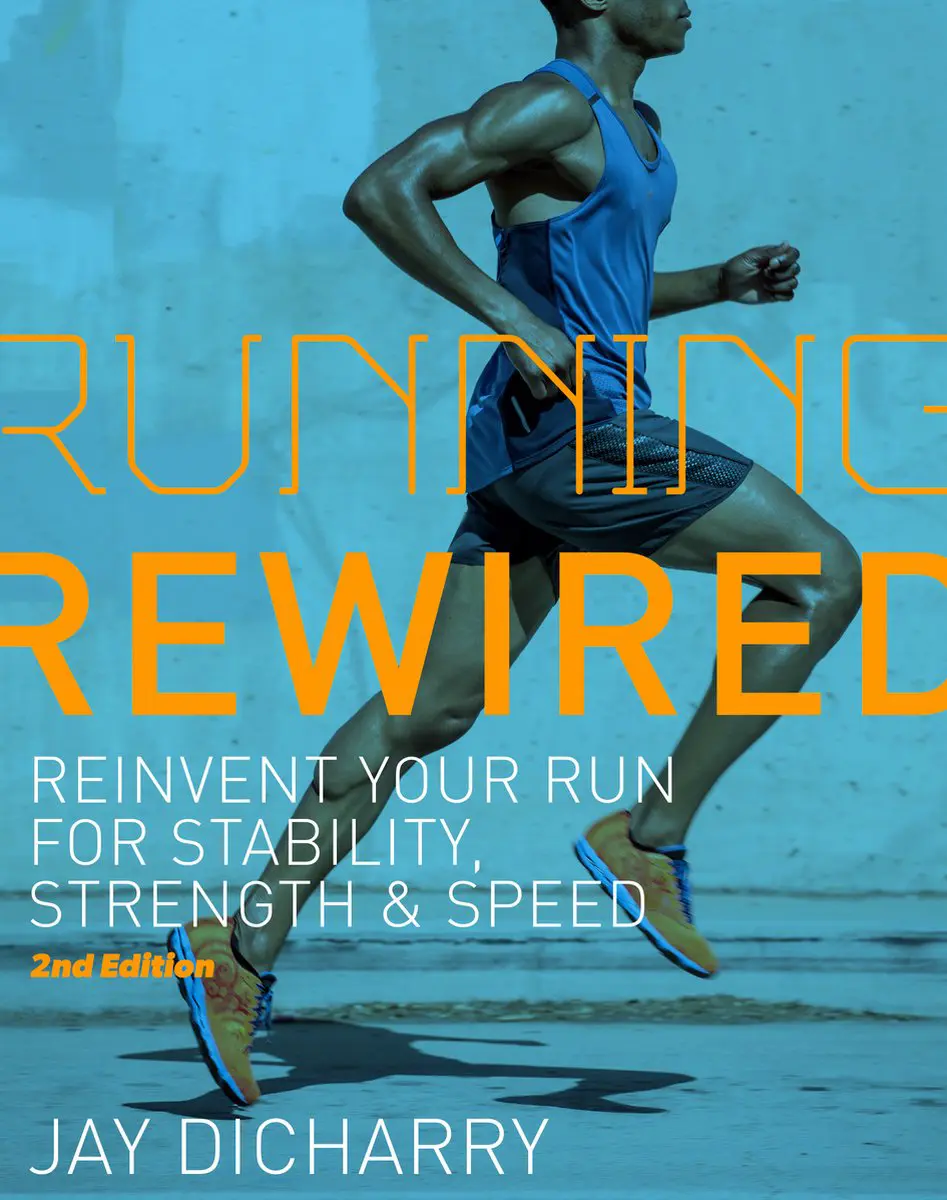
The book has many great workouts for runners.
Amateur runners don't need heavy weight machines; bodyweight exercises or just some simple equipments (resistance bands, balance boards, dumbbells) are just beneficial enough.
For a typical runner, what often lacks is not muscle strength itself, but the activation of nerves connecting the muscles. Some simple but targeted exercises can make big difference.
Here's an example of core combo exercises I captured from the book:
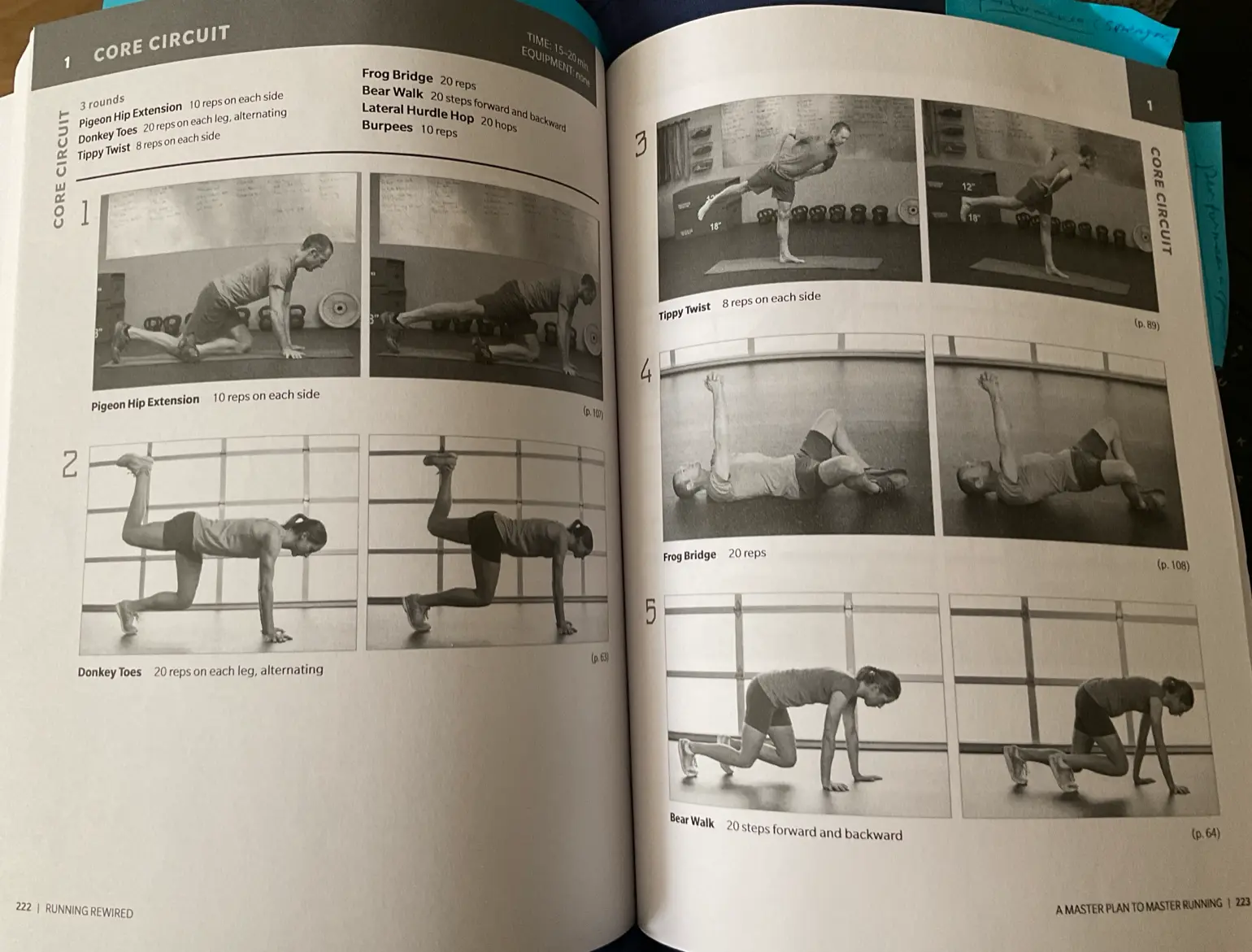
These kinds of exercises improve running efficiency and reduce injury risk.
Also, they are somewhat of a relief, at least for me. What I means is: I don't need to cut back a lot of time on feet due to these strength trainings. These targeted exercises don't require heavy weights, nor long sessions, nor intense stress.
Again, simple, targeted exercises can bring great benefits.
Besides the book above, I also went through the "legendary" book Daniels' Running Formula.
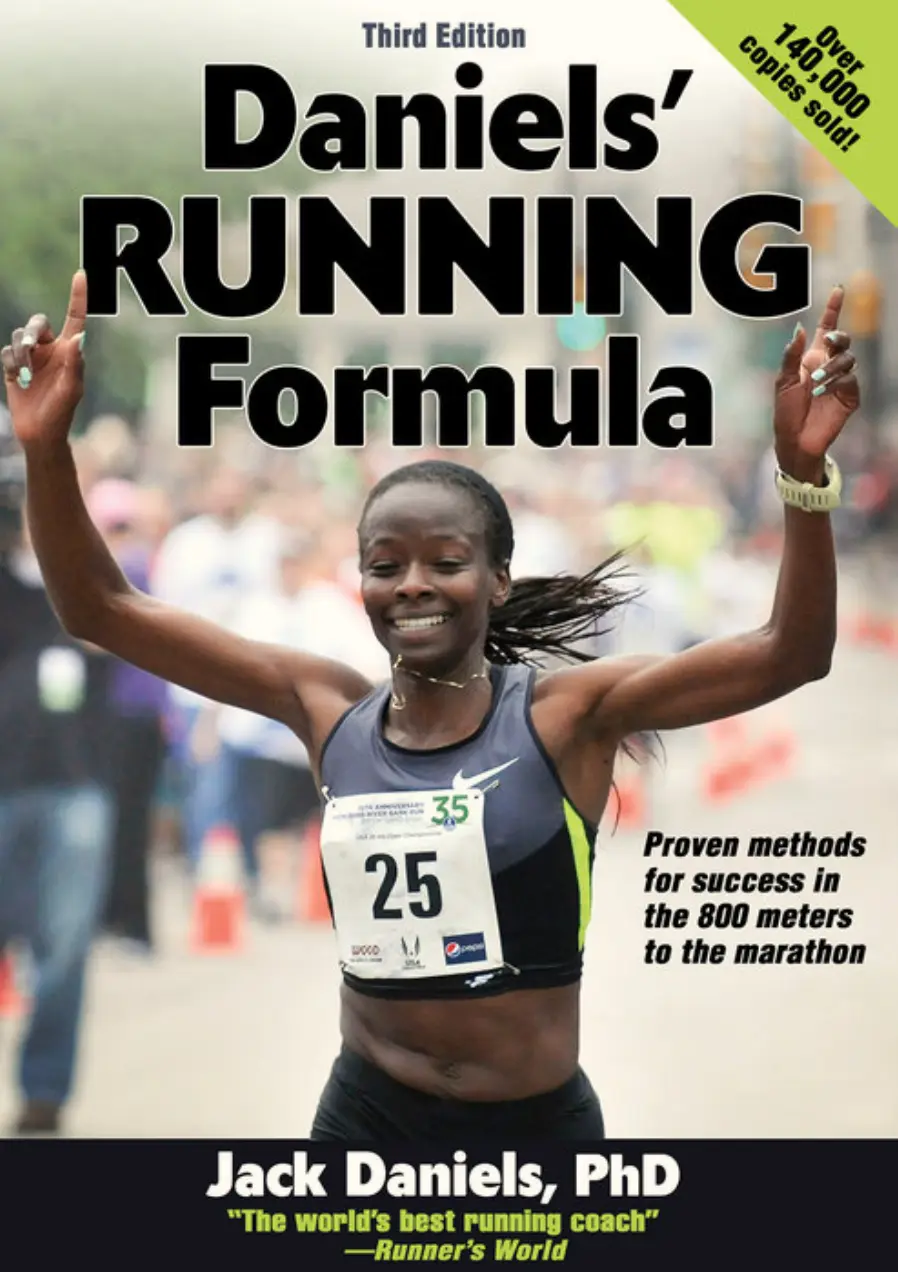
I will combine the several running types from Daniels' method, in combination with the principles from "The Big Book of Endurance Training and Racing" by Phil Maffetone to create a specific plan for this training cycle.
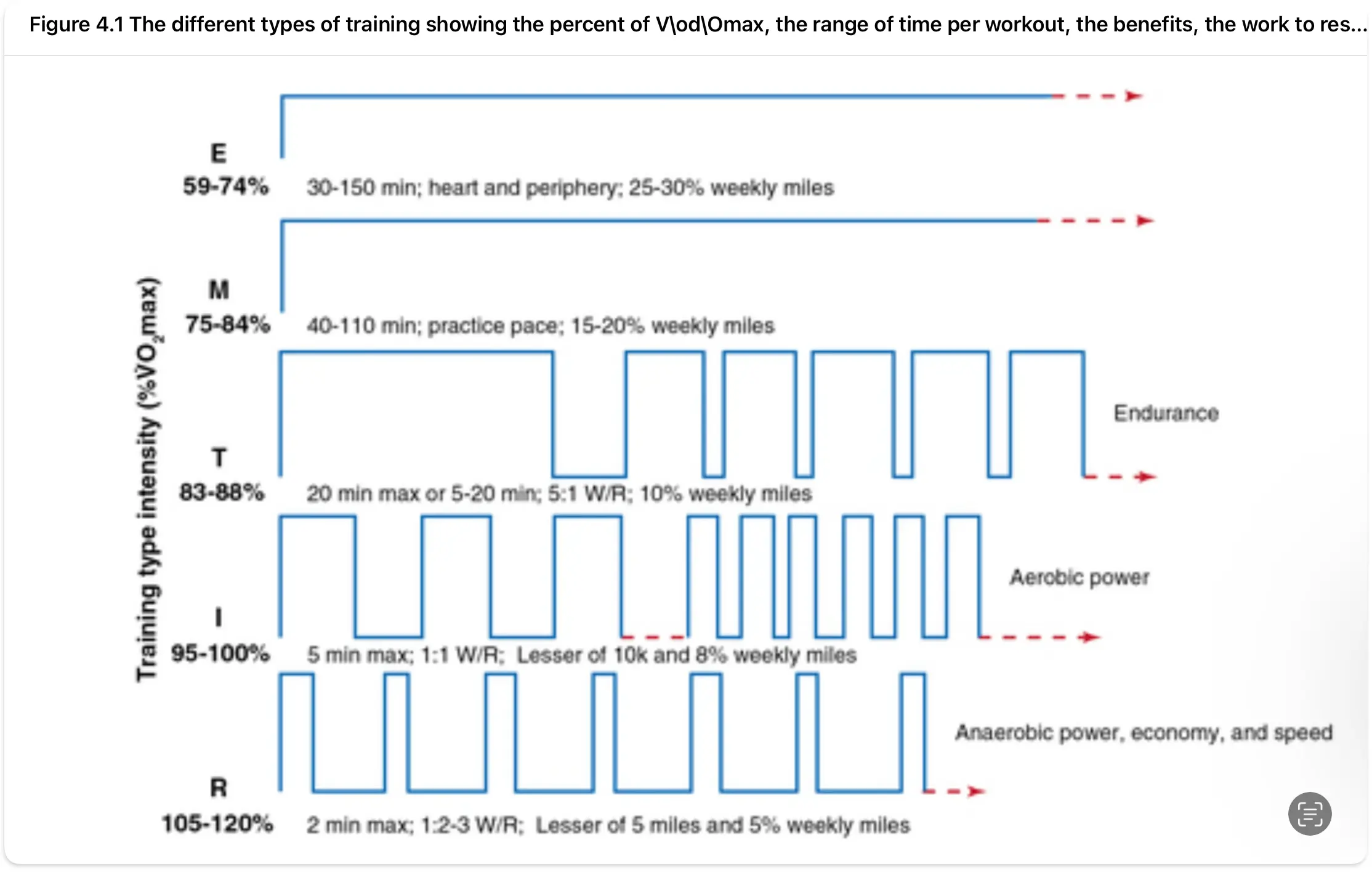
Daniels' method includes several running types:
- Easy pace (E-run), which will make up most of the total volume, including long distance runs (long, L-run). Daniels defines E-run as 60% to 75% of max heart rate. This upper limit is also kind of my MAF HR. This aligns with my previous trining well.
Following the 80/20 principle by Matt Fitzgerald and Stephen Syler, I'll ensure E-runs make up at least 80% of the weekly run. The remaining <20% will be higher intensity runs:
- Threshold run (T-run). Daniels defines it as about 88% of max heart rate, feeling "comfortably hard" - difficult but comfortable, manageable, and not forced, which can last for about 30 minutes.
- Interval High Intensity Run (I-run). I-run is higher intensity, near maximum heart rate, but lasts only 3-5 minutes with low-intensity recovery in between.
- Short repetitions (R-runs), also known as Strides elsewhere. R-runs are very short distances at sprinting speed, like 100 meters, 200 meters, no more than 1-2 minutes.
The Daniels training programs also include marathon pace runs (M-run).
Here's a diagram of these run types:
I've been doing mostly aerobic running for the past two years. This builds my aerobic base.
But from the past few marathon experiences, my body isn't used to high intensity for long periods. I want to introduce high intensity running in this cycle to strengthen those fast twitch muscle in my body.
That's why I'm introducing those high intensity runs from Daniels' method: R-runs, I-runs, and T-runs.
However, I am also aware that introducing high intensity training needs caution.
These different types of workouts have different intensities and stress levels to the body. His book emphasizes this point: implementing his method requires several phases for the body to gradually adapt.
My planis as follows:
- First, introduce R-runs, short sprints to acclimate the body to faster speeds and improve running efficiency. Then introduce I-runs in the second phase, and finally T-runs.
- Each phase lasts at least 6 weeks, with one high-intensity run per week on top of aerobic runs (E-runs), maintaining the 80/20 principle.
- Ensure the quality of high-intensity runs, avoiding strength training 48 hours before, and ensuring good recovery after.
Based on these phases, I divided the complete cycle into smaller cycles.
Before officially starting the training cycle, I started already with some R-runs over the past several weeks.
Week 1: 5x100m R-runs, Week 2: 7x100m, Week 3: 10x100m, Week 4: only E-runs;
Following week: 5x200m, then 3x1.5km T-runs (less intense, shorter duration).
The past few weeks are kind of a "prep" cycle.
Starting next week, I'll introduce I-runs, which will be the second mini-cycle. One I-run workout per week, starting with 2-minute intervals, gradually increasing to 4-minute intervals in three weeks.
There will be two special quality workouts every week: one I-run and one long run on weekends, the rest are E-runs.
Over three weeks, the weekly volume increases gradually, with a reduced recovery in the fourth week. Four weeks make a mini-cycle.
The first two mini-cycles focus on I-runs, the third on T-runs, and the final before the race will be on marathon pace runs (M-runs) and some R-runs.
That's my overall plan.
Daniels' book also has a VDOT table. VDOT can be seen as VO2max value. Each VDOT value corresponds to a predicted finish time for various distances and pace for each run type for the workouts.
Here are the estimated finish times and paces for VDOT=44/45:

My goal for the Amsterdam Marathon is 3:30.
My time of Athens Marathon last year was 3:39. There weas lots of elevation. On a flat course, this probably corresponds to about 3:30. So I think it’s achievable in the flat Amsterdam.
But I am not aiming for a better time; I want to frun 3:30 in good shape, not finishing overly extended -- just finish strong.
That's it for the start of this training cycle's running log.
Every start of a training cycle excites me. There is a clear goal and a concrete plan of action.
The rest is all about execution. As long as the execution is on track, progress will build up and compound itself!
Let the training begin!
You might also like:
Rotterdam Marathon · Recap (in Chinese)
My WeChat Public Account: