

Explanation of the concept of idiom decks using the analogy of database tables.
The idiom deck can be downloaded from 成語 (Traditional + Simplified) (+ Example Sentences) - AnkiWeb and then imported into Anki.
Basic concept: Quickly understand using the analogy of relational database tables
- Anki: A deck is defined by a note type. A note type contains field definitions and can have one or more card types.
- Database: A table contains multiple records, each with multiple fields. Multiple queries can produce different results based on different fields.
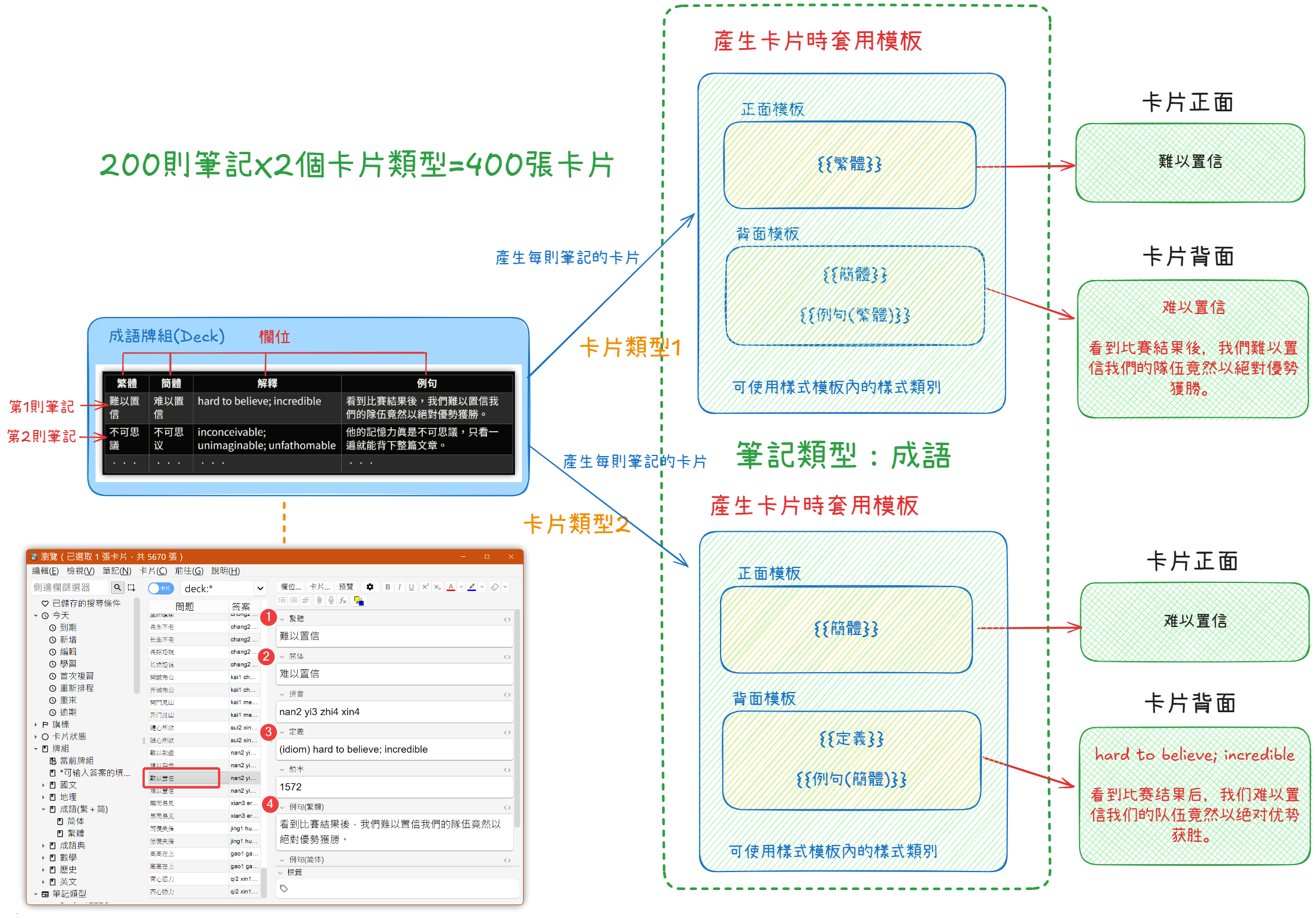
1. Deck: Idioms
- Treat a deck as equivalent to a database table.
▼ Idiom Deck
| Traditional | Simplified | Explanation | Example (Traditional) | Example (Simplified) |
|---|---|---|---|---|
| 難以置信 | 难以置信 | hard to believe; incredible | 看到比賽結果後,我們難以置信我們的隊伍竟然以絕對優勢獲勝。 | 看到比赛结果后,我们难以置信我们的队伍竟然以绝对优势获胜。 |
| 不可思議 | 不可思议 | inconceivable; unimaginable; unfathomable | 他的記憶力真是不可思議,只看一遍就能背下整篇文章。 | 他的记忆力真是不可思议,只看一遍就能背下整篇文章。 |
| ••• | ••• | ••• | ••• | ••• |
1.1. Data Content
- One note = one record in the database table.
1.2. Note Type: Idioms
- A note type consists of fields and card types.
- A card type is composed of a front template, a back template, and a style template.
1.2.1. Fields
- Equivalent to columns (schema) in a database table.
- Example: The idiom deck (table) has fields for Traditional, Simplified, Explanation, Example (Traditional), and Example (Simplified).
1.2.2. Card Types
- One note type can produce one or more card types.
- Each card has a front and a back, defined by their respective templates, with optional style templates for appearance.
- The front and back content can be any HTML, with
{{Field Name}}representing the corresponding data from the note (record).
1.3. Generating Cards
- This can be seen as the final query result.
- Each card has only two outputs: front and back.
- If the idiom deck has 200 notes and the note type has 2 card types, the output will be
$200 \times 2 = 400$ cards.
2. Conclusion
- If Anki is viewed as a database, multiple decks are equivalent to multiple tables.
- Each table has defined fields and multiple records, analogous to a deck's note type and its notes.
- A database query result is equivalent to the cards generated in Anki.
💡 Related Links
✅ Explanation article (Traditional Chinese)
✅ Explanation article (English)
✅ Explanation article (Japanese)